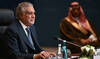
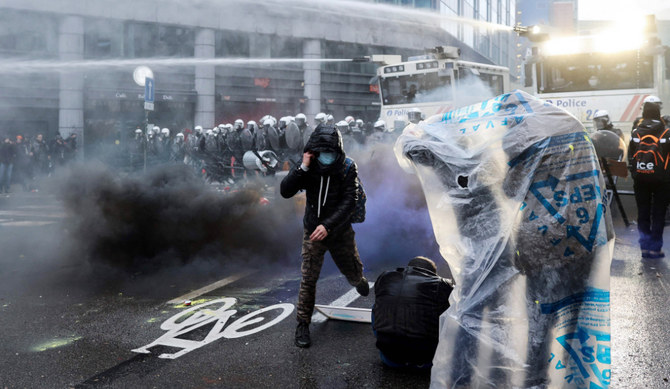
BRUSSELS: Belgian police fired water cannon and used tear gas Sunday to disperse protesters opposed to compulsory health measures against the coronavirus pandemic.
Around 8,000 people marched through Brussels toward the headquarters of the European Union, chanting “Freedom!” and letting off fireworks.
The crowd was smaller than the 35,000 vaccine and lockdown skeptics who marched last month, and police were better prepared.
Protesters were blocked from reaching the roundabout outside the EU headquarters by a barbed wire barricade and a line of riot officers.
As two drones and a helicopter circled overhead, they threw fireworks and beer cans. Police responded with water cannon and tear gas.
As the crowd dispersed into smaller groups around the European quarter, there were more clashes and some set fire to barricades of rubbish.
Police said two of their officers and four protesters had been hospitalized, and 20 people had been arrested.
Several European countries have seen demonstrations in recent weeks as governments respond to a surge in covid cases with tighter restrictions.
In Brussels, the organizers hoped to match the November 21 demo, in which police seemed caught off guard and there were violent clashes.
The demonstrators oppose compulsory health measures — such as masks, lockdowns and vaccine passes — and some share conspiracy theories.
Banners on Sunday compared the stigmatization of the non-vaccinated to the treatment of Jews forced to wear yellow stars in Nazi Germany.
“Covid = Organized Genocide,” said one sign. “The QR code is a Swastika,” declared another, referring to the EU Covid safe digital certificate.
Parents — some of whom brought small children to the protest — chanted their belief that the vaccine would make their toddlers sick.
Off duty firefighters in uniform, marched at the head of the protest as it wound its way through the city, to demand the right to refuse vaccination.
The measures imposed to fight COVID-19 in Belgium were decided by the country’ own national and regional governments, but the European Union has also attracted the skeptics’ anger.
On Wednesday, European Commission president Ursula von der Leyen said that in her view it was time to “think about mandatory vaccination,” a suggestion that was denounced by speakers at the protest.
On Friday, Belgian Prime Minister Alexander de Croo announced a series of measures to tighten sanitary rules, bringing school Christmas holidays forward and asking children aged six and over to wear masks.
Belgium, with a population of 11 million, has recorded an average of more than 17,800 daily infections with COVID-19 over the past seven days, as well as 44 deaths.
Around 800 people with severe forms of the disease are in intensive care in hospitals across the country, leading to overcrowding and the postponement of treatment for many other conditions.


Clashes erupt at Brussels protest against COVID-19 rules
https://arab.news/4rzbu
Clashes erupt at Brussels protest against COVID-19 rules

- The demonstrators oppose compulsory health measures — such as masks, lockdowns and vaccine passes — and some share conspiracy theories


France releases suspected Russia ‘shadow fleet’ tanker after fine
- The ship is suspected of being part of a shadow fleet that carries oil for countries such as Russia and Iran
- “The tanker Grinch is leaving French waters after paying several million euros and enduring a costly three-week immobilization in Fos-sur-Mer,” Barrot said
MARSEILLE: France on Tuesday released a tanker called Grinch suspected of being part of Russia’s sanctions-busting “shadow fleet” after its owner paid a fine of several million euros, a minister said.
French forces and their allies boarded the oil tanker last month between Spain and Morocco after it started its journey in Russia. It was escorted to a port near the southern city of Marseille.
Ship tracking websites MarineTraffic and VesselFinder said the vessel had been flying a Comoros flag.
The ship is suspected of being part of a shadow fleet that carries oil for countries such as Russia and Iran in violation of US sanctions.
“The tanker Grinch is leaving French waters after paying several million euros and enduring a costly three-week immobilization in Fos-sur-Mer,” Foreign Minister Jean-Noel Barrot said on X.
Russia has reportedly built up a flotilla of old tankers of opaque ownership to get around sanctions imposed by the European Union, the United States and the G7 group of nations, over Moscow’s 2022 all-out invasion of Ukraine.
The sanctions, aimed at limiting Moscow’s revenues to pursue its war, have shut out many tankers carrying Russian oil from Western insurance and shipping systems.
“Evading European sanctions comes at a price. Russia will no longer be able to bankroll its war with impunity through a shadow fleet off our shores,” Barrot said.
The public prosecutor’s office and regional authorities said that, “as part of a guilty plea procedure, the company that owns the vessel was sentenced by the Marseille judicial court to a financial penalty.”
“The company, which has already taken numerous steps in this direction, has committed to obtaining a new flag as soon as possible,” they said in a joint statement, without adding where the owner was based.
A ship called Grinch is under UK sanctions, while another named Carl with the same registration number is sanctioned by the United States and European Union.
The boarding last month was the second of its kind in recent months.
France in September detained a Russian-linked ship called the Boracay, a vessel claiming to be flagged in Benin, a move Russian President Vladimir Putin condemned as “piracy.”
The Boracay’s Chinese captain is to stand trial in France next week.
The European Union lists 598 vessels suspected of being part of the “shadow fleet” that are banned from European ports and maritime services.