

In Pakistan’s Khaplu valley, autumn foliage becomes ‘blessing’ fuel for winter survival

An elderly man stands near dried leaves in Garbong village of Khaplu valley in Ghanche district of Gilgit-Baltistan, Pakistan, on December 2, 2021. (AN photo by Nisar Ali)
Short Url
Updated 05 December 2021
Follow

In Pakistan’s Khaplu valley, autumn foliage becomes ‘blessing’ fuel for winter survival

  • Villagers collect dry leaves between late November and early December to use as fuel during freezing winters
  • In the absence of reliable gas or electricity sources, people have found alternative means to heat their homes 

KHAPLU, Gilgit-Baltistan: When autumn arrives in Khaplu valley with its foliage of boastful reds, yellows and copper browns, families welcome it as a “blessing” — not for the colorful spectacle, but for the fuel the falling leaves will become when burnt come winter, helping locals survive the harsh weather in Pakistan’s mountainous north.
The valley in the northern region of Gilgit-Baltistan, surrounded by some of Pakistan’s highest peaks and glaciers, is home to over 24,000 people who remain largely cut off from the rest of the country in the winter months when temperatures can fall below minus 20 degrees Celsius.
In the absence of reliable gas or electricity sources, residents have had to find alternative means of heating their homes. One option is burning the colorful leaves that fall in autumn, which locals call “gold” and diligently collect between late November and early December to use as burning fuel in the winter ahead.
“We don’t waste dried leaves because they are the main source of heating for us,” Muhammad Jaffar, a 68-year-old resident of Garbong village, told Arab News.
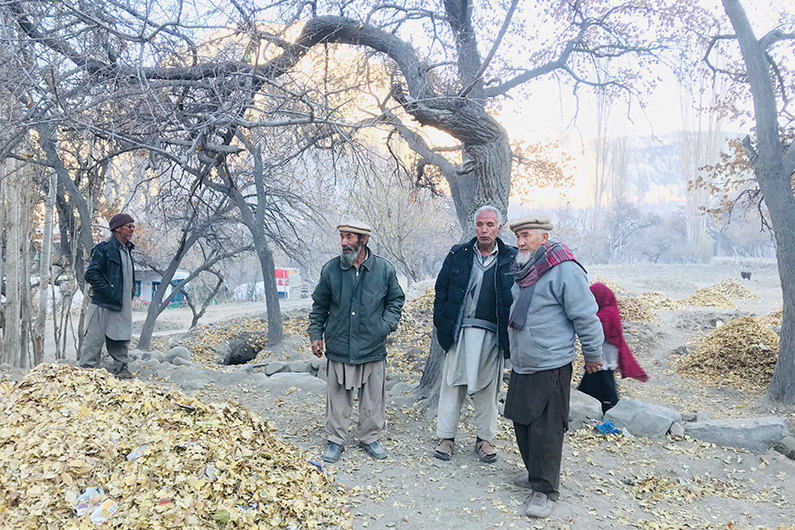


People stand near a pile of dried leaves in Garbong village of Khaplu valley in Ghanche district of Gilgit-Baltistan, Pakistan, on December 2, 2021. (AN photo by Nisar Ali)

Jaffar, a member of the village’s welfare committee, which is responsible for leaf collection and distribution, said the dried leaves were “the biggest blessing.”


Men and women collect their share of dried leaves after distribution in Garbong village of Khaplu valley in Ghanche district of Gilgit-Baltistan, Pakistan, on December 2, 2021. (AN photo by Nisar Ali)

The collection and distribution of dried leaves among Garbong’s 130 households takes almost a week. Each household nominates a woman representative and does not receive leaves if it fails to do so. The same practice is observed in all other villages in Khaplu valley.
Muhammad Ali, who summons residents using a mosque loudspeaker every morning during the week to collect their share of leaves from the nearby Stronpi village, said leaf collection rules and exact dates were established years ago to avoid conflict.
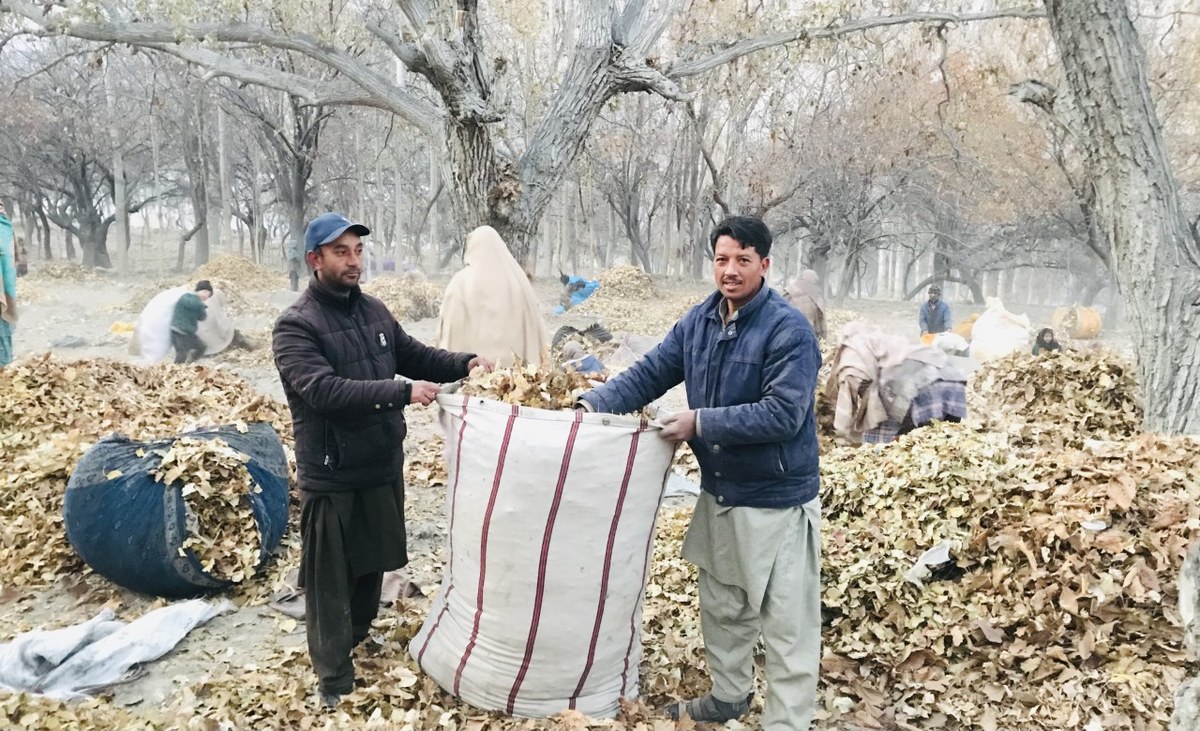


Members of the village committee pose for a photograph at the distribution site in Garbong village of Khaplu valley in Ghanche district of Gilgit-Baltistan, Pakista,n on December 2, 2021. (AN photo by Nisar Ali).

“Fifteen years ago, women would fight each other for dried leaves,” he said. “Now, the committee monitors all affairs of the village from mosque to working in the fields and personal disputes as well as dried leaf collection.”
Once distributed among village households, the leaves are burnt in the open air. When they stop giving off smoke, they are brought into the kitchen in a metal pot, placed under a special square table and covered with a blanket or quilt.
“Family members nestle around the table with the brunt leaves placed under it,” Stronpi resident Sajid Ali said.
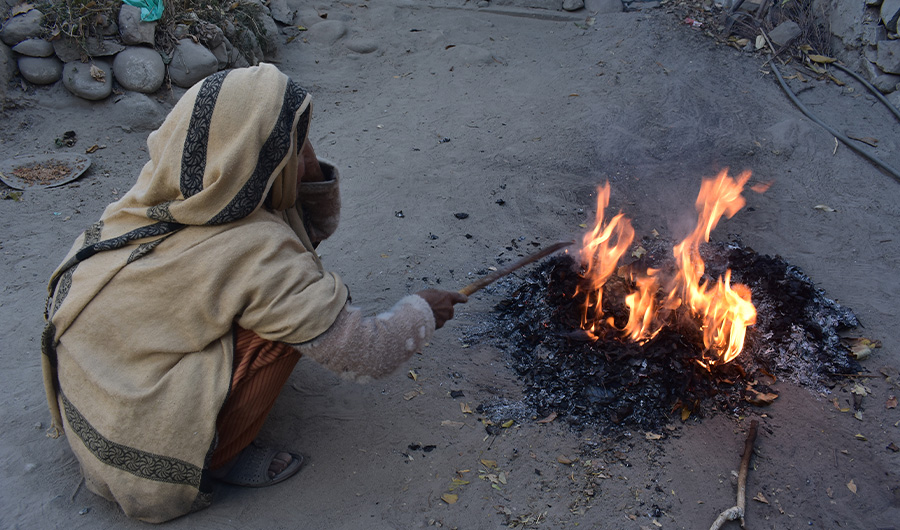


An woman burns dired leaves in Garbong village of Khaplu valley in Ghanche district of Gilgit-Baltistan, Pakistan, on December 2, 2021. (AN photo by Nisar Ali)

Fatima, a village’s elder who only gave her first name, said there was a special room in her basement to store the leaves during winter.
“Without dried leaves, how could we spend the winter days?” she said. “It’s only seasonal dried leaves, but for us it is like gold.”
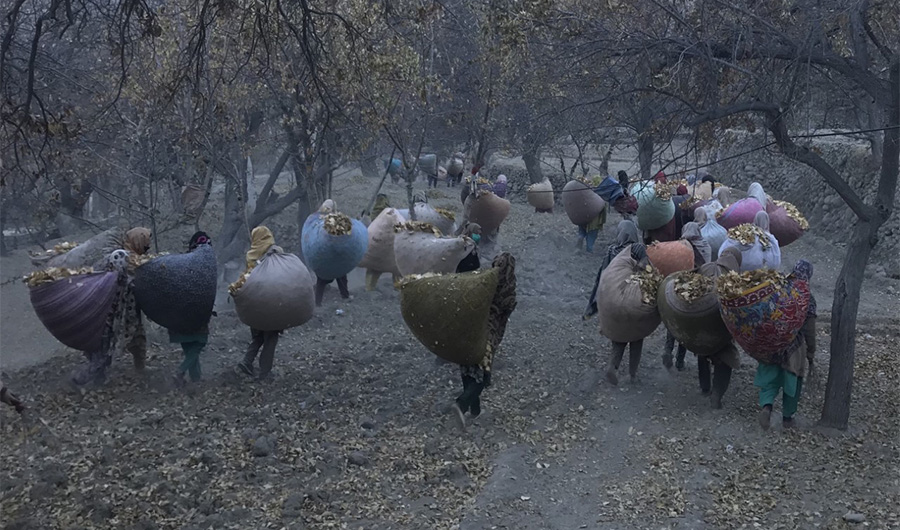


People carrying dried leaves walk in Garbong village of Khaplu valley in Ghanche district of Gilgit-Baltistan, Pakistan, on December 2, 2021. (AN photo by Nisar Ali)


Pakistan says responding to Afghan ‘offensive operations’ after border fire as tensions escalate

Updated 26 February 2026
Follow

Pakistan says responding to Afghan ‘offensive operations’ after border fire as tensions escalate

  • Afghan Taliban spokesperson says “large-scale offensive operations” launched against Pakistani military bases
  • Pakistan says Afghan forces opened “unprovoked” fire across multiple sectors along shared border

ISLAMABAD: Afghanistan’s Taliban authorities said on Thursday they had launched “large-scale offensive operations” against Pakistani military bases and installations, prompting Pakistan to say its forces were responding to what it described as unprovoked fire along the shared border.

The escalation follows Islamabad’s weekend airstrikes targeting what it said were Tehreek-e-Taliban Pakistan (TTP) and Daesh militant camps inside Afghanistan in response to a wave of recent bombings and attacks in Pakistan. Islamabad said the strikes killed over 100 militants, while Kabul said dozens of civilians were killed and condemned the attacks as a violation of its sovereignty.

In a post on social media platform X, Afghan government spokesperson Zabihullah Mujahid said Afghanistan had launched “large-scale offensive operations” in response to repeated violations by the Pakistani military.


Pakistan’s Ministry of Information said Afghan forces had initiated hostilities along multiple points of the frontier.

“Afghan Taliban regime unprovoked action along the Pakistan–Afghanistan border given an immediate, and effective response,” the ministry said in a statement.

The statement said Pakistani forces were targeting Taliban positions in the Chitral, Khyber, Mohmand, Kurram and Bajaur sectors, claiming heavy Afghan casualties and the destruction of multiple posts and equipment. It added that Pakistan would take all necessary measures to safeguard its territorial integrity and the security of its citizens.


Separately, security officials said Pakistani forces had carried out counterattacks in several border sectors.

“Pakistan’s security forces are giving a befitting reply to the unprovoked Afghan aggression with full force,” a security official said, declining to be named. 

“The Pakistani security forces’ counter-attack destroyed Taliban’s hideouts and the Khawarij fled,” they added, referring to TTP militants. 

The claims from both sides could not be independently verified.

Cross-border violence has intensified in recent weeks, with Pakistan blaming a surge in suicide bombings and militant attacks on militants it says are based in Afghanistan. Kabul denies providing safe havens to anti-Pakistan militant groups.

The clashes mark the third major escalation between the neighbors in less than a year. Similar Pakistani strikes last year triggered weeklong clashes before Qatar, Türkiye and other regional actors mediated a ceasefire in October.

The 2,600-kilometer (1,600-mile) frontier, a key trade and transit corridor linking Pakistan to landlocked Afghanistan and onward to Central Asia, has faced repeated closures amid tensions, disrupting commerce and humanitarian movement. Trade between the two nations has remained closed since October 2025.