

French President Macron meets Saudi crown prince in final Gulf stop

1 / 4
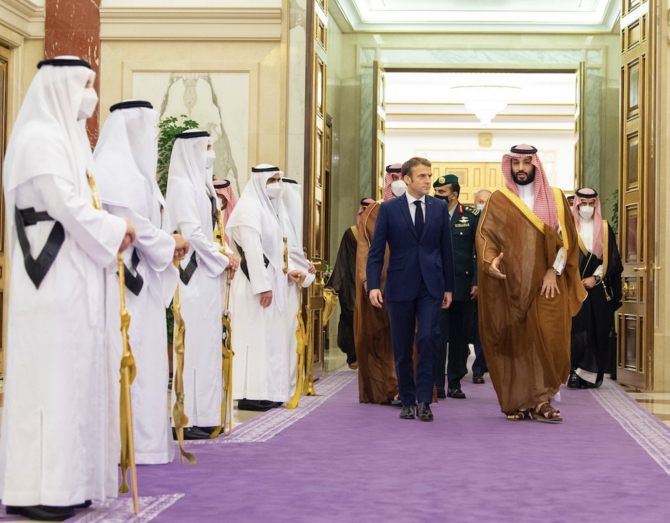
Saudi Crown Prince Mohammed bin Salman receives French President Emmanuel Macron in Jeddah on Saturday December 4, 2021. (SPA)
2 / 4
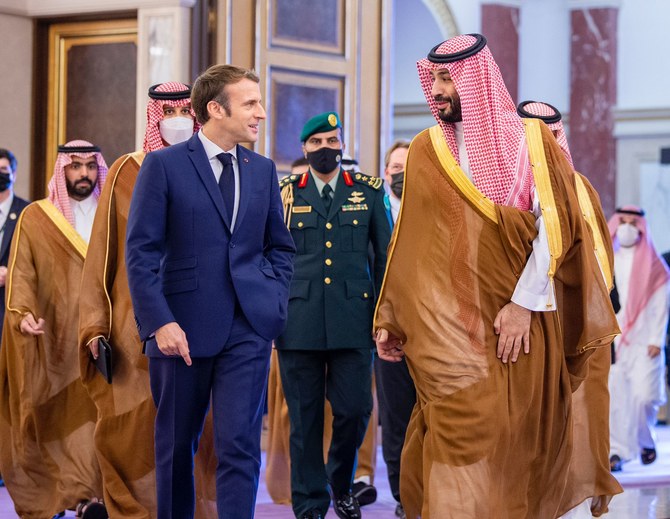
Saudi Crown Prince Mohammed bin Salman received French President Emmanuel Macron. (SPA)
3 / 4
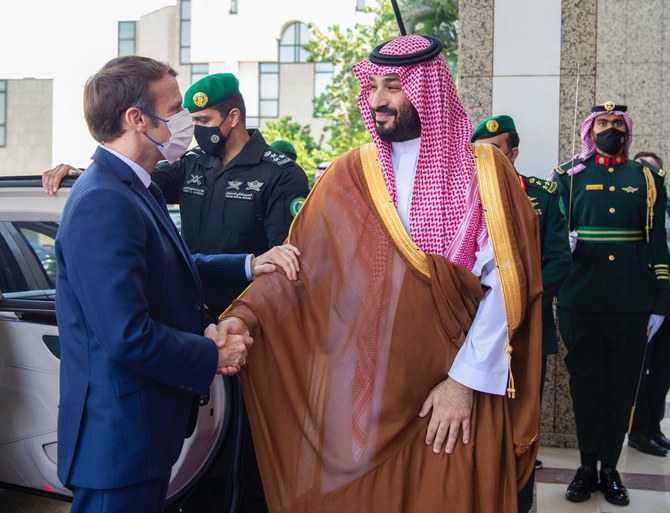
Saudi Crown Prince Mohammed bin Salman received French President Emmanuel Macron. (SPA)
4 / 4
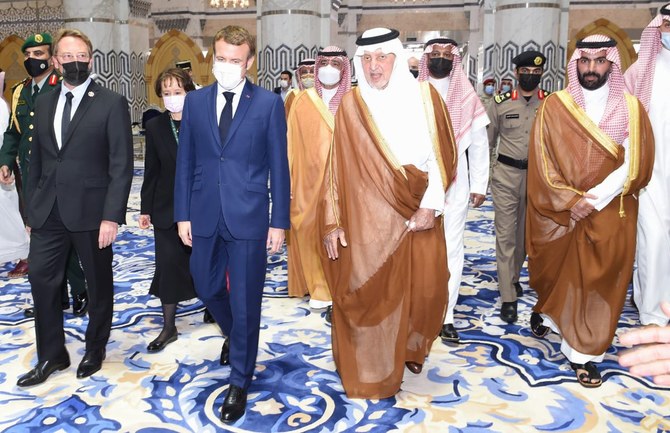
Macron arrived in Jeddah earlier today and was received at the airport by Prince Khalid al-Faisal, governor of Makkah and royal advisor. (SPA)
Short Url
Updated 05 December 2021
Follow

French President Macron meets Saudi crown prince in final Gulf stop

  • France stressed its determination not to allow Iran to develop or acquire a nuclear weapon
  • The president's visit to Saudi Arabia was the final stop in a two-day tour of three Gulf states

RIYADH: French President Emmanuel Macron was received by Saudi Crown Prince Mohammed bin Salman at the Al-Salam palace in Jeddah on Saturday.

The two leaders dicussed bilateral cooperation, the latest developments in the Middle East, and efforts to achieve international stability and peace.

The crown prince hosted a working lunch for the president and it was also attended by Bahrain's Crown Prince Salman bin Hamad and other officials.

A joint Saudi-French statement welcomed the strength of economic relations between the two countries and agreed on the importance of strengthening economic partnership, enhancing private sector participation, exchanging expertise, developing human capabilities, and utilizing opportunities offered by the Kingdom's Vision 2030 and France's 2030 economic plan in various sectors of joint interest.

The Kingdom welcomed the increased cooperation of French companies in sectors within Vision 2030, including energy, water, and waste management, sustainable cities, transportation, civil aviation, mobility solutions, digital economy and health.

France also desires to attract Saudi investments in the public and private sectors, namely in new technologies, emerging companies and industries of the future, the statement said.

The Kingdom, meanwhile, aspires to boost Saudi private sector investments in the French market.

The two sides commended the signing of different contracts and agreements in all economic fields during meetings that took place on the sidelines of the visit and that renewed the deep private sector partnership in both countries.

France and Saudi Arabia agreed on the need for the Lebanese government to carry out comprehensive reforms in the finance, energy, and anti-corruption sectors.

The two sides also agreed to work with Lebanon to ensure the implementation of these measures and emphasized the need to limit arms to legitimate state institutions.

They said that Lebanon should not be a launch pad for any terrorist acts that destabilize the security and stability of the region, or be a source of drug trafficking.

The two countries also expressed their deep concern over the development of the Iranian nuclear program and Tehran’s lack of cooperation and transparency with the International Atomic Energy Agency.

France stressed its determination not to allow Iran to develop or acquire a nuclear weapon.

They also agreed on the need to confront Iran's destabilizing activities in the region, including the use and transfer of drones and ballistic missiles that have led to attacks on the Kingdom.

Macron arrived in Jeddah earlier on Saturday and was received at the airport by Makkah governor Prince Khalid Al-Faisal.

The president's visit to Saudi Arabia was the final stop in a two-day tour of three Gulf states.
Earlier in the day, Macron was in Qatar, where he praised the state’s role in assisting with evacuation efforts of European citizens out of Afghanistan following the Taliban’s takeover of the country over the summer.


Experimental farm in Al-Lith looks into future of Saudi Arabian agriculture

Updated 01 February 2026
Follow

Experimental farm in Al-Lith looks into future of Saudi Arabian agriculture

  • Research initiative reflects strategic transformation

JEDDAH: An experimental farm in Saudi Arabia’s Al-Lith Governorate is one of the research initiatives reflecting the strategic transformation taking place in the Kingdom’s agricultural sector.

The farm uses highly efficient, sustainable production models that combine scientific research with commercial application, contributing to strengthening the country’s food security system and the sustainability of water resources.

Located in the Ghumaiqa Center on an area of about 10 hectares, the cutting-edge farm is a testing platform for modern agricultural technologies that tackle the challenge of water scarcity.

The farm includes developed open fields and modern greenhouses, supported by smart irrigation encompassing drip and sprinkler irrigation alongside surface and subsurface technologies.

All the systems operate via smart controls that enable the monitoring of water consumption and ensure improved efficiency, thereby achieving a balance between agricultural production and water conservation.

The farm also uses treated and diluted low-salinity seawater.

It aims to diversify agricultural water sources, reduce reliance on freshwater, and open new horizons for agriculture in coastal and semi-arid environments.

The project represents a promising investment opportunity in the field of smart agriculture, enabling the development of commercially scalable production models, particularly for high-value vegetables and fruits, while reducing operational costs associated with water and energy, enhancing the economic feasibility of future agricultural projects.

In addition, the project contributes to transferring and localizing agricultural expertise, supporting local food supply chains, and creating an attractive environment for agricultural investment.

This aligns with Sustainable Development Goals and enhances the efficiency of the private sector in adopting innovative agricultural solutions.

Yahya bin Abdulrahman Al-Mahabi, the director of the Ministry of Environment, Water and Agriculture office in Al-Lith Governorate, told the Saudi Press Agency that the project represented the future of agriculture in the Kingdom.

He explained that the vision was based on investing in technology, enhancing the return on water per unit, and integrating scientific research with investment opportunities.

Al-Mahabi spoke of the experimental farm as a modern, scalable and replicable model applicable in several regions of the Kingdom, particularly in coastal environments.

Al-Mahabi highlighted the Ministry of Environment, Water and Agriculture’s commitment to supporting distinctive projects that contributed to achieving food security while developing rural areas and enhancing agricultural production efficiency, in line with the objectives of the Kingdom’s Vision 2030.