

Pakistan’s Serbian embassy Twitter account hacked, recovered hours after criticizing PM Khan 

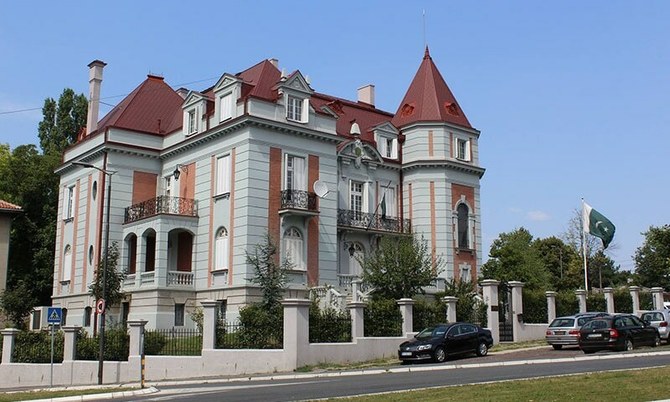
This undated photo shows an outer view of Pakistan's embassy in Serbia. (Photo courtesy: Pakistan Embassy Serbia Facebook)
Short Url
Updated 03 December 2021
Follow

Pakistan’s Serbian embassy Twitter account hacked, recovered hours after criticizing PM Khan 

  • Embassy confirms its accounts on Facebook and Instagram were hacked as well 
  • Messages posted during this period criticized PM Imran Khan for record inflation 

ISLAMABAD: Pakistan’s foreign ministry said on Friday the official Twitter handle of its embassy in Serbia had been recovered, hours after it was hacked and displayed messages criticizing Prime Minister Imran Khan for record-breaking inflation in the country. 

Not just Twitter, but the Pakistani embassy’s accounts on Facebook and Instagram were hacked as well, the embassy confirmed. However, the accounts have now been recovered. 

“The messages posted during that period were not from the Embassy of Pakistan in Serbia,” the Pakistani embassy said in a tweet. “The accounts now stand restored.” 

Criticizing the prime minister, the now-deleted tweet read: “With inflation breaking all previous records, how long do you expect @ImranKhanPTI that we government official[s] will remain silent and keep working for you without been paid for past 3 months & our children been forced out of school due to non-payment of fees.” 

“Is this #NayaPakistan?” the message read, adding, “I am sorry @ImranKhanPTI, am not left with another option.” 

Cyberattacks targeting Pakistani entities are nothing new. The country reported more than 628 defacement attacks that changed the visual appearance of a website or a web page between January and September last year, according to data from cybersecurity services provider, Pakistan Computer Emergency Response Team (PakCERT). 

The attacks have increased after the COVID-19 outbreak in February 2020 and subsequent lockdowns which increased online transactions. 

In October, the National Bank of Pakistan (NBP) was hit by a cyberattack, with no financial losses were reported. NBP is Pakistan’s leading financial institution with 1,512 branches in the country and 21 overseas. After the attack the bank’s customer service was distrusted, which was restored after a day. 

Poor IT infrastructure has made Pakistani banks a victim of frequent cyberattacks, with industry experts estimating that cyber warfare costs local banks around a billion rupees in losses each year. 


Pakistan urges concessional finance for developing nations to boost clean energy security

Updated 11 January 2026
Follow

Pakistan urges concessional finance for developing nations to boost clean energy security

  • Pakistan has emerged as one of world’s fastest growing solar markets, with 12GWs of off-grid and 6GWs of net-metered capacity in 2025
  • PM’s aide says Islamabad remains committed to Paris Agreement, looks for continued support in building a resilient and low-carbon future

ISLAMABAD: Pakistan has urged international partners to scale up concessional financing for developing countries, the country’s Press Information Department (PID) said on Sunday, citing an aide to Prime Minister Shehbaz Sharif.

The call was made by Sharif’s coordinator on climate change, Romina Khurshid Alam, while delivering Pakistan’s national statement at the 16th International Renewable Energy Agency (IRENA) Assembly in Abu Dhabi.

Pakistan has emerged as one of the world’s fastest growing solar markets, with 12 gigawatts (GWs) of off-grid and over 6GWs of net-metered solar capacity by the end of 2025. Last fiscal year, renewables accounted for a historic 53 percent of total electricity generation, according to Alam.

The prime minister’s aide stressed that affordable funding for developing nations is critical to accelerating their transition to clean energy and strengthening energy security amid rising climate and economic challenges.

“Alam reaffirmed Pakistan’s target of achieving 60 percent renewables in the power mix by 2030,” the PID said in a statement.

“In her call to action, she urged IRENA and Member States to increase concessional finance for developing nations, treat technologies such as energy storage and green hydrogen as global public goods, and strengthen regional cooperation for shared energy security.”

IRENA is a global intergovernmental agency for energy transformation that serves as the principal platform for international cooperation, supports countries in their energy transition, and provides state of the art data and analyzes on technology, innovation, policy, finance and investment. Its membership comprises 170 countries and the European Union (EU).

The 16th session of the IRENA Assembly is taking place on Jan. 10-12 in Abu Dhabi and focuses on the theme of “Powering Humanity: Renewable Energy for Shared Prosperity.” The session has gathered global leaders and energy decision-makers to discuss strategies and underline necessary actions for the acceleration of renewable energy across countries, regions, and the world, driving economic inclusion, equity, and human well-being.

Alam shared that Pakistan is taking action against energy poverty through initiatives like the Punjab Solar Panel Scheme 2026, which provides free or subsidized systems to low-income households.

She highlighted how distributed solar kits have restored power and livelihoods in flood-affected communities and offer a replicable model for climate-resilient recovery.

“Pakistan remains fully committed to the Paris Agreement and looks to IRENA for continued technical and financial support in building a resilient, inclusive, and low-carbon future,” Alam said.

Adopted in 2015 to combat climate change, the Paris Agreement binds nations to hold “the increase in the global average temperature to well below 2°C above pre-industrial levels” and pursue efforts “to limit the temperature increase to 1.5°C above pre-industrial levels.”