

Pakistani president ratifies bill allowing use of electronic voting machines 

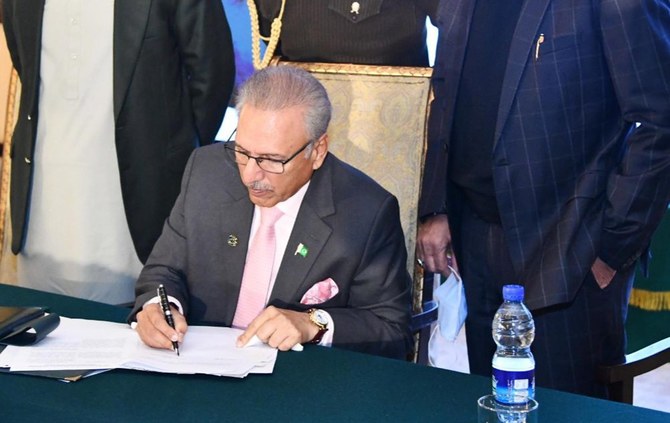
Pakistan President Dr Arif Alvi signing the Election (Amendment) Bill 2021 into law at, Aiwan-e-Sadar, Islamabad, Pakistan, on December 2, 2021. (PID Photo)
Short Url
Updated 03 December 2021
Follow

Pakistani president ratifies bill allowing use of electronic voting machines 

  • Last month, a joint parliamentary sitting sanctioned use of EVMs for next general elections in the country 
  • Government has been pushing for use of technology but opposition accuses it of trying to manipulate system 

ISLAMABAD: Pakistani President Arif Alvi on Thursday signed the Election (Amendment) Bill, 2021 that allows the use of electronic voting machines (EVMs) in the country, Pakistani state-run APP news agency reported. 

Last month, a joint parliamentary sitting sanctioned the use of EVMs for the next general elections, though opposition factions resisted the move and vowed to challenge it in the country’s top court. 

The government has lately pushed for the use of technology to make future Pakistani elections fairer and more transparent, but opposition parties accuse it of trying to manipulate the voting system by introducing technology, which has not been tested in Pakistan before. 

Alvi, however, asked critics not to be afraid of a “simple” electronic voting machine (EVM), which he said would help hold a fair election and bring an end to poll rigging. 

“People will have to trust it. It involves no advancement. It is too simple. The country achieves progress by adopting new things,” the president said, addressing a ceremony wherein he signed the bill into law. 

The bill also provides for the right of vote to overseas Pakistanis. 

EVMs will ensure holding a fair election that has long been desired in Pakistan as every election followed controversies and rigging allegations, which also impacted credibility of respective governments, according to Alvi. 

These machines would help print votes on the spot, instead of printing ballot papers at the press. They would help do away with the practice of printing extra ballot papers that used to be sold out later, kidnapping of presiding officers, and confusion in vote count. 

He said the voter would cast their vote by touching the EVM screen, instead of stamping the ballot paper. “The process is the same. Then what is the resistance for?” 

While the machine would use an in-built calculator to count votes, manual counting would also be available for skeptics, the president said, adding that the Ministry of Science and Technology was not a manufacturer of EVMs, it rather made a prototype for experiment. 

It would be the Election Commission of Pakistan (ECP) to select the EVM based on the required specifications, he explained. 

About Internet-voting (I-voting) for overseas Pakistanis, Alvi recounted the ruling Pakistan Tehreek-e-Insaf’s (PTI) legal and political struggle for voting right to Pakistani expatriates. He said physical voting for expatriates was not possible due to multiple complications. 

The countries, which had rejected EVMs, had their own better systems in place, according to the president. Contrarily, Pakistan needed it owing to weaknesses in its system. 

EVMs would help alleviate confusion caused by post-election rigging allegations and bring about a strong government to support democracy, he said. 

“Don’t worry, the nation will be convinced,” the president remarked. “Just like this one, the country will make progress in other fields too.” 


Peshawar church attack haunts Christians at Christmas

Updated 13 sec ago
Follow

Peshawar church attack haunts Christians at Christmas

  • The 2013 suicide attack at All Saints Church killed 113 worshippers, leaving lasting scars on survivors
  • Prime Minister Shehbaz Sharif vowed to protect religious minorities on Christmas, act against any injustice

PESHAWAR: After passing multiple checkpoints under the watchful eyes of snipers stationed overhead, hundreds of Christians gathered for a Christmas mass in northwest Pakistan 12 years after suicide bombers killed dozens of worshippers.

The impact of metal shards remain etched on a wall next to a memorial bearing the names of those killed at All Saints Church in Peshawar, in the violence-wracked province of Khyber Pakhtunkhwa.

“Even today, when I recall that day 12 years ago, my soul trembles,” Natasha Zulfiqar, a 30-year-old housewife who was wounded in the attack along with her parents, told AFP on Thursday.

Her right wrist still bears the scar.

A militant group claimed responsibility for the attack on September 22, 2013, when 113 people were killed, according to a church toll.

“There was blood everywhere. The church lawn was covered with bodies,” Zulfiqar said.

Christians make up less than two percent of Pakistan’s 240 million people and have long faced discrimination in the conservative Muslim country, often sidelined into low-paying jobs and sometimes the target of blasphemy charges.

Along with other religious minorities, the community has often been targeted by militants over the years.

Today, a wall clock inside All Saints giving the time of the blast as 11:43 am is preserved in its damaged state, its glass shattered.

“The blast was so powerful that its marks are still visible on this wall — and those marks are not only on the wall, but they are also etched into our hearts as well,” said Emmanuel Ghori, a caretaker at the church.

Addressing a Christmas ceremony in the capital Islamabad, Prime Minister Shehbaz Sharif vowed to protect religious minorities.

“I want to make it clear that if any injustice is done to any member of a minority, the law will respond with full force,” he said.

For Azzeka Victor Sadiq, whose father was killed and mother wounded in the blasts, “The intensity of the grief can never truly fade.”

“Whenever I come to the church, the entire incident replays itself before my eyes,” the 38-year-old teacher told AFP.