

Yemen army advances in Shabwa as coalition pounds Houthi targets

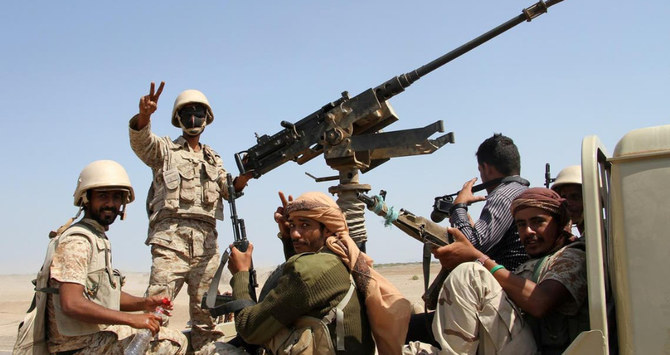
Yemen government forces liberated a large swathe of land in the southern province of Shabwa after heavy clashes with the Iran-backed Houthis. (AFP/File)
Short Url
Updated 02 December 2021
Follow

Yemen army advances in Shabwa as coalition pounds Houthi targets

  • The Yemeni army troops have mounted many attacks on the Houthis in Bayhan, Ousylan and Ain since September

AL-MUKALLA: Yemen government forces liberated a large swathe of land in the southern province of Shabwa after heavy clashes with the Iran-backed Houthis as the Arab coalition struck more militia sites across Yemen.

Backed by air cover from the Arab coalition, government troops pushed deeper into Houthi-controlled Bayhan and Ousylan districts, expelling militia fighters from wide areas and taking control of a strategic road that connects the two districts, a military official told Arab News on Thursday.

The official said that at least 60 Houthis were killed in the fighting and government troops are pressing ahead with their attacks on the Houthis in the two districts.

The Yemeni army troops have mounted many attacks on the Houthis in Bayhan, Ousylan and Ain since September, when the Houthis seized control of the three districts and rolled into government-controlled areas in the neighboring Marib province.

In addition, government forces pushed to cut off key supply routes to the Houthis south of Marib, thereby alleviating the militia’s pressure on the central city of Marib.

At least 35 Houthis were killed in heavy fighting with government troops west and south of Marib city amid intensifying airstrikes by the Arab coalition warplanes, the military source said.

The heaviest battles occurred in Al-Amud and Abu Resh, where government forces repelled Houthi attacks. Less intensive fighting broke out in Mashjah and Al-Kasara, west of Marib, and the Houthis were forced to retreat after failing to make headway.

The Arab coalition announced on Thursday that it carried out precision airstrikes on targets in Sanaa, Saada and Marib that killed more than 45 Houthis.

The coalition said that early on Thursday its warplanes struck major weapon and supply warehouses and two sites under construction for military use in Sanaa and destroyed workshops for assembling drone and ballistic missiles in Saada, the Houthi heartland.

Hundreds of Houthi fighters have been killed in Marib province since last month when the Arab coalition intensified its air raids, paving the way for government forces on the ground to push back Houthi attacks.


Hezbollah chief accuses Israel of ignoring ceasefire agreement

Updated 3 sec ago
Follow

Hezbollah chief accuses Israel of ignoring ceasefire agreement

  • Naim Qassem says moves to disarm his group in Lebanon are an 'Israeli-American plan'
  • Lebanese military is expected to complete Hezbollah’s disarmament south of Litani River as oart of ceasefire
BEIRUT: Hezbollah leader Naim Qassem on Sunday said moves to disarm the group in Lebanon are an “Israeli-American plan,” accusing Israel of failing to abide by a ceasefire agreement sealed last year.
Under heavy US pressure and fears of expanded Israeli strikes, the Lebanese military is expected to complete Hezbollah’s disarmament south of the Litani River — located about 30 kilometers (19 miles) from the border with Israel — by the end of the year.
It will then tackle disarming the Iran-backed movement in the rest of the country.
“Disarmament is an Israeli-American plan,” Qassem said.
“To demand exclusive arms control while Israel is committing aggression and America is imposing its will on Lebanon, stripping it of its power, means that you are not working in Lebanon’s interest, but rather in the interest of what Israel wants.”
Despite a November 2024 ceasefire that was supposed to end more than a year of hostilities between Israel and the Iran-backed Hezbollah group, Israel has kept up strikes on Lebanon and has maintained troops in five areas it deems strategic.
According to the agreement, Hezbollah was required to pull its forces north of the Litani River and have its military infrastructure in the vacated area dismantled.
Israel has questioned the Lebanese military’s effectiveness and has accused Hezbollah of rearming, while the group itself has rejected calls to surrender its weapons.
“The deployment of the Lebanese army south of the Litani River was required only if Israel had adhered to its commitments... to halting the aggression, withdrawing, releasing prisoners, and having reconstruction commence,” Qassem said in a televised address.
“With the Israeli enemy not implementing any of the steps of the agreement... Lebanon is no longer required to take any action on any level before the Israelis commit to what they are obligated to do.”
Lebanese army chief Rodolphe Haykal told a military meeting on Tuesday “the army is in the process of finishing the first phase of its plan.”
He said the army is carefully planning “for the subsequent phases” of disarmament.