

Pakistan urges OIC to help address Afghanistan's urgent humanitarian needs

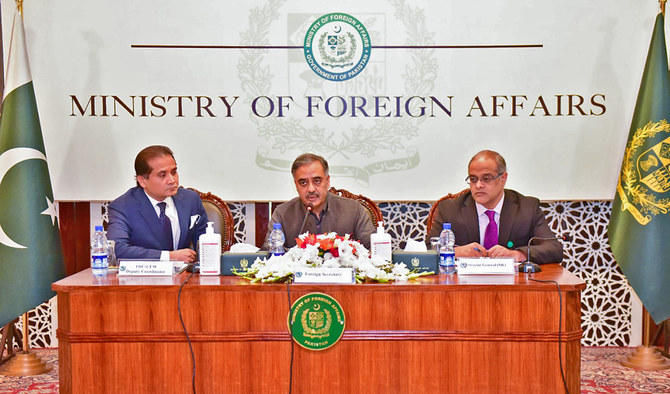
Pakistan's foreign secretary Sohail Mahmood, center, briefs the OIC heads of mission in Islamabad, Pakistan, on December 1, 2021. (Photo courtesy: Pakistan foreign office)
Short Url
Updated 01 December 2021
Follow

Pakistan urges OIC to help address Afghanistan's urgent humanitarian needs

  • The Organization of Islamic Cooperation will be holding an extraordinary session on Afghanistan later this month
  • Pakistan's foreign secretary says 60 percent of Afghan nationals can face 'crisis level of hunger' that may lead to mass refugee exodus

ISLAMABAD: Pakistan's foreign secretary Sohail Mahmood said on Wednesday the Organization of Islamic Cooperation (OIC) should play a role in helping the people of Afghanistan who were facing a serious humanitarian crisis.

Afghanistan witnessed a major political change in August when the Taliban seized control of its capital city, Kabul, while the international community was still in the process of pulling out its troops.

The political change exposed the economic vulnerabilities of the country, however, which required substantial foreign assistance after being in a state of war for several decades.

The top official of Pakistan's foreign office briefed the Islamabad-based heads of OIC missions on the prevailing situation in Afghanistan ahead of the group's proposed extraordinary session on the subject later this month.

"The Foreign Secretary emphasized that as the collective voice of the Islamic Ummah, the OIC, can and must play its part in helping address the urgent humanitarian and economic needs of our Afghan brethren," said an official statement released by the foreign office in Islamabad. "In addition, he underlined, OIC’s leadership could help galvanize other international actors to come forward and extend a helping hand to the Afghan people currently in dire need of international support and solidarity."

The Pakistani official informed that the OIC extraordinary session was organized after Saudi Arabia took the initiative last month, adding that the administration in Islamabad welcomed the decision and offered to host the foreign ministers of OIC nations on December 17.

Quoting the United Nations estimates, he said that 60 percent of Afghanistan's 38 million people faced "crisis level of hunger," adding there was a risk of acute malnutrition among Afghan women and children along with the problem of internal displacement.

The foreign secretary maintained a potential economic collapse in Afghanistan could not be ruled out.

"This would not only be a humanitarian tragedy but also exacerbate the security situation, spur instability, and lead to a mass exodus of refugees," he said, adding: "This would have grave consequences for international peace and stability."

Pakistan has also urged the international community in the past not to adopt a policy of disengagement toward Afghanistan after the Taliban takeover since it would have negative consequences for the people in the war-battered country along with the rest of the region.


Police kill five militants, foil plan to block highway in Pakistan’s southwest

Updated 5 sec ago
Follow

Police kill five militants, foil plan to block highway in Pakistan’s southwest

  • The militants were killed in an intelligence-based operation in Mastung district of Balochistan
  • Search, combing operations are underway to apprehend accomplices of militants who fled the scene

QUETTA: Pakistan’s counterterrorism police on Monday said they had killed five militants, who were planning to block the Quetta–Sibi highway and target security forces, in an intelligence-based operation in the southwestern Balochistan province.
The operation took place in Mastung district when militants affiliated with the Balochistan Liberation Army (BLA) were planning to carry out “subversive activities” against security forces and the public, according to a CTD spokesperson.
CTD received credible intelligence that armed BLA militants had taken positions near Mastung’s Dasht area to block the Quetta–Sibi highway and target security forces and civilian traffic. Acting swiftly on the information, CTD teams moved into the area. The militants opened indiscriminate fire upon sighting CTD personnel.
“During the encounter, five unknown terrorists were shot dead, while other accomplices managed to flee, taking advantage of the rugged and mountainous terrain,” the CTD spokesperson said in a statement.
Balochistan, which borders Iran and Afghanistan, has long been the site of a separatist insurgency and witnessed a series of high-profile militant attacks last year. In March, the BLA hijacked a passenger train and the siege killed at least 60 people, while in May, a suicide bombing in Khuzdar killed several children on a school bus.
The separatists accuse the central government of stealing their resources to fund development in Punjab. The federal government denies the allegations and says it is working for the uplift of local communities in Balochistan, where China has been building a deep-sea port as part of its Belt and Road Initiative.
Officials found seven hand grenades, five sub-machine guns with live rounds and three motorcycles from the scene, according to the CTD statement.
“Search and combing operations are underway to apprehend the fleeing terrorists and dismantle the remaining network,” it read.