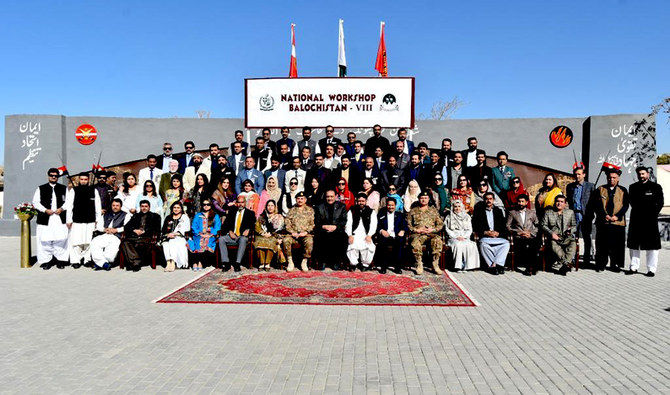
QUETTA: Participants at a workshop on Balochistan organized by the provincial government and the Pakistan Army’s 12 Corps all through the month of November described the experience as a “rare” opportunity to understand Pakistan’s most complicated region and for people from other provinces to interact with locals from different walks of life.
The eighth edition of the National Workshop Balochistan (NWB-VIII) ran from November 1-28. The nearly 80 participants, of which 75 percent belonged to Balochistan, also took field visits to Karachi, Islamabad, Chaman, Gwadar, Turbat and parts of the Iran-Pakistan border.
Among top leaders they interacted with were Army Chief General Qamar Javed Bajwa, President Dr. Arif Alvi, Planning Minister Asad Umar, Commander 12 Corps Lt. Gen. Sarfraz Ali Soomro, Major General Inayat Hussain, GOC Special Security Division South and others and the heads of the Gwadar Port Authority and Gwadar Development Authority.
Among the participants were members of the national and provincial assemblies, tribal elders from Balochistan, retired military officers, journalists, business persons, members of civil society and academicians and authors. The participants discussed all major issues of Balochistan, including health, education, economy, insurgencies, missing persons, and the China-Pakistan Economic Corridor.
“This workshop gave me a sense of connectivity, a chance to feel the pulse and vibes of the people here and the opportunity to visit far flung areas, and to understand the problems of this region — that was the real takeaway,” said Ajmal Jami, a special correspondent and talk show host at Dunya News, who joined NWB from Lahore in Pakistan’s largest province of Punjab.
He described the workshop as a “rare” chance for people from the provinces of Punjab, Khyber Pakhtunkhwa and Sindh to access the people and problems of Balochistan.
“As a journalist, I got to meet with the political leadership and tribal notables in Balochistan, I also went into the markets and met ordinary people, to understand what the problems of the residents here are, and what the problems of the politicians here are,” Jami added. “And what I have understood is that the means of livelihood are almost nonexistent and infrastructural development is really needed. This gap needs to be bridged. Unless that is done, there can be no improvement in the lives of the people of Balochistan.”
“The workshop was designed to connect people of Balochistan and the rest of the country with the challenges and opportunities in Balochistan,” said journalist and academic Dr. Ali Hamza, from Lahore, adding that he got to learn about both the challenges faced by Balochistan, as well as efforts to find solutions.
Indeed, Balochistan, a huge but sparsely populated, mountainous, desert region bordering Afghanistan and Iran, has some of the worst social indicators in the country, with over 50 percent people living below the poverty line and 92 percent of provincial districts classified as “highly deprived” by the United Nations. Locals complain that Balochistan has received paltry royalties on the province’s vast mineral, oil and gas resources from the central government, while remaining one of the country’s poorest regions. A long running separatist insurgency and attacks by other militant groups have also deprived the residents of a sense of security.
A number of participants Arab News spoke to said infrastructure development in remote parts of the province and access to education and health were key to the uplift of the province.
Balochistan Chief Minister Mir Abdul Qudus Bizenjo, while accepting the problems of the province, said the workshop organized by his government and the Pakistan army, was also an opportunity to see the positive side of Balochistan, its business and trade potential and the hospitality and diversity of its many people and ethnicities.
“These workshops will help in building national harmony and end gaps among different ethnicities,” Bizenjo told Arab News.
Syed Bashir Agha, a Quetta-based entrepreneur who deals in gemstones and minerals, said events like NWB could help counter false perceptions about the province.
“People from different sectors and cultures gathered in Quetta, which gave us an opportunity to enhance our skills and knowledge, while the issue of Balochistan was thoroughly debated during the workshop,” Agha said. “It helped change the perception of the province in the minds of participants from other provinces.”
Another participant, Nazir Achakzai, who hails from the Pak-Afghan border town of Chaman, said despite being a resident of Balochistan he had never visited southern parts of the province that border Iran.
“During various discussions, security experts briefed the participants on the situation of Balochistan and we discussed flawed policies of the state that have pushed Baloch dissidents to pick up arms as well as the negotiations aimed at bringing separatists into the national mainstream,” Achakzai told Arab News.
Faiza Mir, a lecturer at the University of Balochistan’s (UoB) International Relations Department, said the experience of the conference had convinced her that more interaction was needed between the people of Balochistan and other parts of the country.
She suggested that youth conferences, literature festivals and inter-provincial events be held in Balochistan, where people from Punjab, KP and Sindh should be invited: “The leadership of the country should bring students from Karachi, Lahore, Islamabad and Peshawar to visit not only Quetta but Turbat, Gwadar, Khuzdar and other remote cities of Balochistan.”
Sahibzadi Mahin Khan, the president of the Women Chambers of Commerce and Industry in Karachi’s Qur’angi, said she had a very different idea of Balochistan when she arrived at the conference, having heard that the region was conservative and women had few educational and job opportunities.
Her perceptions took a “180-degree turn,” she said, after having spent a month attending NWB.
“During this period, I have met with women working in different professions in Balochistan, who have a very broad vision about the development of Pakistan, which I found to be a good omen,” Khan said.
“During visits to different towns, we witnessed a number of ongoing development projects. The mineral-rich province needs resources and attention from the center in order to bring its economy at par with other developed provinces of the country.”
Major Ahmad Kamran from 12th Corps said he was grateful that NWB VIII had concluded successfully.
“The purpose to conduct these workshops is to allow all segments of the society to gather at one platform in order to discuss the problems of Balochistan and solutions,” he told Arab News. “This forum provides an opportunity to meet people across Pakistan as 75 percent participants in NWB were from Balochistan and 30 percent were from the rest of the country, while national level guest speakers were invited to discuss the issues pertaining to national security, economy and other issues of Balochistan.”
Major Kamran said there were no subjects the participants were barred from broaching and no questions remained unanswered:
“The participants were allowed to ask questions related to Balochistan with the superior leadership of the country including even the issue of missing persons and security and development of Balochistan.”


![]()

Workshop organized by Pakistan army, provincial government allows rare access to ‘pulse’ of Balochistan
Short Url
https://arab.news/mce27
Workshop organized by Pakistan army, provincial government allows rare access to ‘pulse’ of Balochistan
- National Workshop Balochistan ran from November 1-28 with over 70 percent participants from Balochistan,
- Participants met army chief, president, Quetta corps commander, visited Karachi, Islamabad, Chaman, Gwadar, Turbat, Pak-Iran border
Latest updates




Recommended


© 2026 SAUDI RESEARCH & PUBLISHING COMPANY, All Rights Reserved And subject to Terms of Use Agreement.