GENEVA: The heavily mutated Omicron coronavirus variant is likely to spread internationally and poses a very high risk of infection surges that could have “severe consequences” in some places, the World Health Organization (WHO) said on Monday.
No Omicron-linked deaths had yet been reported, though further research was needed to assess its potential to resist vaccines and immunity induced by previous infections, it added.
Anticipating increased case numbers as the variant, first reported last week, spreads, the UN agency urged its 194 member states to accelerate vaccination of high-priority groups.
“Omicron has an unprecedented number of spike mutations, some of which are concerning for their potential impact on the trajectory of the pandemic,” the WHO said. “The overall global risk ...is assessed as very high.”
Tedros Adhanom Ghebreyesus, WHO director-general, said Omicron’s emergence showed how “perilous and precarious” the situation was.
“Omicron demonstrates just why the world needs a new accord on pandemics,” he told the start of an assembly of health ministers expected to launch negotiations on such an agreement.
“Our current system disincentivizes countries from alerting others to threats that will inevitably land on their shores.”
The new global deal, expected by May 2024, would cover issues such as sharing of data and genome sequences of emerging viruses, and of any potential vaccines derived from research.
Scientist Richard Hatchett, CEO of the Coalition for Epidemic Preparedness Innovations (CEPI), a foundation that funds vaccine development, said Omicron’s emergence had fulfilled predictions that transmission of the virus in areas with low vaccination rates would speed its evolution.
“The inequity that has characterized the global response has now come home to roost,” he told the talks, noting that Botswana and South Africa had fully vaccinated less than a quarter of their populations.
’OVERWHELMING DEMANDS’
Omicron was first reported on Nov. 24 from South Africa, where infections have risen steeply.
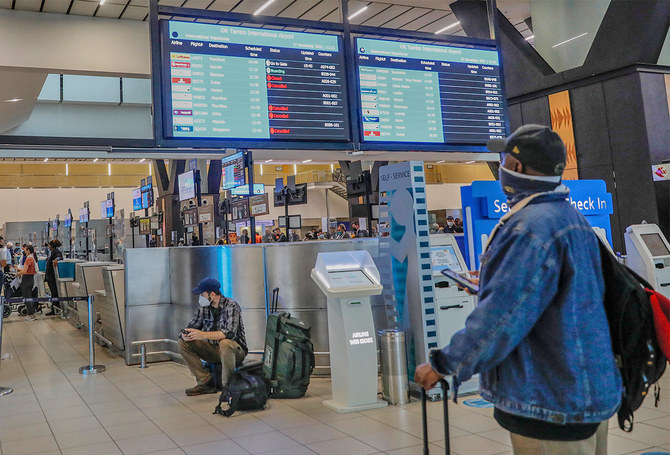
It has since spread to more than a dozen countries, many of which have imposed travel restrictions to try to seal themselves off. Japan on Monday joined Israel in saying it would close its borders completely to foreigners. read more
The WHO reiterated that, pending further advice, countries should use a “risk-based approach to adjust international travel measures,” while acknowledging that a rise in coronavirus cases might lead to higher morbidity and mortality rates.
“The impact on vulnerable populations would be substantial, particularly in countries with low vaccination coverage,” it added.
In vaccinated persons, meanwhile, “COVID-19 cases and infections are expected ... albeit in a small and predictable proportion.”
Overall, there were “considerable uncertainties in the magnitude of immune escape potential of Omicron,” and more data was expected in coming weeks.

Omicron poses very high global risk, world must prepare — WHO
https://arab.news/jkxh7
Omicron poses very high global risk, world must prepare — WHO
- Says overall global risk “assessed as very high,” urges member states to vaccinate, shore up health systems
- Says “uncertainties” on degree of vaccine immunity shows how “perilous and precarious” situation is
Sweden unveils new prison conditions for teens
- The loosely-formed networks have increasingly recruited under-15s, often online, as highly-paid hitmen
- Eight existing prisons have been tasked with preparing special sections for children
STOCKHOLM: Sweden on Thursday revealed prison conditions that teens as young as 13 will face if convicted of a serious criminal offense, once a much-criticized juvenile judicial reform takes effect in July.
The minority rightwing government, which is backed by the far-right Sweden Democrats and has prioritized the fight against surging crime rates, announced in January that it would reduce the age of criminal responsibility from 15 to 13.
A majority of the 126 authorities the government consulted about the change were critical or opposed it outright, including the police and the prison service, but the government has moved forward with its plans regardless.
The Scandinavian country has struggled for more than a decade to contain a surge in organized violent crime, linked primarily to settlings of scores between rival gangs and battles to control the drug market.
The loosely-formed networks have increasingly recruited under-15s, often online, as highly-paid hitmen to carry out bombings and shootings, knowing they would not face prison time if caught.
Eight existing prisons have been tasked with preparing special sections for children, with three of them due to open by July 1 when the reform is scheduled to enter into force, the government said Thursday.
The children will be kept separated from adult inmates, and will be locked in their cells for 11 hours at night instead of the 14 hours for adults, Justice Minister Gunnar Strommer told a press conference.
In addition to attending school lessons during the day, the children will have their own cafeteria, recreation yard, gym and infirmary.
Currently, most minors found guilty of serious crimes are not sentenced to prison.
They are usually ordered into closed detention facilities, called SIS homes, tasked with mandatory care and rehabilitation, rather than a punitive system like prison.
However, many SIS homes have in recent years become recruiting bases for the criminal networks.
- ‘Counter-productive’ -
“Society and crime have changed fundamentally,” Strommer said.
“Young people in general commit fewer crimes. But those who do commit more and much more serious crimes,” he said, adding that “it is much more common for youths to use weapons and explosives.”
He said Sweden was facing “an emergency situation with the gangs, the shootings and explosions with 15, 16 or 17-year-old kids convicted of murder or involvement in murder plots.”
“But there are even younger children involved... For a long time, we have done far too little to address this development, and the system simply hasn’t kept up.”
Children’s rights association Bris said the government’s reform was “counter-productive, insufficiently researched and violates children’s rights.”
It warned that locking such young children away in prison would lead to increased recidivism and encourage criminal networks to recruit ever younger children.
The union representing social workers and prison and SIS home employees, Akademikerförbundet SSR, was also critical, lamenting the speed at which the reform was being pushed through.
“We are very concerned that the Swedish Prison and Probation Service will not have time to build up staff expertise in working with children and to establish a high-quality school,” union expert Fredrik Hjulstrom said.
“The staff of the Prison and Probation Service are qualified to work with adults, and a completely different set of skills is required to succeed with children.”
The reform is being introduced temporarily, limited to five years to start with.
The government is currently trying to rapidly push through a slew of reforms in various areas, ahead of legislative elections in September.


