ISLAMABAD: Police have registered cases against hundreds of suspects for attacking and setting fire to a police station in Khyber Pakhtunkhwa’s Charsadda district after demanding that officers hand over a man accused of burning the Holy Quran, Pakistani media reported on Tuesday.
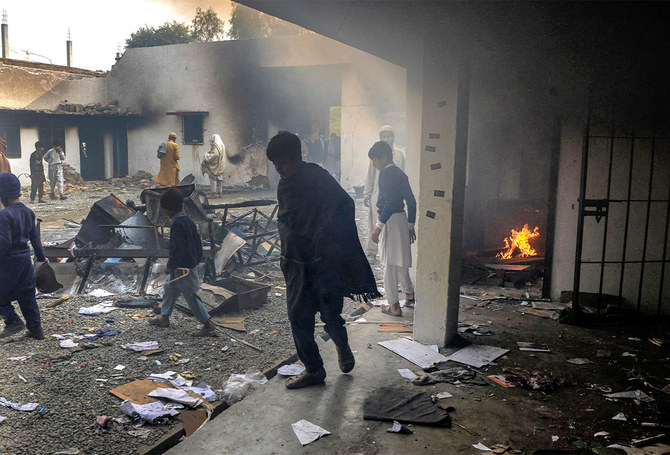
A crowd of up to 5,000 people surrounded the police station in Charsadda town in the northwestern Khyber Pakhtunkhwa province on Sunday night, also setting fire to more than 30 cars On Monday morning, around 2,000 people remained outside the police station, burning uniforms of officers.
According to a police first information report (FIR) published in Dawn.com, police cases were registered “against 30 named suspects and between 300 to 400 unnamed suspects.”
Cases have been filed under sections 324 (attempted murder), 353 (assault or act to deter a public servant from discharging duty), 345 (wrongful confinement), 436 (mischief by fire or explosive substance with intent to destroy house, etc.), 427 (damage to property), 120 (concealing design to commit offense punishable with imprisonment), 148 and 149 of the Pakistan Penal Code along with Section 7 of the Anti-Terrorism Act.
“The FIR, which was registered at the Tangi police station, stated that an angry mob gathered in front of the Mandani police station and wanted officials to hand over a man arrested for allegedly desecrating the Holy Quran,” Dawn said. “The mob became violent and attacked police, before opening fire on officials present at the police post. It added that the mob entered the police post and also seized weapons and other valuables.”
According to the FIR, the mob set 22 vehicles on fire, including three police vans, and stole 12 submachine guns and ammunition. Police also confirmed that the Mandani police station and four posts were destroyed and set on fire during the protest.
Police told Dawn almost 30 people had been arrested so far, and schools and other educational institutions in the area had been closed. KP Chief Minister Mahmood Khan chaired a meeting on the incident, saying “elements and criminals who had provoked people to damage public property had been identified and the person who had allegedly desecrated the Holy Quran had been arrested,” Dawn reported.
“It was decided that strict action would be taken against those involved in vandalism, as the participants of the meeting condemned the incident,” a handout from the meeting said. “Speaking on the occasion, the chief minister also condemned the desecration of the Holy Quran, saying that the responsible person would be given stern punishment.”
Blasphemy is punishable by death in Pakistan, and although no executions have been carried out, suspects are often killed by vigilantes.
A Christian couple was lynched then burnt in a kiln in Punjab in 2014 after being falsely accused of desecrating the Holy Quran. A former Punjab governor Salman Taseer was gunned down by his bodyguard, Mumtaz Qadri, in Islamabad in 2011 over his call for reforms of the blasphemy law.
Asia Bibi, a Pakistani Christian woman and a laborer from central Punjab province, was convicted of blasphemy in 2010 and was on death row until her acquittal in 2018, which prompted days of violent demonstrations by hard-liners. She and her family later fled the country for Canada.
The country has frequently been paralyzed in recent years by anti-blasphemy protests waged by the Tehreek-e-Labbaik Pakistan party, often linked to the publishing of cartoons depicting the Prophet Muhammad (peace be upon him) by a French satirical magazine.


![]()

Hundreds of suspects booked for setting Pakistan police station on fire in alleged blasphemy case
Short Url
https://arab.news/r8gmd
Hundreds of suspects booked for setting Pakistan police station on fire in alleged blasphemy case
- Crowd of up to 5,000 people surrounded police station in Charsadda town on Sunday night
- On Monday morning, 2,000 people remained outside police station burning uniforms of officers

Latest updates


© 2026 SAUDI RESEARCH & PUBLISHING COMPANY, All Rights Reserved And subject to Terms of Use Agreement.