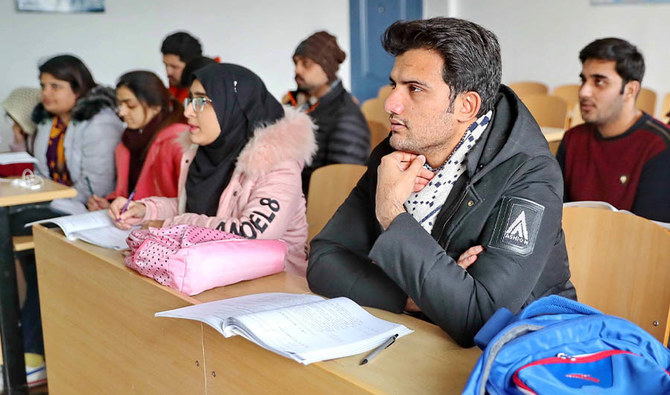
ISLAMABAD: Over a year into the pandemic, Pakistani students say they fear losing their qualifications from Chinese universities, as thousands of them remain stranded at home, unable to return to classes despite the government’s assurance of constant negotiations with Beijing.
Approximately 28,000 Pakistani students are enrolled in Chinese educational institutions and most of them have been stuck in Pakistan since China suspended the entry of foreign nationals in late March 2020 to stop the spread of COVID-19.
For more than a year, the Pakistani government has been saying it remains in touch with Chinese authorities to help the students return to their colleges and universities, but some of them are already on the verge of losing hope.
“We are hopeless and fearful that our money, time is wasted, and future is at stake,” Aroosa Khan, a Karachi-based student who has completed two years of medicine in China, told Arab News on Saturday.
“We are around 7,000 medical students in China, out of which above 85 percent are now stuck in Pakistan due to travel ban,” she said, expressing worry that they would not be able to become good doctors if they cannot practice at university hospitals and clinical labs.
As Pakistan does not recognize medical degrees obtained from online courses, which have been provided by Chinese institutes to overseas students due to the travel ban, Khan said years of studies and thousands of dollars spent on education may go into vain.
“It is not our fault that we have been compelled to take virtual classes. Majority of these medical students are on self-financing where their families had spent around Rs5 million ($28,000),” she added. “They are under acute stress and have become patients of depression due to uncertainty hovering over their future.”
The worries of medical students are shared by those enrolled in engineering courses.
Adam Ali from Attock, who is pursuing a degree in artificial intelligence at a Chinese university, said they had exhausted all avenues to seek help.
“We have met everyone in foreign office, foreign minister, education minister and all other officials but nothing happened despite tall claims. When we write to Pakistani embassy in China, they even didn’t respond to our emails,” he told Arab News.
“When this travel ban was imposed and we started online classes, at that we were ensured by our foreign office that we will be able to travel back to China through chartered flights for next semester by the end of July 2020. But nothing happened.”
Another engineering student, Jamal Nasir from Sialkot, said he had left his job to pursue a master’s degree with a Chinese university scholarship, but as online classes were introduced that facility was discontinued.
“I had a good job but have left it to pursue my master’s on a scholarship, which included a monthly stipend. After resumption of online classes, they have stopped (the) stipend as well, which created lot of financial issues,” he said. “Now neither I have job nor completing my studies due to travel ban.”
As students from some other countries, including South Korea, were allowed back to Chinese campuses in August 2020 as part of intergovernmental deals, Nasir asked why it was not possible for Pakistanis to follow suit.
“If they want, they can impose quarantine and other standard restrictions but at least allow professional degree students to take physical classes,” he said.
The Pakistani government says it is trying to resolve the issue.
“The issue has been discussed at various levels with the Chinese authorities both in Beijing and Islamabad,” foreign office spokesperson Asim Iftikhar told Arab News.
“We are also exploring the possibility of addressing the issues of research, lab work, scholarship etc. with the relevant Pakistani and Chinese authorities and institutions,” he said. “We are pursuing the matter and are continuously in touch with the Chinese side at all levels.”
The Chinese embassy in Islamabad told Arab News it had “nothing to comment on the matter at this time.”


![]()

Unable to return to China, thousands of Pakistani students fear losing degrees
Short Url
https://arab.news/v7z7p
Unable to return to China, thousands of Pakistani students fear losing degrees
- Approximately 28,000 Pakistani students are enrolled in Chinese educational institutions
- China suspended the entry of foreigners in March 2020 to stop the spread of COVID-19
Latest updates


© 2026 SAUDI RESEARCH & PUBLISHING COMPANY, All Rights Reserved And subject to Terms of Use Agreement.