Australia to introduce new laws to force media platforms to unmask online trolls

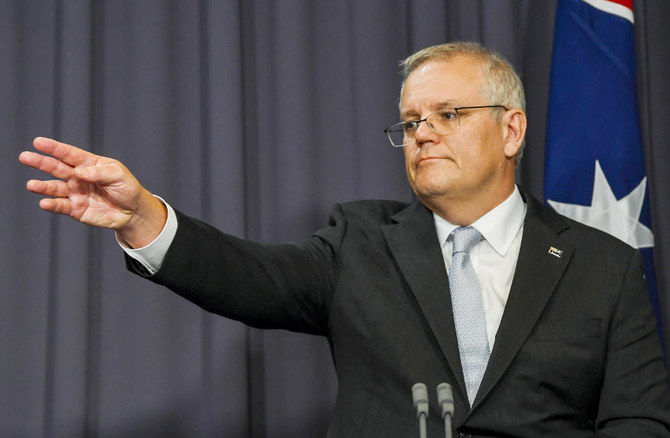
Australian Prime Minister Scott Morrison gestures during a press conference at Parliament House in Canberra, Thursday, Nov. 25, 2021. (AP)
Short Url
Updated 28 November 2021
Follow

Australia to introduce new laws to force media platforms to unmask online trolls

  • The new legislation will introduce a complaints mechanism, so that if somebody thinks they are being defamed, bullied or attacked on social media, they will be able to require the platform to take the material down

MELBOURNE: Australia will introduce legislation to make social media giants provide details of users who post defamatory comments, Prime Minister Scott Morrison said on Sunday.
The government has been looking at the extent of the responsibility of platforms, such as Twitter and Facebook, for defamatory material published on their sites and comes after the country’s highest court ruled that publishers can be held liable for public comments on online forums.
The ruling caused some news companies like CNN to deny Australians access to their Facebook pages.
“The online world should not be a wild west where bots and bigots and trolls and others are anonymously going around and can harm people,” Morrison said at a televised press briefing. “That is not what can happen in the real world, and there is no case for it to be able to be happening in the digital world.”
The new legislation will introduce a complaints mechanism, so that if somebody thinks they are being defamed, bullied or attacked on social media, they will be able to require the platform to take the material down.
If the content is not withdrawn, a court process could force a social media platform to provide details of the commenter.
“Digital platforms — these online companies — must have proper processes to enable the takedown of this content,” Morrison said.
“They have created the space and they need to make it safe, and if they won’t, we will make them (through) laws such as this.”



WEF report spotlights real-world AI adoption across industries

Updated 19 January 2026
Follow

WEF report spotlights real-world AI adoption across industries

DUBAI: A new report by the World Economic Forum, released Monday, highlights companies across more than 30 countries and 20 industries that are using artificial intelligence to deliver real-world impact.

Developed in partnership with Accenture, “Proof over Promise: Insights on Real-World AI Adoption from 2025 MINDS Organizations” draws on insights from two cohorts of MINDS (Meaningful, Intelligent, Novel, Deployable Solutions), a WEF initiative focused on AI solutions that have moved beyond pilot phases to deliver measurable performance gains.

As part of its AI Global Alliance, the WEF launched the MINDS program in 2025, announcing its first cohort that year and a second cohort this week. Cohorts are selected through an evaluation process led by the WEF’s Impact Council — an independent group of experts — with applications open to public- and private-sector organizations across industries.

The report found a widening gap between organizations that have successfully scaled AI and those still struggling, while underscoring how this divide can be bridged through real-world case studies.

Based on these case studies and interviews with selected MINDS organizations, the report identified five key insights distinguishing successful AI adopters from others.

It found that leading organizations are moving away from isolated, tactical uses of AI and instead embedding it as a strategic, enterprise-wide capability.

The second insight centers on people, with AI increasingly designed to complement human expertise through closer collaboration, rather than replace it.

The other insights focus on the systems needed to scale AI effectively, including strengthening data foundations and strategic data sources, as well as moving away from fragmented technologies toward unified AI platforms.

Lastly, the report underscores the need for responsible AI, with organizations strengthening governance, safeguards and human oversight as automated decision-making becomes more widespread.

Stephan Mergenthaler, managing director and chief technology officer at the WEF, said: “AI offers extraordinary potential, yet many organizations remain unsure about how to realize it.

“The selected use cases show what is possible when ambition is translated into operational transformation and our new report provides a practical guide to help others follow the path these leaders have set.”

Among the examples cited in the report is a pilot led by the Saudi Ministry of Health in partnership with AmplifAI, which used AI-enabled thermal imaging to support early detection of diabetic foot conditions.

The initiative reduced clinician time by up to 90 percent, cut treatment costs by as much as 80 percent, and delivered a 10 time increase in screening capacity. Following clinical trials, the solution has been approved by regulatory authorities in Saudi Arabia, the UAE and Bahrain.

The report also points to work by Fujitsu, which deployed AI across its supply chain to improve inventory management. The rollout helped cut inventory-related costs by $15 million, reduce excess stock by $20 million and halve operational headcount.

In India, Tech Mahindra scaled multilingual large language models capable of handling 3.8 million monthly queries with 92 percent accuracy, enabling more inclusive access to digital services across markets in the Global South.

“Trusted, advanced AI can transform businesses, but it requires organizing data and processes to achieve the best of technology and — this is key — it also requires human ingenuity to maximize returns on AI investments,” said Manish Sharma, chief strategy and services officer at Accenture.