Pakistan's army chief appoints first female official as colonel commandant of medical corps

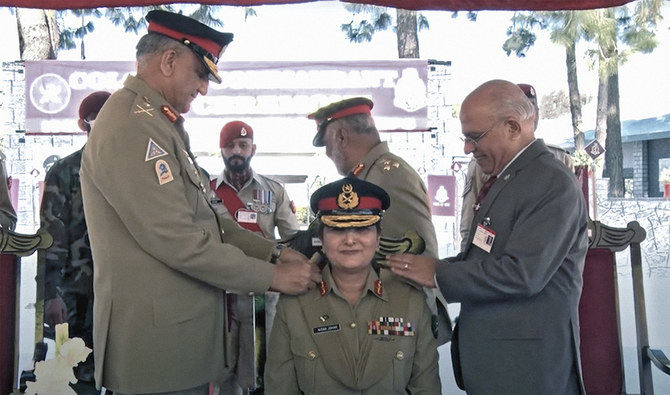
Pakistan's army chief General Qamar Javed Bajwa appoints Lieutenant General Nagar Johar as Colonel Commandant of the Army Medical Corps by pinning the badges of the rank on her uniform in Abbottabad, Pakistan, on November 26, 2021. (ISPR)
Short Url
Updated 26 November 2021
Follow

Pakistan's army chief appoints first female official as colonel commandant of medical corps

  • Lieutenant General Nigar Johar hails from a conservative region in the Khyber Pakhtunkhwa province
  • She is also the first and only woman who was promoted to the rank of lieutenant general in the army

ISLAMABAD: The first female lieutenant general of the Pakistan Army was formally appointed as Colonel Commandant of the Army Medical Corps (AMC) on Friday, announced the military's media wing, as the country's army chief called the development a moment of pride for the nation.
The appointment was made by Chief of Army Staff General Qamar Javed Bajwa during his visit to the AMC Center in Abbottabad where he first laid floral wreath at a martyrs' memorial.
General Bajwa pinned the badges of the rank on Lieutenant General Nigar Johar's uniform, making her the first female general in the army to receive the distinction.
The army chief lauded the AMC's contributions in ensuring high standards of healthcare during the days of war and peace.
He said the appointment "of the first ever three-star female General Officer of Pakistan Army as Colonel Commandant of AMC is indeed a matter of immense pride for Pakistan Army and the country," informed the official statement.
General Bajwa maintained the AMC had always answered the call of duty during natural calamities, adding its doctors and paramedics had acted as frontline warriors against COVID-19 and displayed exemplary commitment and resolve for the safety and well-being of the people of Pakistan.
"Keeping pace with rapid advancements in medical science is imperative for the doctors and paramedics to keep themselves at par with modern militaries and best global practices in health care," he continued.
Lieutenant General Johar hails from Swabi, a conservative region in the Khyber Pakhtunkhwa province.
She joined the Army Medical College in 1981 and graduated in 1985.



World Bank approves $700 million for Pakistan’s economic stability

Updated 6 sec ago
Follow

World Bank approves $700 million for Pakistan’s economic stability

  • Of this, $600 million will go for federal programs and $100 million will ⁠support a provincial program in Sindh
  • The results-based design ensures that resources are only disbursed once program objectives are achieved

ISLAMABAD: The World Bank has approved $700 million in ​financing for Pakistan under a multi-year initiative aimed at supporting the country’s macroeconomic stability and service delivery, the bank said on Friday.

The funds will be released under the bank’s Public ‌Resources for Inclusive ‌Development — Multiphase ‌Programmatic ⁠Approach (PRID-MPA) that ‌could provide up to $1.35 billion in total financing, according to the lender.

Of this amount, $600 million will go for federal programs and $100 million will ⁠support a provincial program in ‌the southern Sindh province. The results-based design ensures that resources are only disbursed once program objectives are achieved.

“Pakistan’s path to inclusive, sustainable growth requires mobilizing more domestic resources and ensuring they are used efficiently and transparently to deliver results for people,” World Bank country director Bolormaa Amgaabazar said in a statement.

“Through this MPA, we are working with the Federal and Sindh governments to deliver tangible impacts— more predictable funding for schools and clinics, fairer tax systems, and stronger data for decision‑making— while safeguarding priority social and climate investments and strengthening public trust.”

The approval ‍follows a $47.9 ‍million World Bank grant ‍in August to improve primary education in Pakistan’s most populous Punjab province.

In November, an IMF-World Bank ​report, uploaded by Pakistan’s finance ministry, said Pakistan’s fragmented ⁠regulation, opaque budgeting and political capture are curbing investment and weakening revenue.

Regional tensions may surface over international financing for Pakistan. In May, Reuters reported that India would oppose World Bank funding for Pakistan, citing a senior government ‌source in New Delhi.

“Strengthening Pakistan’s fiscal foundations is essential to restoring macroeconomic stability, delivering results and strengthening institutions,” said Tobias Akhtar Haque, Lead Country Economist for the World Bank in Pakistan.

“Through the PRID‑MPA, we are launching a coherent nationwide approach to support reforms that expand fiscal space, bolster investments in human capital and climate resilience, and strengthen revenue administration, budget execution, and statistical systems. These reforms will ensure that resources reach the frontline and deliver better outcomes for people across Pakistan with greater efficiency and accountability.”

In Sindh, the program is expected to increase provincial revenues, enhance the speed and transparency of payments, and broaden the use of data to guide provincial decision making. The program will directly support the increase of public resources for inclusive development, including more equitable and responsive financing for primary health care facilities and more funding for schools.