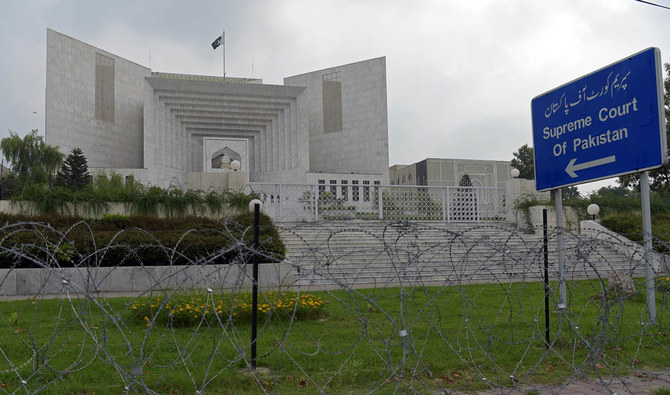
KARACHI: Pakistan’s top judge on Friday directed the country’s defense secretary to submit a policy statement signed by the chiefs of army, navy and air force regarding the commercial use of military lands in Karachi.
A three-member Supreme Court bench, headed by Chief Justice Gulzar Ahmed, was hearing different cases related to illegal encroachments on government lands in the country’s southern seaside metropolis when the defense secretary, Lt. Gen. (r) Mian Hilal Hussain, informed the court that the military had decided not to allow any commercial activities on its lands.
However, the court asked what was going to happen to all the commercial activities that had already taken place.
“How are you going to fix it,” asked the chief justice while demanding a signed policy report by the three services chiefs regarding how the commercial activities would be brought to an end.
“This land was provided to you for strategic and defense purposes,” he continued. “You are using it to launch commercial ventures and have built wedding halls, cinemas and housing societies.”
The defense secretary, who was ordered by the chief justice to appear and answer questions related to the case a day earlier, demanded some time from the court to present the required document.
The bench also heard a different encroachment case related to Nasla Tower in Karachi and instructed Commissioner Iqbal Memon to ensure that the residential building was razed to the ground within a week.
The court also reprimanded the Karachi chief of the Jamaat-e-Islami party Naeem Ur Rehman for demanding compensation for the effected families and individuals.
Meanwhile, police fired teargas shells to disperse protesters, including political activists, local builders and other citizens, who had gathered outside Nasla Tower at the Shahrah-e-Faisal road.
The protest was called by the chairman of the Association of Builders and Developers, Mohsin Shaikhani, who got injured during the shelling while the police were trying to stop people who wanted to resist the demolition work.


![]()

Pakistan’s top court grills defense secretary over commercial use of military lands
Short Url
https://arab.news/j9wmq
Pakistan’s top court grills defense secretary over commercial use of military lands
- The country’s chief justice says the military got its lands for defense and strategic purposes, not to launch commercial ventures
- The court also instructed the Karachi commissioner to demolish Nasla Tower within a week
Latest updates


© 2026 SAUDI RESEARCH & PUBLISHING COMPANY, All Rights Reserved And subject to Terms of Use Agreement.