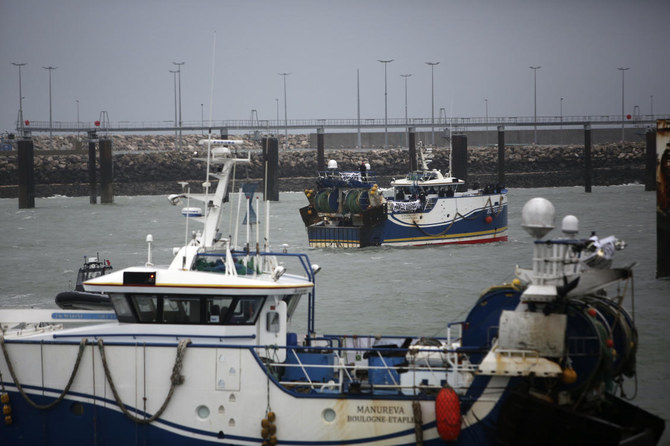
CALAIS, France: French fishermen blockaded the port of Calais on Friday, temporarily preventing two ferries carrying trucks and passengers from entering, in protest against the UK’s failure to issue more licenses to fish in British waters.
In an effort to disrupt trade, several trawlers manouevered to force the DFDS and P&O ferries to reduce speed and hold outside the port, a major entry point to the continental market for British goods.
The blockade, which lasted 90 minutes, marked an escalation in the post-Brexit row between London and Paris over fishing rights in Britain’s coastal waters.
Britain says any licenses that are being withheld lack the correct documentation to issue them.
The two ferries outside the port on Friday reduced their speed until their path was clear, the MarineTraffic app showed.
The protest then shifted to the Channel Tunnel where the fishermen held up goods moving to and from Britain through the Channel Tunnel rail link.
Dover — Calais is the shortest sea route between Britain and the European Union — just 23 miles (37 km) — and has been one of Britain’s main arteries for European trade since the Middle Ages.
Before Brexit and the pandemic, 1.8 million trucks per year were routed through Calais.
Earlier in the day, fishermen blocked a small British cargo, the Normandy Trader, from docking in the Brittany port of Saint-Malo. France says Jersey, a British Crown Dependency, has also failed to issue licenses due to its fishermen under a post-Brexit deal.
The one-hour Saint-Malo protest and the larger action further east along France’s coast risk reigniting a dispute between the two countries over a mutual licensing system for fishing vessels.
They are also embroiled in a row over cross-Channel migration.
With Britain’s exit from the European Union, the two sides agreed to set up a licensing system for granting fishing vessels access to each other’s waters.
Paris says London and the Channel Island of Jersey, a British crown dependency, are not honoring the agreement.
Britain says it is respecting the post-Brexit arrangements.
In October, France briefly seized a British scallop dredger off its northern coast for allegedly operating without a legitimate permit, and both countries have this year sent patrol vessels to waters off Jersey.
President Emmanuel Macron has accused Britain of pushing his country’s patience and said the government would not yield in the dispute.
Fishing rights dogged Brexit talks for years, not because of its economic importance but because of its political significance for both Macron and British Prime Minister Boris Johnson.
Separately, the French government said Britain’s Home Minister Priti Patel was no longer welcome at a Sunday meeting on immigration with other European officials following criticism of France by Johnson over its handling of cross-Channel migration.
The meeting is to address how to curb the flow of migrants after 27 people drowned trying to reach British shores on Wednesday.


![]()

French fishermen block Calais port over fishing license row
Short Url
https://arab.news/5bhgs
French fishermen block Calais port over fishing license row
- In an effort to disrupt trade, several trawlers manouevered to force the DFDS and P&O ferries to reduce speed and hold outside the port
- The blockade, which lasted 90 minutes, marked an escalation in the post-Brexit row between London and Paris over fishing rights in Britain's coastal waters


Latest updates


© 2026 SAUDI RESEARCH & PUBLISHING COMPANY, All Rights Reserved And subject to Terms of Use Agreement.