

Pakistan's finance chief says no new taxes will be imposed in supplementary budget

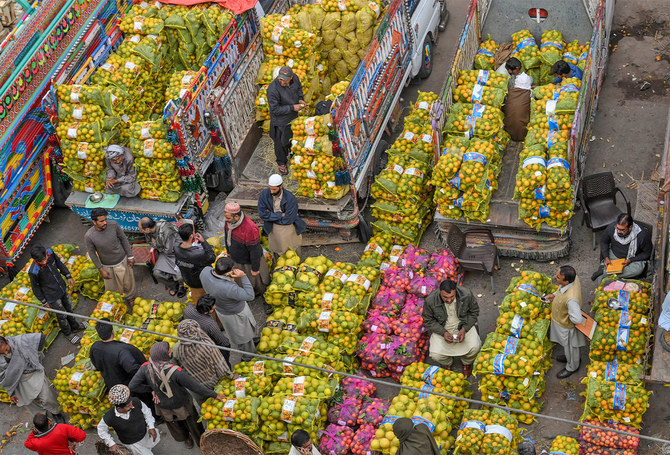
Traders gather at a fruit market in Lahore, Pakistan, on November 27, 2019. (AFP)
Short Url
Updated 27 November 2021
Follow

Pakistan's finance chief says no new taxes will be imposed in supplementary budget

  • Shaukat Tarin maintains the country's national currency is undervalued by about Rs10
  • The country's finance chief warns 'speculators' that the Pakistani rupee will soon move in the other direction and gain strength

ISLAMABAD: Pakistan's finance chief Shaukat Tarin said on Friday the government was not planning to introduce new taxes after securing a recent agreement with the International Monetary Fund, though he added it was going to withdraw certain exemptions.
The IMF announced earlier this week it had reached a staff level agreement with the administration in Islamabad which required the approval of the international financial institution's executive board following the implementation of fiscal and institutional reforms by Pakistan.
It laid out five conditions which included sales tax reforms, increase in petroleum development levy and the greater autonomy for the central bank.
Addressing a news conference shortly after the IMF announcement, Tarin had said the government would meet the five demands by presenting supplementary finance bills which are more popularly known as mini-budgets in Pakistan.
"We are not going to increase taxes but withdraw some exemptions," said the finance chief.


He recalled his statement after assuming the office that the government would not burden the country's taxpayers anymore, adding this was despite the fact that Pakistani officials had already agreed to impose new taxes to get $500 million from the IMF in March.
Asked about the dismal performance of Pakistan's national currency, Tarin said people previously thought the rupee was sliding due to the delay in the IMF agreement or increase in the discount rate amid souring inflation.
However, he maintained that Pakistan's national currency was under pressure due to speculative trading in the market.
Tarin said some people were even spreading rumors that the Pakistani currency would get demonetized, though he categorically announced that "nothing like that is going to happen at least on my watch."
"Let me warn the speculators that the Pakistani currency will also move in the other direction," he continued. "We are taking some measures to ensure that. And when the rupee is going to move on the other side, it hurt them a lot. So, they should not indulge in such speculation."
The finance chief said it was important to keep an eye on the real effective exchange rate to determine the real strength of the rupee.
"Experts say the Pakistani rupee should be somewhere around Rs165 to Rs167 against [the US dollar] ... Our national currency is undervalued by about Rs10," he said.
The Pakistani rupee traded at Rs175.46 in the interbank market on Friday.


JazzCash signs deal with Binance in UAE to explore regulated crypto adoption in Pakistan

Updated 12 sec ago
Follow

JazzCash signs deal with Binance in UAE to explore regulated crypto adoption in Pakistan

  • MoU focuses on awareness and development of compliant virtual-asset solutions in Pakistan
  • Pakistan introducing licensing regime for crypto firms as it formalizes digital-asset oversight

ISLAMABAD: Pakistani financial-technology platform JazzCash has signed a memorandum of understanding with global cryptocurrency exchange Binance in the United Arab Emirates to explore cooperation on virtual-asset use and education in Pakistan, the company said on Wednesday.

The agreement sets a framework for discussions on awareness campaigns and future digital-asset products that would comply with Pakistan’s emerging crypto regulations. The move signals growing engagement between global blockchain companies and Pakistani fintechs as authorities shift toward formal licensing of the sector.

Pakistan has spent the past year drafting rules to regulate the fast-expanding market for digital coins and tokens, requiring virtual-asset service providers to obtain government approval. Officials say the transition is aimed at curbing money-laundering and terror financing risks, boosting transparency and encouraging responsible innovation.

“JazzCash has always championed technologies that expand financial access while promoting secure and inclusive participation in the digital economy," JazzCash Chief Executive Officer Murtaza Ali said. 

“By entering into this exploratory MoU with Binance, we are advancing our efforts to understand how global digital-asset trends can support Pakistan’s evolving regulatory landscape. We aim to engage responsibly, support regulatory progress, and advance opportunities that build trust, transparency and innovation for our customers.”

The MoU does not establish a commercial partnership, but marks one of the most high-profile engagements between Pakistan’s fintech sector and a global crypto exchange as the country moves toward regulated digital-asset adoption.

Binance welcomed the cooperation, framing it as part of Pakistan’s shift toward regulated digital-asset activity.

"With regulatory frameworks like [Pakistan Virtual Assets Regulatory Authority] PVARA paving the way, this collaboration represents a significant step toward expanding financial inclusion and empowering more people to access the benefits of blockchain technology in a secure and compliant environment," Binance Chief Marketing Officer Rachel Conlan said.

Earlier this month, Binance executives met Pakistani finance officials to discuss digital-payments reform, blockchain-skills training and the potential for Web3-linked jobs. Pakistan also set up the Pakistan Crypto Council and formed PVARA this year to license and supervise crypto-asset service providers.