World races to contain new COVID threat, the omicron variant

1 / 4
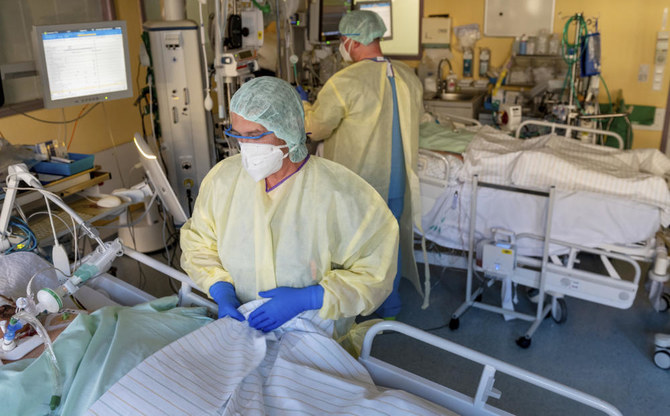
Intensive care nurses treat patients severely ill with Covid-19 disease in the Corona intensive care unit at the University Hospital in Halle/Saale on Monday, Nov. 22, 2021. (AP)
2 / 4
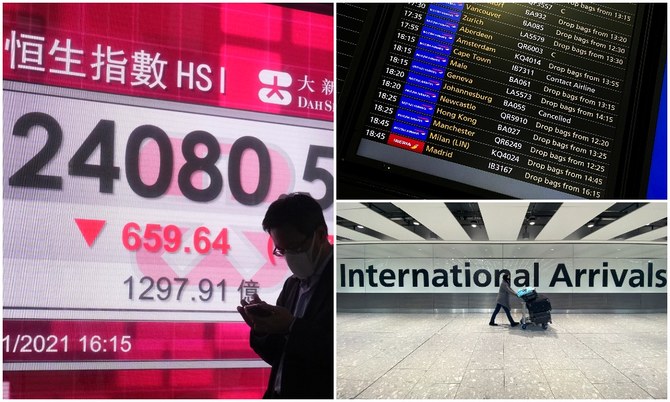
A jittery world is fearing the worst nearly two years after COVID-19 emerged and triggered a pandemic that has killed more than 5 million people around the globe. (AP photos)
3 / 4
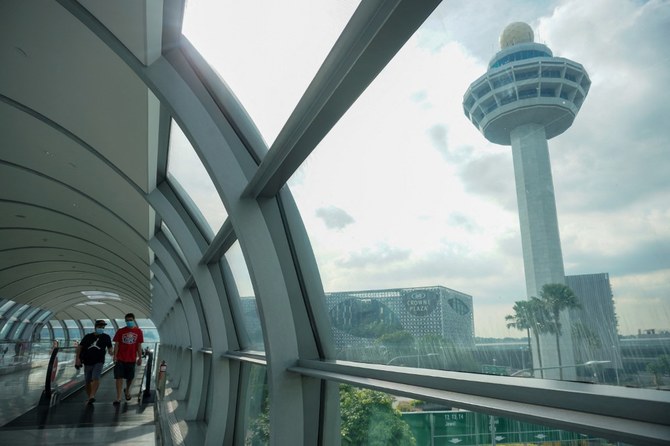
Singapore swiftly joined Britain in imposing a travel ban, with the country’s health ministry saying it would restrict arrivals from South Africa and countries nearby as a precaution. (AFP)
4 / 4
South Africa has requested an urgent sitting of a World Health Organization working group on virus evolution on Friday to discuss the new variant. (AP)
Short Url
Updated 28 November 2021
Follow

World races to contain new COVID threat, the omicron variant

  • Scientists are still learning about the variant, first identified at the start of this week
  • Several countries, including in the Gulf, institute travel restrictions on visitors from southern Africa

JEDDAH: Fears mounted on Saturday that a highly infectious new COVID-19 strain was pushing its way into Europe as the world brought the shutters down to contain the new omicron variant.

Britain confirmed its first two infections and suspected new cases emerged in Germany and the Czech Republic, while Dutch authorities quarantined 61 passengers from South Africa who tested positive for COVID-19.

South Africa complained it was being “punished” with air travel bans for first detecting the strain, which the World Health Organization has termed a “variant of concern.”

South Korea, Australia, and Thailand joined the US, Brazil, Canada, and a host of other countries around the world restricting travel from the region, fearing a major setback to global efforts against the pandemic.

Saudi Arabia was among countries in the Middle East and North Africa to ban travelers from several African nations.

The Saudi Interior Ministry and authorities in the UAE said visitors from seven African countries were barred from entry.

They listed the countries as South Africa, Namibia, Botswana, Zimbabwe, Mozambique, Lesotho, and Eswatini.

The Saudi ban comprises flights to and from those countries. But foreign nationals from the seven countries could enter the Kingdom if they had spent the previous 14 days in another country and comply with Saudi health protocols.

In a separate announcement on Saturday, the Interior Ministry said the Kingdom will allow direct entry to travelers from all countries who have received one dose of a COVID-19 vaccine starting next Saturday. The ministry added the travelers would need to quarantine for three days.

Scientists are racing to determine the threat posed by the heavily mutated strain, which is more transmissible than the dominant Delta variant, and whether it can evade existing vaccines.

Anxious travelers thronged Johannesburg international airport, desperate to squeeze onto the last flights to countries that had imposed sudden travel bans. Many had cut holidays and rushed back from South African safaris and vineyards.

“It’s ridiculous, we will always be having new variants,” British tourist David Good said, passport in hand. “South Africa found it but it’s probably all over the world already.”

The WHO on Friday declared the recently discovered B.1.1.529 strain of COVID-19 to be a variant of concern, renaming it omicron.

Professor Andrew Pollard, the director of the Oxford Vaccine Group which developed the AstraZeneca vaccine, expressed cautious optimism that existing vaccines could be effective at preventing serious disease from the omicron variant.

He said most of the mutations appear to be in similar regions as those in other variants.

South Africa is worried that the curbs will hurt tourism and other sectors of its economy, the Foreign Ministry said, adding the government is engaging with countries that have imposed travel bans to persuade them to reconsider.

Omicron has emerged as many countries in Europe are already battling a surge in COVID-19 infections, and some have re-introduced restrictions on social activity to try to stop the spread. Austria and Slovakia have entered lockdowns.


Ethiopia accuses Eritrea of arming rebels in escalating war of words

Updated 5 sec ago
Follow

Ethiopia accuses Eritrea of arming rebels in escalating war of words

  • The charge by Ethiopia’s federal police escalates a feud between Ethiopia and Eritrea
  • The two countries fought a three-year border war that broke out in 1998

ADDIS ABABA: Ethiopian police said they had seized thousands of rounds of ammunition sent by Eritrea to rebels in Ethiopia’s Amhara region, an allegation Eritrea dismissed as a falsehood intended to justify starting a war.
The charge by Ethiopia’s federal police escalates a feud between Ethiopia and Eritrea, longstanding foes who reached a peace deal in 2018 that has since given way to renewed threats and acrimony.
The police said in a statement late on Wednesday they had seized 56,000 rounds of ⁠ammunition and arrested two suspects this week in the Amhara region, where Fano rebels have waged an insurgency since 2023.
“The preliminary investigation conducted on the two suspects who were caught red-handed has confirmed that the ammunition was sent by the Shabiya government,” the statement said, using a term for Eritrea’s ruling party.
Eritrea’s Information Minister Yemane Gebremeskel told Reuters that Ethiopian Prime ⁠Minister Abiy Ahmed’s Prosperity Party (PP) was looking for a pretext to attack.
“The PP regime is floating false flags to justify the war that it has been itching to unleash for two long years,” he said.
In an interview earlier this week with state-run media, Eritrean President Isaias Afwerki said the Prosperity Party had declared war on his country. He said Eritrea did not want war, but added: “We know how to defend our nation.”
The two countries fought a three-year border war that broke out in 1998, five years after Eritrea won its independence from Ethiopia. They ⁠signed a historic agreement to normalize relations in 2018 that won Ethiopia’s Abiy the Nobel Peace Prize the following year. Eritrean troops then fought in support of Ethiopia’s army during a 2020-22 civil war in Ethiopia’s northern Tigray region.
But relations soured after Asmara was frozen out of the peace deal that ended that conflict. Since then, Eritrea has bristled at repeated public declarations by Abiy that landlocked Ethiopia has a right to sea access — comments many in Eritrea, which lies on the Red Sea, view as an implicit threat of military action.
Abiy has said Ethiopia does not seek conflict with Eritrea and wants to address the issue of sea access through dialogue.