TRENCIN, Slovakia: Slovakia went into a two-week lockdown on Thursday, as the country with one of the EU’s lowest vaccination rates reported a critical situation in hospitals and new infections that topped global tables.
Slovakia, a country of 5.5 million, ordered all but essential shops and services closed and banned people from traveling outside their districts unless going to work, school, or a doctor. Gatherings of more than six people were banned.
The decision comes as coronavirus cases surge across Europe, making the continent the center of the pandemic again, and follows neighboring Austria which started a lockdown on Monday.
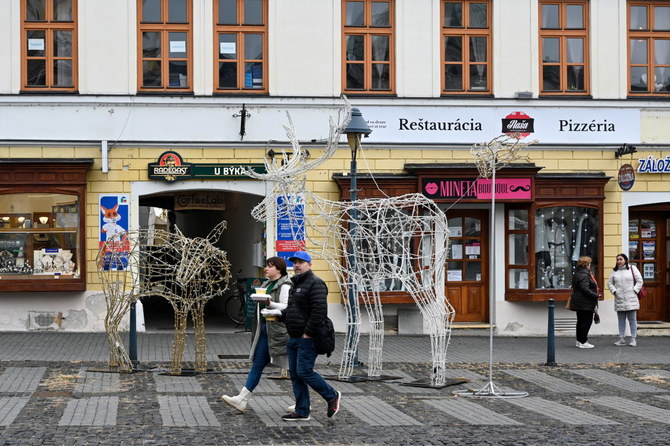
In the city of Trencin, 130 km (81 miles) north of Bratislava, musical instrument shop manager Roman Spatny said his income was tied to sales and would vanish with another lost Christmas season.
“For us this is a plain knife in the back. We have to be closed at a time that business-wise is the most important for us, same as last year,” he said. “Important decisions are taken from one hour to the next. There is no way to properly react to this.”
Student Natalia Paskova, 17, saw little choice: “The situation is getting worse so the decisions are justified,” she said.
The government initially announced new restrictions applying only to the unvaccinated on Monday, before opting for the general lockdown. It said any loosening — to be assessed after 10 days — would apply to first to those who are vaccinated.
Slovakia reported over 10,000 new cases in each of the past two days, the highest to date. With 1,929 average daily cases per million population over the past week, it has the world’s highest incidence rate according to Our World in Data.
The country has the EU’s third lowest vaccination rate of just 45.7 percent of the population, versus an EU average of 65.8 percent, according to the European Center for Disease Prevention and Control (ECDC).
Hospitals have reached the limits of 3,200 patients which the government said was critical to maintain care. The health ministry has said it had started discussing possible help abroad. Slovakia has reported 14,107 deaths since the start of the pandemic.


![]()

Slovaks lock down to slow world’s highest COVID-19 infection rate
Short Url
https://arab.news/vadwr
Slovaks lock down to slow world’s highest COVID-19 infection rate
- Slovakia, a country of 5.5 million, ordered all but essential shops and services closed
- The decision comes as coronavirus cases surge across Europe


Latest updates


© 2026 SAUDI RESEARCH & PUBLISHING COMPANY, All Rights Reserved And subject to Terms of Use Agreement.