

New discoveries to boost tourism in northwestern Pakistani ‘city of Alexander’ — archaeologists 

A citadel is seen from the Hindu Shahi temple in the ancient Bazira, Barikot, in the middle of the Swat valley in northwestern Pakistan during archeological works in October. (Photo courtesy: Italian Archaeological Mission to Pakistan)
Short Url
Updated 25 November 2021
Follow

New discoveries to boost tourism in northwestern Pakistani ‘city of Alexander’ — archaeologists 

  • Bazira has been excavated by the Italian Archaeological Mission to Pakistan since the 1970s
  • The ancient city was besieged and seized by Alexander the Great in 327 BCE

PESHAWAR: Authorities in northwestern Pakistan are expecting an increase in tourism as recent archaeological works have unearthed new structures in the ancient city of Bazira that centuries ago was conquered by Alexander the Great.
Located in Barikot, in the middle of the Swat valley, Khyber Pakhtunkhwa province, Bazira has been excavated by the Italian Archaeological Mission to Pakistan since the 1970s.
The city was besieged and seized by Alexander the Great in 327 BCE and is nowadays referred to as the “city of Alexander.” A number of ancient empires had ruled Bazira since the conquest, including the Maurya Empire, Kushans, and the Hindu Shahis, and the Ghaznavids.
Archaeologists say this month’s excavations help them understand the city’s structure as they have unearthed walls, bastions and stairs of a fort on the Ghwandai hill, at the foot of which Bazira urban settlements were built. 
“The most important and recent discovery on the hill concerns three points, including the existence of a seventh-11th century Shahi-era fortress that defended a water reservoir for the temple and an earlier Kushan acropolis of which important monumental traces remain,” Dr. Luca M. Olivieri, who leads the Italian mission, told Arab News earlier this week.
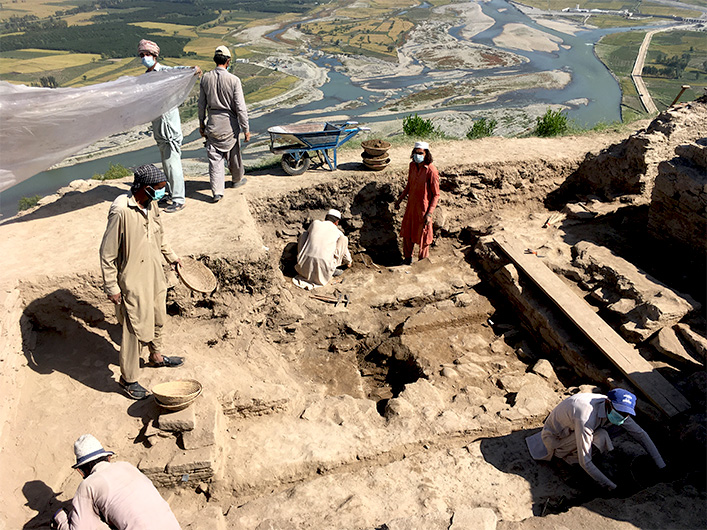


The Bazira excavation site in Barikot, Khyber Pakhtunkhwa, northwestern Pakistan. (Photo courtesy: Khyber Pakhtunkhwa Archeology and Museums Directorate)

The acropolis, where the archaeologists have also found small stupas from the first century BCE — among some of the oldest evidence of Buddhist worship in an urban area — was transformed to house a Hindu temple at the time of the Ghaznavid’s conquest of the town from Hindu-Shahi rulers, while a fortress was established on the summit to keep a watch on key areas of the Swat valley.
The fort has a huge water tank where bastions were built to protect it and the Vishnu Temple, a Hindu place of worship dedicated to Lord Vishnu, is also situated there.
“Today, about a tenth of the ancient city has been explored including the Vishnuite temple on the acropolis, the Shahi fortress conquered by the Ghaznavids in the 11th century,” Olivieri said.
Niaz Ali Shah, regional director at the Khyber Pakhtunkhwa archaeology and museums directorate in Swat which excavates the site with the Italian archaeologists, said that “stairs, drainage system, remains of walls and fortress and remains of a temple have been fully discovered.”
“I think the latest discovery will woo religious tourists to visit their historical places,” he added. “As we’ve exposed the ancient history of other religions through material remains, it will primarily attract Buddhist and Hindus’ tourists to visit this town to see how we preserve their history.”


Daesh media chief for ISKP in Pakistan’s custody — state media

Updated 18 December 2025
Follow

Daesh media chief for ISKP in Pakistan’s custody — state media

  • Sultan Aziz Azzam, a senior member of ISKP, used to head its Al Azzam media outlet, says state media
  • Azzam was arrested in May while attempting to cross into Pakistan from Afghanistan, says state media

ISLAMABAD: Pakistani authorities have taken into custody Sultan Aziz Azzam, the head of Daesh regional affiliate ISKP’s media outlet, state media reported on Thursday citing intelligence sources. 

The state-run Pakistan TV Digital reported that Azzam was a senior member of ISKP and hailed from Afghanistan’s Nangarhar province. As per the state media report, he is also a graduate of the University of Nangarhar where he studied Islamic jurisprudence. 

Pakistan TV Digital reported Azzam joined ISKP in 2016 and later became a prominent member of its leadership council.

“He was arrested in May 2025 while attempting to cross from Afghanistan into Pakistan,” Pakistan TV Digital reported, citing intelligence sources. 

“He is believed to have overseen media operations and headed ISKP’s Al Azzam media outlet.”

In November 2021, Washington listed Azzam as a “Specially Designated Global Terrorist” (SDGT). The move bars American citizens from engaging in transactions with persons designated as SDGTs. 

According to a report on the UN Security Council’s website, Azzam has played an “instrumental role” in spreading Daesh’s violent ideology, glorifying and justifying “terrorist acts.” 

“Building on his former experience as an Afghan journalist, his activity as ISIL-K’s spokesperson has increased ISIL-K’s visibility and influence among its followers,” the report states. 

The report further states Azzam claimed responsibility on behalf of Daesh for the suicide attack near Hamid Karzai International Airport on Aug. 26, 2021, which killed at least 170 Afghans and 13 US service members and injured 150 more. 

The development takes place amid tense relations between Pakistan and Afghanistan, with Islamabad alleging militants use Afghan soil to carry out attacks against Pakistan. Kabul denies the allegations.

Tensions surged in October when Pakistan and Afghanistan engaged in fierce border clashes, claiming to have killed dozens of soldiers of the other side.

Pakistan has urged the Afghan Taliban-led government to take “decisive action” against militants it says operate from its soil. Afghanistan says it cannot be held responsible for Pakistan’s security challenges.