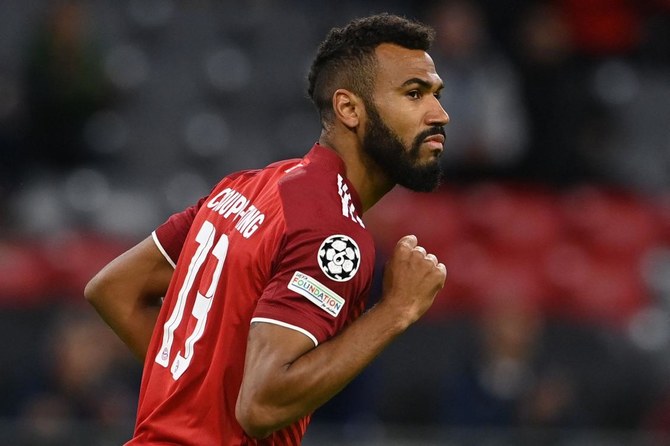
MUNICH: Bayern Munich players Joshua Kimmich and Eric Maxim Choupo-Moting have tested positive for the coronavirus, the club said Wednesday.
Both players were already in isolation over close contact with people suspected of having the virus. Bayern said both were “doing well.”
Kimmich said last month in a TV interview that he had not yet made a decision about whether to be vaccinated and voiced reservations about vaccines. The midfielder's comments caused concern among public health experts at a time when vaccine take-up in Germany had slowed.
Kimmich co-founded a fundraising campaign last year with teammate Leon Goretzka which donated money to social and charitable organizations to continue working during the pandemic and which also sent some money to UNICEF to help make vaccines more easily available in poorer nations.
Kimmich and backup striker Choupo-Moting had been due to return in time for Bayern’s game against Arminia Bielefeld on Saturday, but it now appears an already depleted squad will have to cope without them.
With numerous players in isolation, injured or suspended, Bayern had a thin squad for its 2-1 win over Dynamo Kyiv in the Champions League group stage on Tuesday. Coach Julian Nagelsmann couldn't rest key players — with Bayern already through to the knockout stages — and named only four outfield substitutes as he relied on fringe players, youngsters, and out-of-position regulars to finish the game.
Kimmich is a regular starter in midfield and Choupo-Moting is Nagelsmann's preferred backup for striker Robert Lewandowski, who has played a full 90 minutes in each of Bayern's last eight games.
Also Wednesday, Bayern said defenders Niklas Süle and Josip Stanišić both returned to training following their own positive tests for the virus.

Bayern’s Kimmich, Choupo-Moting positive for coronavirus
https://arab.news/4j6xs
Bayern’s Kimmich, Choupo-Moting positive for coronavirus
- Both players were already in isolation over close contact with people suspected of having the virus
- Kimmich said last month in a TV interview that he had not yet made a decision about whether to be vaccinated
Why 2026 could be Saudi Arabia’s most important sporting year yet
RIYADH: As Saudi Arabia accelerates toward hosting some of the world’s biggest sporting events, the focus has shifted from spectacle to systems.
Under Vision 2030, building long-term capability in event-hosting has become as important as attracting the events themselves. And 2026 may be the year where that strategy is comprehensively tested more than ever.
The calendar alone hints at its significance. A mix of returning global fixtures and first-time arrivals will have Saudi Arabia host a near-continuous run of major events across multiple sports, creating an opportunity to refine and scale its hosting model.
The year begins with the Dakar Rally, which returns to Saudi Arabia for a seventh edition. More than 900 drivers will traverse over 7,000 km of desert terrain in one of the most logistically demanding events in world sport.
Shortly after, attention shifts to Al-Inma Stadium, with the Spanish Super Cup bringing Barcelona, Athletic Bilbao, Atletico Madrid and Real Madrid to Jeddah.
A new arrival will make its way to Saudi Arabia just a day prior: the AFC U-23 Asian Cup, a key tournament on the road to AFC Asian Cup 2027.
Sixteen nations will compete, offering a rehearsal not just for players, but also organizers and infrastructure ahead of the Kingdom’s first continental flagship event.
January 2026 also marks a milestone beyond the confines of traditional sport. The WWE Royal Rumble — part of the WWE’s “Big Four” Premium Live Events — will be staged outside of North America for the first time.
Riyadh is set to be the stage for the larger-than-life professional wrestling characters that have wowed Saudi fans on many an occasion in recent years.
The remainder of 2026 continues in similar fashion. Events confirmed include the Formula 1 Saudi Arabian Grand Prix, Formula E, AFC U-17 Asian Cup, eSports World Cup, WTA Finals, Gulf Cup and the Asian Indoor and Martial Arts Games.
These events form a calendar that includes elite competition, youth development, mass participation and digital sport.
What makes 2026 particularly important — despite the presence of much larger events in the following years, such as the AFC Asian Cup, the Asian Games and the FIFA World Cup — is not the scale of individual events, but the volume and variety.
These events will allow Saudi Arabia to deepen its operational expertise and test its ability to deliver consistently across a range of disciplines. This approach aligns with the Kingdom’s broader national objectives.
According to the Vision 2030 website, adult participation in physical activity for at least 150 minutes a week reached 59.1 percent in 2025, breaking past the 2027 target.
Also, children’s participation has risen to 19 percent, speeding past the 2029 goal by four years. Major events, in this context, are not endpoints, but catalysts for the rapid growth on show.
That is why tournaments such as the AFC U-23 Asian Cup and AFC U-17 Asian Cup sit alongside the global spectacles on the 2026 calendar.
More than just a way of bringing as many events as possible to the Kingdom, they represent pathways for athletes, fans, volunteers and organizers to engage with sport at every level, while contributing to Saudi Arabia’s growing identity as a capable and credible host.
By the time the Kingdom turns its full attention to the AFC Asian Cup 2027 — just over 12 months from now — much of the groundwork will have already been laid.
In that sense, it is clear to see that 2026 will not just be about headlines, but also building the Kingdom’s readiness for the sheer variety of events to come.


