

Central bank says Pakistan must address structural impediments to sustain growth

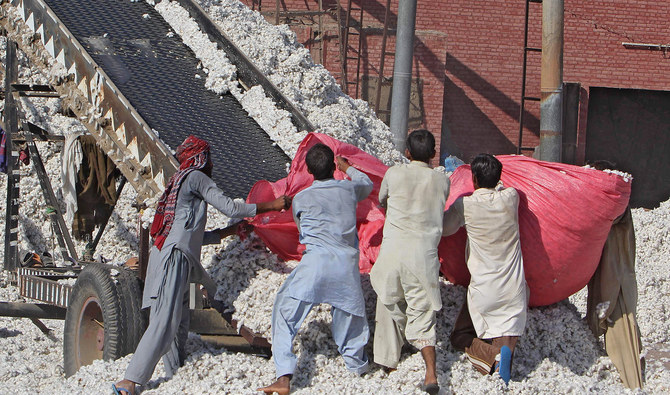
In this photograph taken on February 24, 2016, Pakistani workers process freshly picked cotton at a factory at Khanewal in the central province of Punjab. (AFP/File)
Short Url
Updated 25 November 2021
Follow

Central bank says Pakistan must address structural impediments to sustain growth

  • The State Bank of Pakistan predicts strong remittance inflows amid global economic recovery in its annual report
  • The central bank maintains the current account deficit is projected to be within the range of 2 to 3 percent of the GDP during FY22

KARACHI: Pakistan’s central bank said on Wednesday the country must address structural impediments to sustain its current economic momentum and reach a growth rate between 4 to 5 percent.

In its annual report, The State of Pakistan's Economy 2020-21, the bank reiterated its growth projection between 4 and 5 percent against the target of 4.8 percent on the back of the continued recovery momentum.

The report maintained it was crucial to deal with the structural impediments for sustainable economic expansion in the country.

“These impediments include consistent decline in the yield of important crops (especially cotton); insufficient export coverage of imports, low and declining productivity of labor, stagnant tax-to-GDP ratio; anemic investment-to-GDP ratio; and the rising fiscal burden of the power sector,” the State Bank of Pakistan (SBP) said.

The report maintained the national inflation rate was expected to remain within a range of 7 to 9 percent during the current fiscal year.

“The headline inflation is expected to retreat more visibly in the second half of the year, with the phasing out of the base impact of the hike in power tariffs,” the bank said, adding: “These projections are subject to multiple upside risks, including from a greater-than-anticipated increase in global commodity prices and upward revision in utility tariffs.”

“In addition to triggering a sharp increase in domestic prices, these developments may also give rise to significant second-round impacts on inflation,” said the SBP report.

According to the Federal Bureau of Statistics, inflation in Pakistan went up to 9.2 percent in October 2021 as compared to 8.9 percent in October 2020.

The SBP also envisaged the fiscal deficit within a range of 6.3 to 7.3 percent of the GDP for FY22.

“In the fiscal sector, the government plans to continue with the adjustment measures, which are projected to reduce the deficit to 6.3 percent of the GDP, from 7.1 percent in FY21,” the report added.

In the external sector, pressures are emerging from the import side, with payments exceeding $6 billion in recent months. The surge in imports is broad-based, partly reflecting the increasing pace of economic activity in the country.

“A part of the expansion in the import payments is projected to be financed through a consistent increase in the workers’ remittances and export receipts,” the central bank said. “Particularly, remittances are expected to remain upbeat amid the recovery in the global economy.”

The SBP maintained the current account deficit was projected to be within the range of 2 to 3 percent of the GDP during FY22.

It added the outlook of financial flows was likely to remain conducive on the back of the $3.8 billion already received from the global special drawing rights allocations and Eurobonds, along with further loan disbursements from multilateral and bilateral creditors, and inflows into the Roshan Digital Accounts.


Islamabad, Tehran to extend electricity supply agreement for Pakistan’s southwest

Updated 4 sec ago
Follow

Islamabad, Tehran to extend electricity supply agreement for Pakistan’s southwest

  • Tariffs to remain between 7.7–11.45 cents/kWh as Islamabad seeks stability for energy-short border regions
  • Iran currently powers Gwadar and other border towns where Pakistan’s national grid remains limited

ISLAMABAD: Pakistan and Iran have agreed to extend their cross-border electricity supply pact for the southwestern province of Balochistan, maintaining tariffs between 7.7 and 11.45 cents per kilowatt-hour, Pakistan’s energy ministry said on Tuesday.

The deal, first signed in 2002, underpins energy security for parts of southwestern Pakistan where the national grid remains underdeveloped and erratic supply has hampered both industry and residential consumption. Coastal towns like Gwadar and nearby Mand Town in Balochistan have for years relied on imported Iranian power as connectivity with Pakistan’s main transmission network is incomplete and local generation insufficient.

Iran currently exports 100 megawatts of electricity to Gwadar under a March 2023 agreement and could scale up deliveries once additional infrastructure is operational. In May 2023, Prime Minister Shehbaz Sharif and Iranian President Ebrahim Raisi jointly inaugurated the Polan–Gabd transmission line to enable another 100 MW of supply.

Energy ministry spokesperson Zafar Yab Khan confirmed the extension of the deal, saying it had been moved forward between the two governments.

“Yes, it is correct,” he told Arab News, adding that the revised agreement was expected to be placed before Pakistan’s Economic Coordination Committee (ECC).

However, the ECC, Pakistan’s top economic decision-making forum, did not take up the extension in its meeting on Tuesday.

Power trade between Iran and Pakistan has expanded gradually over two decades, with tariffs negotiated periodically to reflect fuel costs and cross-border infrastructure upgrades. In August 2023, the ECC approved amendments to a separate contract extending a 104-MW supply from Iran’s Jakigur district into Pakistan’s Mand town through December 2024.

Gwadar, a key node in the China-Pakistan Economic Corridor (CPEC), is expected to remain dependent on imported electricity until new domestic lines are completed, making continued Iranian supply critical for industries, port operations and basic household demand.