

Tehran ‘stepping up hate campaign’ against Baha’i minority

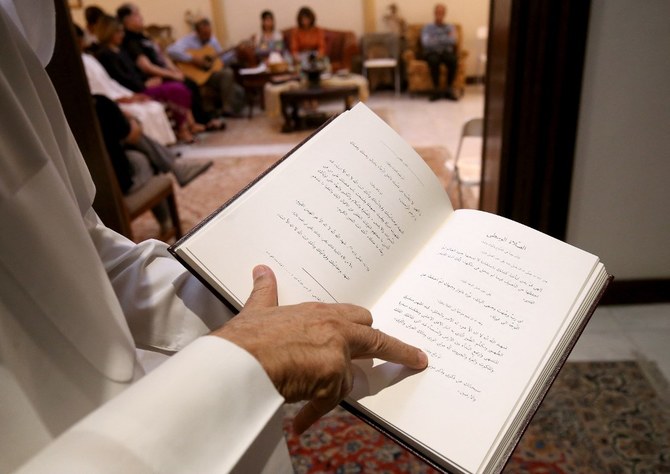
The religious group was founded in the mid-19th century and there are sizable communities in the US, Africa and the Middle East including Kuwait, above. (AFP)
Short Url
Updated 24 November 2021
Follow

Tehran ‘stepping up hate campaign’ against Baha’i minority

  • Resolution introduced in US House of Representatives slams state-sponsored persecution
  • Baha’is are the largest non-Muslim religious minority in Iran

CHICAGO: The Iranian regime has sanctioned a “campaign of hate” to fuel public animosity against the country’s Baha’i religious community, Baha’i officials told Arab News.

Anthony Vance, Baha’i public affairs director in the US, said Iran has adopted laws that target its 300,000 Baha’is, barring them from universities and public sector employment, as well as confiscating their property and arresting their leaders.

The religious group was founded in the mid-19th century in what was then Persia, and now has about 8 million followers worldwide.

More than 2 million Baha’is live in India, and there are sizable communities in the Middle East, Africa and the US.

“After the 1979 revolution, between 1979 and 1992, over 200 Baha’is were executed, killed in Iran, mostly by execution. Most were elected members of the (Baha’i) administration institutions. It’s clear that the (Iranian) regime was targeting those whom they perceived to be the leadership of the Baha’i community,” Vance said.

“Baha’is are barred from university education. They’re barred from employment in the public sector, by the government that is, or in government-owned entities. Given that the public sector makes up more than half of the Iranian economy, that’s quite a disadvantage in that society,” he added.

“There are genuine efforts to impoverish the Baha’i community. There have been confiscations of Baha’i property, several thousands since the revolution. But more recently, there have been attempts to make it a normal, legal attempt in the country. Just to illustrate, last year there were two appellate court decisions to affirm the lower court in the province of Mazid Darran that said the Baha’is were ritually unclean and don’t have any right to own property.”

Vance said persecution by Iran “is quite systematic” and has prevented the Baha’i community from growing in recent years.

The Baha’is are the largest non-Muslim religious minority in Iran. The religion’s principle founder, a merchant who adopted the name Bab (“The Gate“), was executed in 1850 after he began preaching that another prophet similar to Jesus and Mohammed would appear. Persecution increased under the ayatollahs following the 1979 revolution.

Vance said Baha’is respect and recognize the importance of the Christian and Muslim traditions, and it is a monotheistic religion.

Persecution of Baha’is by Iran was the focus of a resolution introduced on Oct. 25 in the US House of Representatives, which condemned Tehran’s state-sponsored persecution of the community. There are more than 180,000 Baha’is in the US, Vance said.

The resolution called on Tehran to immediately release imprisoned or detained Baha’is and all other prisoners held solely on account of their religion; to end the campaign of hate propaganda against the Baha’is; and to reverse state-imposed policies denying them and members of other religious minorities equal opportunities to higher education, earning a livelihood, due process under the law, and the free exercise of religious practices.

It also calls on US President Joe Biden and Secretary of State Antony Blinken to condemn the Iranian regime’s continued violation of human rights and demand the immediate release of prisoners held solely on account of their religion.

The resolution, introduced by Florida Democrat Ted Deutch and supported by a bipartisan group, also calls for sanctions on Iranian regime officials over human rights abuses against the Baha’i community.

Vance praised support from the governments of Bahrain, the UAE and Saudi Arabia, where there are small Baha’i populations.


Trump claims Iran working on missiles that could hit US

Updated 31 min 14 sec ago
Follow

Trump claims Iran working on missiles that could hit US

  • Trump says his preference is diplomacy, but would never allow Tehran to have a nuclear weapon

WASHINGTON: US President Donald Trump on Tuesday claimed Iran is seeking to develop missiles that can strike the United States and accused Tehran of working to rebuild a nuclear program that was targeted by American strikes last year.

The United States and Iran are engaged in high-stakes negotiations over Iran’s atomic program and other issues including missiles, with Trump saying he prefers diplomacy but is willing to use force if talks fail.

“They’ve already developed missiles that can threaten Europe and our bases overseas, and they’re working to build missiles that will soon reach the United States of America,” Trump said during his State of the Union address.

In 2025, the US Defense Intelligence Agency said Iran could potentially develop a militarily viable intercontinental ballistic missile by 2035 “should Tehran decide to pursue the capability,” but did not say if it had made such a decision.

Tehran currently possesses short- and medium-range ballistic missiles with ranges that top out at about 1,850 miles (3,000 kilometers), according to the US Congressional Research Service.

The continental United States is more than 6,000 miles from Iran’s western tip.

Washington and Tehran have concluded two rounds of talks aimed at reaching a deal on Iran’s nuclear program to replace the agreement that Trump tore up during his first term in office.

 ‘Preference’ is diplomacy

The United States has repeatedly called for zero uranium enrichment by Iran but has also sought to address its ballistic missile program and support for armed groups in the region — demands Iran has rejected.

Iran has also repeatedly rejected that it is pursuing nuclear weapons.

Trump ordered strikes on three Iranian nuclear sites last year, claiming afterward that Tehran’s atomic program was obliterated.

On Tuesday, he said Iran wants “to start all over again,” and that it is “at this moment again pursuing their sinister nuclear ambitions.”

Trump has sent a massive US military force to the Middle East, deploying two aircraft carriers as well as more than a dozen other ships, a large number of warplanes and other assets to the region.

He has repeatedly threatened to strike Iran if negotiations fail to reach a new agreement. Talks with Tehran are currently set to continue on Thursday.

“My preference is to solve this problem through diplomacy but one thing is certain: I will never allow the world’s number one sponsor of terror, which they are by far, to have a nuclear weapon,” Trump said.

The US president’s speech primarily focused on domestic issues, making no mention at all of China — Washington’s primary military and economic rival — and only briefly referring to Russia.

Trump said he was working to end the bloody conflict between Russia and Ukraine, and repeated his inaccurate claim that he had brought eight other wars to an end since returning to office in January 2025.

He also hailed NATO’s decision to spend five percent of gross domestic product on defense — a move made under heavy pressure from Trump and his administration.