

Jordan’s king calls for stepping up efforts on Palestinian two-state solution in UAE during Gulf tour

1 / 2
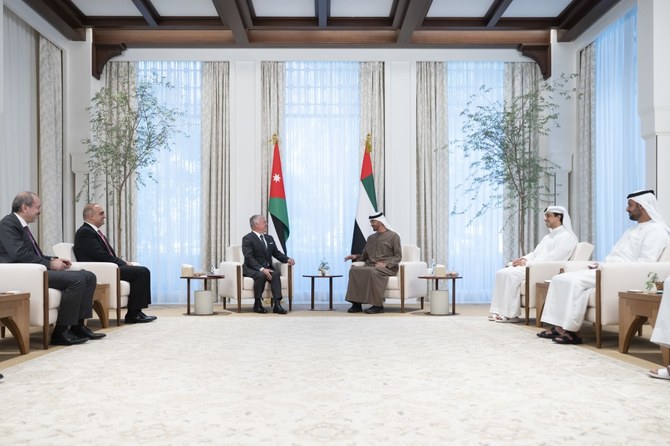
Abu Dhabi Crown Prince Sheikh Mohammed bin Zayed receives Jordan’s King Abdullah II. (WAM)
2 / 2
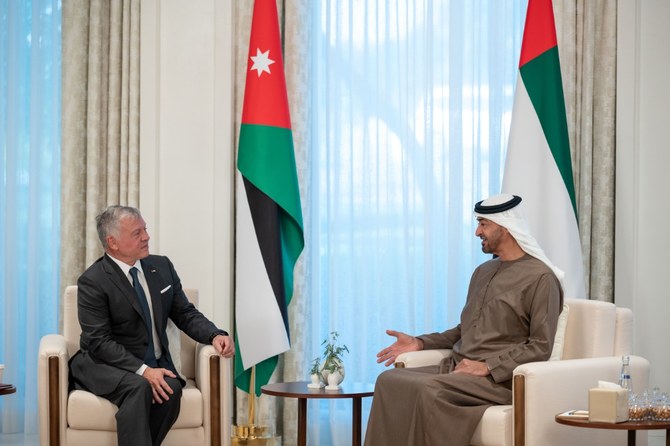
Abu Dhabi Crown Prince Sheikh Mohammed bin Zayed receives Jordan’s King Abdullah II. (WAM)
Short Url
Updated 24 November 2021
Follow

Jordan’s king calls for stepping up efforts on Palestinian two-state solution in UAE during Gulf tour

LONDON: Jordan’s King Abdullah II emphasized the need to step up efforts to reach a just and comprehensive peace on the basis of the two-state solution in the Palestinian issue.
His comments came during a meeting with Abu Dhabi Crown Prince Sheikh Mohammed bin Zayed at Al-Shati Palace in the UAE capital.
Sheikh Mohammed affirmed the depth of relations between the UAE and Jordan at all levels during the meeting.
The two sides “reviewed various aspects of bilateral relations and ways to develop and push them forward during the coming period,” state news agency WAM reported.

They also exchanged views on regional and international developments, especially the situation in the Middle East.
Discussing developments in Syria, King Abdullah reiterated his country’s support for efforts to safeguard Syrian sovereignty, stability, territorial integrity, and the unity of its people, Petra news agency said.
The two sides affirmed the need for continuous coordination and consultation on ways to strengthen development partnerships and provide solutions to ongoing problems and challenges faced by the region.
King Abdullah left the UAE later on Tuesday. He was in Bahrain a day earlier where he met with the kingdom’s rulers. 


In major policy shift on Syria, UN Security Council lifts sanctions on Hayat Tahrir Al-Sham

Updated 28 February 2026
Follow

In major policy shift on Syria, UN Security Council lifts sanctions on Hayat Tahrir Al-Sham

  • Move reflects evolving Syrian political landscape in the post-Assad era, ending a global freeze on assets, travel ban and arms embargo

NEW YORK CITY: The UN Security Council on Friday removed Al-Nusra Front, the militant group that evolved into Hayat Tahrir Al-Sham, from its so-called Daesh and Al-Qaeda Sanctions List.

The move signals a major shift in international policy toward Syria’s evolving political landscape in the post-Assad era, and ends a global freeze on assets, travel ban and arms embargo that have been imposed on the group since 2014.

Al-Nusra Front and Hayat Tahrir Al-Sham were led by Ahmad Al-Sharaa, formerly Abu Mohammed Al-Julani, who is now Syria’s president and was a leading figure in the offensive that toppled the Assad regime.

The consensus decision by the Security Council’s sanctions committee was announced by the UK, which holds the presidency of the Security Council this month and was acting in the absence of the chair of the committee. It followed a request by the new Syrian authorities to delist “Al-Nusrah Front for the People of the Levant.”

The decision means measures that were applied to Hayat Tahrir Al-Sham under Security Council Resolution 2734, adopted in 2024, no longer apply. As a result, UN member states are notrequired to freeze the group’s funds, restrict the movement of its representatives, or block the supply or transfer of arms and related materiel.

Al-Nusra Front was added to the sanctions list for its ties to Al-Qaeda and involvement in the financing and execution of militant activities during the war in Syria. The UN initially continued to treat the group’s successor organization, Hayat Tahrir Al-Sham, as a listed alias.

Al-Sharaa has said the group severed all prior transnational jihadist links and is now solely focused on local Syrian matters.