
BEIRUT: President Michel Aoun has urged the Lebanese not to “drown in despair and to trust their state and take part in the next parliamentary elections.”
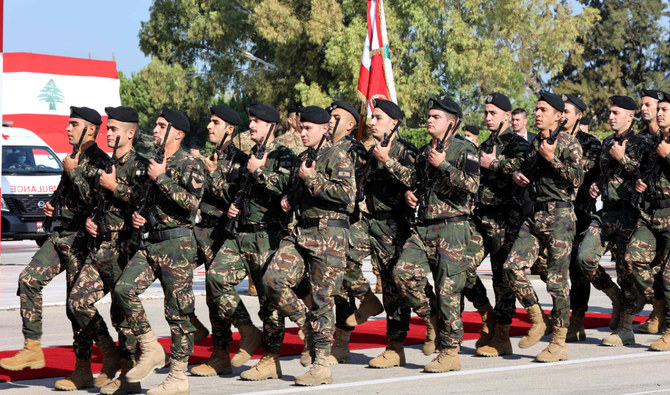
His remarks came as Lebanon celebrated its 78th Independence Day on Monday with a dull symbolic military parade at the Defense Ministry.
Meanwhile, civil society celebrated the day with a powerful and crowded gathering near the Beirut port where the massive blast that shook the city took place on Aug. 4, 2020.
In his televised speech on the eve of the Independence Day, Aoun indicated that the way out of the current government crisis was “not that difficult.”
Aoun said the solution would be to commit to the constitution, which required “the separation of powers.”
On Sunday night, the Culture Ministry lit up the national museum’s building with the Lebanese flag’s colors.
The traditional reception that usually takes place at the presidential palace was not held this year due to the current situation in Lebanon and the circumstances brought about by the coronavirus.
The impact of the political and economic crises were clear — whether through the dull presence of President Aoun, Parliament Speaker Nabih Berri and PM Najib Mikati at the military parade, or the sad statements delivered by some politicians and even diplomats.
The symbolic civil show that was held near the port reflected people’s suffering and unrest due to the disasters that have hit the Lebanese.
The US Embassy in Lebanon simply tweeted a picture featuring a natural scene from a Lebanese region and wrote: “May we celebrate Independence Day in better conditions.”
French Ambassador to Lebanon Anne Grillo extended wishes in a tweet “for a Lebanon that is sovereign and united to overcome the challenges it faces today. A nation and a country that stem from the Lebanese’ strong attachment to living together in an open, free and pluralistic country.”
Grillo, whose country has led an initiative to solve the Lebanese crisis, said that “France stands beside the Lebanese population that is committed with determination, talent and courage to building the nation they aspire to and deserve.”
“The tragic situation in Lebanon requires all authorities, as well as the political class, to assume their responsibilities without further delay,” she said.
Grillo took part in the symbolic parade held by the army command and with the participation of military units, the General Directorate of the Civil Defense and the Lebanese Red Cross.
Following the parade, Aoun, Berri and Mikati shared the same vehicle and headed to the Baabda presidential palace.
Following their meeting, Berri expressed hope for a better situation.
Mikati said: “We cannot have independence if we are not united, and understanding is key.”
“During our meeting today, we had a serious dialogue and I hope it will be fruitful,” he said.
Regarding the crisis with Gulf countries, notably Saudi Arabia, President Aoun said: “Lebanon seeks to establish the best relations with its Arab brothers, and especially the Gulf countries.”
The president hoped “the matter will be resolved soon.”
Aoun, however, did not take any clear position regarding the resignation of Information Minister Georges Kordahi, “based on the need to separate the positions of the Lebanese state and the positions of individuals or groups, specially that the democratic regime in Lebanon guarantees the freedom of opinion and expression.”
This year, Aoun delivered his last speech on that occasion, as his mandate ends in October 2022.
During his speech, Aoun seemed to defend his performance during the past five years of his mandate.
He said that 40 percent of his mandate “passed by without a government, as the formation process was hindered due to artificial obstacles and clashes, which delayed reforms and exacerbated crises.”
Aoun highlighted the “army’s role in assuming responsibility in preserving Lebanon’s stability and security, despite the impacts of the economic crises on the army.”
Former minister May Chidiac commented on the parade: “The symbolism of independence does not lay in a symbolic parade, while Lebanon is actually a nation in captivity, with Hezbollah and its branches controlling its sovereignty and confiscating its role. The people of Lebanon have been humiliated enough because of your false promises.”
Civil society marked the day with a vibrant and powerful show in the square across from the port and not the Martyrs’ Square, where they celebrated that day two years ago.
Participants raised the Lebanese flag and signs that read: “We will bring our country back,” “We will rise from the darkness,” “Lebanon is our home” and “We refuse to leave.”
The parade this year reflected the repercussions of the port explosion and the economic and political crises.
The slogans of the symbolic march focused on the “people, army, and judicial system to stress the importance of building a state of law, away from political interference.”
Among those who took part in the civil show were the families of those who were abducted or went missing during the devastating civil war, and whose fate remains unknown 31 years after the war ended.
The families of the victims of the Beirut blast also took part, fearing the truth would never come out and that those responsible for the crime would go unpunished due to political interference in the judiciary.
Mothers, children, college students, organizations, journalists, engineers, lawyers, doctors, fire fighters and volunteers also took part in the civil parade.
Participants placed a large iron sculpture of the Lebanese flag across the port, next to the “Torch of the Revolution” and the “Hammer of Justice” sculptures, as a reminder that “we shall never forget.”
Google celebrated the day by displaying the Lebanese flag on its homepage.