Pakistan’s opposition alliance hints at anti-government ‘long march’ next year

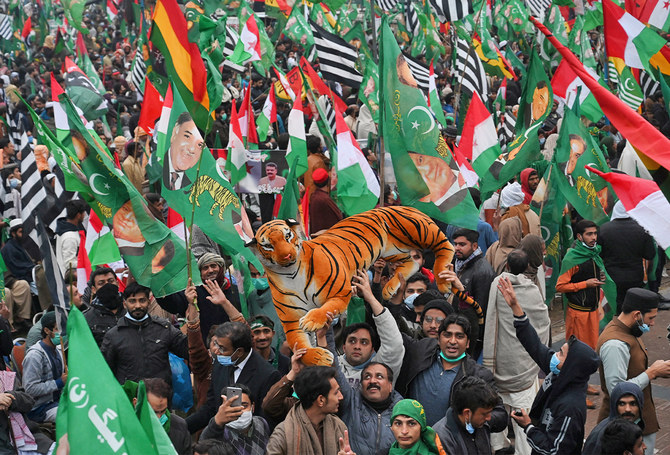
Supporters of Pakistan Democratic Movement (PDM) gather during an anti-government rally in Lahore, Pakistan, on December 13, 2020. (AFP/File)
Short Url
Updated 23 November 2021
Follow

Pakistan’s opposition alliance hints at anti-government ‘long march’ next year

  • Top Pakistan Democratic Movement leaders will consider various options to bring down the government before finalizing their strategy on Tuesday
  • The PDM has been struggling to oust Prime Minister Imran Khan since September 2020 when the alliance was formed

ISLAMABAD: A Pakistani opposition alliance said on Monday it was finalizing its anti-government protest strategy including a long-march on Islamabad along with shutter-down and wheel-jam strikes across the country to oust the government.
A steering committee of the Pakistan Democratic Movement (PDM), an alliance of some nine opposition parties, has prepared suggestions and proposals for the movement which would be presented to a meeting of the heads of its component parties on Tuesday.
The opposition parties have been struggling to oust Prime Minister Imran Khan since September 2020 when they formed the PDM alliance and launched their anti-government campaign.
Khan’s party won the July 2018 general elections in Pakistan, though the opposition has always maintained that the electoral contest was rigged and manipulated.
However, the government vehemently denies the charge.
“A long-march [on Islamabad] can be held in March while a sit-in also remains one of the options,” Hafiz Hamdullah, a PDM spokesperson, told reporters after a four-hour steering committee meeting held in the federal capital.
The opposition parties have already been holding mass gatherings in different cities of the country as part of their public mobilization campaign before initiating a “decisive push” against the government next year.
Hamdullah said a public gathering in Lahore, long-march, wheel-jam and shutter-down strikes were on the opposition’s agenda, adding that a high-level PDM meeting on Tuesday would review these suggestions and take the final decision.
He informed it had also been decided in today’s meeting to move the Supreme Court of Pakistan against the recent electoral reforms passed by a joint sitting of parliament.
The government made use of electronic voting machines mandatory in the next general elections through its recent legislation, besides granting voting rights to about nine million overseas Pakistanis.
Referring to a recent audio leak of a former chief justice of the Supreme Court, Hamdullah said questions were being raised over the integrity of the judiciary while the opposition had also expressed their reservations over judicial matters.
“We will play on both the pitches by doing things in and out of parliament,” he said as he responded to a question regarding the possibility of en masse resignations of the opposition members from parliament to bring down the government.
Two major opposition parties, the Pakistan Peoples Party and Awami National Party, previously left the PDM since they did not agree with the alliance’s anti-government strategy.
The Pakistan Muslim League-Nawaz and Jamiat-e-Ulema-e-Islam are now the only two major opposition factions in the PDM alliance.


Pakistan president meets UAE counterpart, explores trade, investment opportunities

Updated 27 January 2026
Follow

Pakistan president meets UAE counterpart, explores trade, investment opportunities

  • Asif Ali Zardari is in UAE on four-day visit to strengthen bilateral ties, review bilateral cooperation
  • Both sides discuss regional, international developments, reaffirm commitment to promote peace

ISLAMABAD: President Asif Ali Zardari met his UAE counterpart Sheikh Mohammed bin Zayed Al-Nahyan in Abu Dhabi on Tuesday during which both sides explored new opportunities in trade, investment, energy and other sectors, Zardari's office said. 

Zardari arrived in Abu Dhabi on Monday evening with a high-level delegation on a four-day official visit to the UAE to review trade, economic and security cooperation. 

"The leaders discussed ways to further deepen the longstanding and brotherly relations between Pakistan and the UAE," a statement from Zardari's office said about his meeting with the UAE president. 

"They reviewed the full spectrum of bilateral cooperation and explored new opportunities in trade, investment, energy, infrastructure, technology, and people-to-people exchanges, highlighting the significant potential for expanding economic and strategic partnership.

Zardari highlighted the significance of Al-Nayhan's visit to Pakistan last month, the statement said, expressing appreciation for the UAE's continued support for strengthening bilateral ties.

It said both sides also exchanged views on a range of regional and international developments, reaffirming their commitment to promoting peace, stability and sustainable development.

The meeting was also attended by Pakistan's First Lady Aseefa Bhutto-Zardari, the Pakistani president's son Bilawal Bhutto-Zardari, who is also the chairman of the Pakistan Peoples Party, Interior Minister Mohsin Naqvi and Pakistan's ambassador to the UAE. 

ZARDARI MEETS AD PORTS CEO

Zardari earlier met AD Ports Group CEO Captain Mohamed Juma Al-Shamisi to discuss the group's investment initiatives in Karachi. 

"Both sides agreed that the expansion and modernization of port infrastructure would strengthen trade flows and support Pakistan’s broader economic development and country’s seaborne trade," the President's Secretariat said in a statement.

It added that Zardari described the AD Ports Group's long-term investment and expanding role in Pakistan's maritime and logistics sector as a key pillar of Pakistan–UAE economic cooperation.

Pakistan and the UAE maintain close political and economic relations, with Abu Dhabi playing a pivotal role in supporting Islamabad during periods of financial stress through deposits, oil facilities and investment commitments. 

The UAE is Pakistan's third-largest trading partner, after China and the United States, and a key destination for Pakistani exports, particularly food, textiles and construction services.

The Gulf state is also home to more than 1.5 million Pakistani expatriates, one of the largest overseas Pakistani communities in the world, who contribute billions of dollars annually in remittances, a crucial source of foreign exchange for Pakistan’s economy.

Beyond trade and labor ties, Pakistan and the UAE have steadily expanded defense and security cooperation over the years, including military training, joint exercises and collaboration in counter-terrorism and regional security matters.