

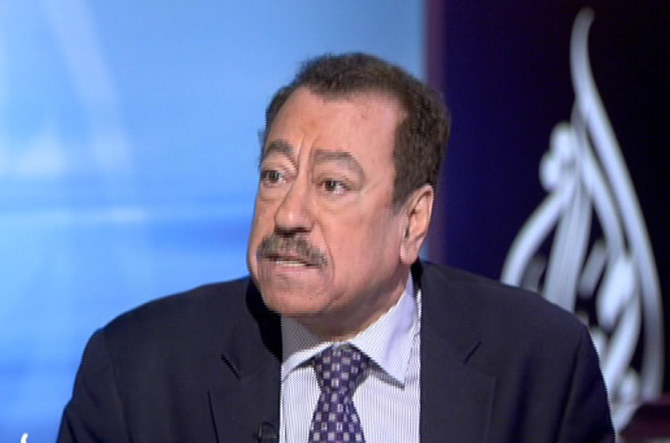

LONDON: Defiant British columnist Abdel Bari Atwan appeared blatantly in contempt of a new British ruling which designated Hamas as an outlawed Palestinian terror group.
Atwan, who is originally Palestinian and came to UK on asylum, said he doesn’t care if his sympathy led him to jail and appeared to making hidden threats to the British government.
“You are fueling our misery, you are fueling our anger. Shame on you, as Brits you created the Palestinian crisis, the Palestinian cause. You are the ones who expelled us from our land. You are the one who issued the Balfour Declaration,” Atwan said in his video response to the law.
“Welcome to terrorism,” he added.
The law was passed yesterday by Home Secretary Priti Patel who said “Hamas has significant terrorist capability, including access to extensive and sophisticated weaponry, as well as terrorist training facilities.”
The organisation would be banned under the Terrorism Act and anyone expressing support for Hamas, flying its flag or arranging meetings for the organisation would be in breach of the law, the interior ministry confirmed. Patel is expected to present the change to parliament next week.
“I swear I wrote my will, I swear I am ready for this and know I am going to end up in prison,” the British-Palestinian editor wrote.
Known for his editorship of the London-based Al Quds Al Arabi newspaper, Atwan is now owner and publisher of the Rai Al Yawm website, which mainly revolves around his own controversial views regularly shared on YouTube.
A long time resident of London, he is well known within Arab media circles. Having made his name working for the leading, moderate Saudi-owned Asharq Al Awsat before leaving to work at Al Quds. He is a regular commentator on Arab affairs on several British television and radio programs, and is often a guest on both main English language and Arabic services of BBC.
While it is true that he is respected and idolized by some, Atwan’s views also made him many critics — particularly when comparing what he says in English versus what he argues in Arabic.
Indeed, many observers criticized what they called the “Abdel Bari Atwan Syndrome” in the post 9/11 era. This was to indicate that he used to make anti-Al-Qaeda statements in English language media, but refer to the late terrorist leader Osama bin Laden as a “Sheikh” and a a resistance fighter during his repeated appearances on channels such as Al Jazeera Arabic.
He once told Egypt’s ONtv TV channel in 2013 that bin Laden was “half a terrorist,” since his organization’s attacks against US forces in Saudi Arabia could not be considered terrorism.
“If you support the Palestinian resistance, you do not consider [Bin Laden’s attacks] terrorism. But if you are with America, Europe, and Israel, you do consider it terrorism,” Atwan said, adding that “It depends on your definition of terrorism.”
On another occasion Atwan said on Lebanese TV that if Iran attacked Israel he would “go to Trafalgar Square and dance with delight.”
More recently Atwan told Lebanese Hezbollah-affiliated news channel Al-Mayadeen that “They [Israel] know very well that what happened in Kabul Airport will repeat itself at Ben Gurion Airport,” before adding that they “should listen to the advice of [Hezbollah Secretary General] Hassan Nasrallah and start learning how to swim, because their only option will be Cyprus, their only option will be the Mediterranean Sea.”
Atwan wasn’t immediately available to comment, however, one former colleague of his at Asharq Al Awsat said “it was always a shame to see such a rare editorial talent being wasted in voicing support to terror groups.”
“There is nothing wrong with calling for resisting occupation or the liberation of occupied Palestinian lands, but to endorse a designated terror group that deliberately fires missiles at innocent women and children is neither resistance nor journalism. Someone of his fine calibre should know better,” the former colleague concluded.


