

Historic development: Afghanistan’s disappearing box cameras

1 / 3
In this photo taken on October 13, 2021, Afghan photographer Haji Mirzaman (R) stands next to his homemade wooden box camera. (AFP)
2 / 3
Afghan photographer Haji Mirzaman shows a processed photograph taken with his homemade wooden box camera, known as a "kamra-e-faoree", at a photography shop in Kabul. (AFP)
3 / 3
Afghan photographer Haji Mirzaman poses for a picture next to his camera at his home in Kabul. (AFP)
Short Url
Updated 20 November 2021
Follow

Historic development: Afghanistan’s disappearing box cameras

  • The golden age of box cameras in Afghanistan came when compulsory national service was introduced in the 1950s, meaning thousands of recruits needed photos for military identity cards

KABUL: Haji Mirzaman was just a teenager when he started taking photos using a homemade wooden box camera in his cousin's studio in downtown Kabul.
He took black-and-white portraits of people for passports, identity cards and other documents using his "magic box" on a sidewalk, producing prints in a couple of minutes.
Now in his 70s, he says the instant camera -- or "kamra-e-faoree" as it is known in Dari -- has survived wars, invasions and a Taliban ban on photography, but is now in danger of disappearing because of digital technology.
"These cameras are retired now," he told AFP at his small house in Kabul as he set up the box on its wooden tripod.
"I am just keeping this last remaining camera."
The box is both camera and darkroom, and to show how it works Mirzaman put photographic paper and developing liquid inside the device in preparation for a shot.
He then briefly removed the lens cover and instantly created a negative.
Reaching inside the box through a light-proof funnel, he processed the negative and then developed a print.
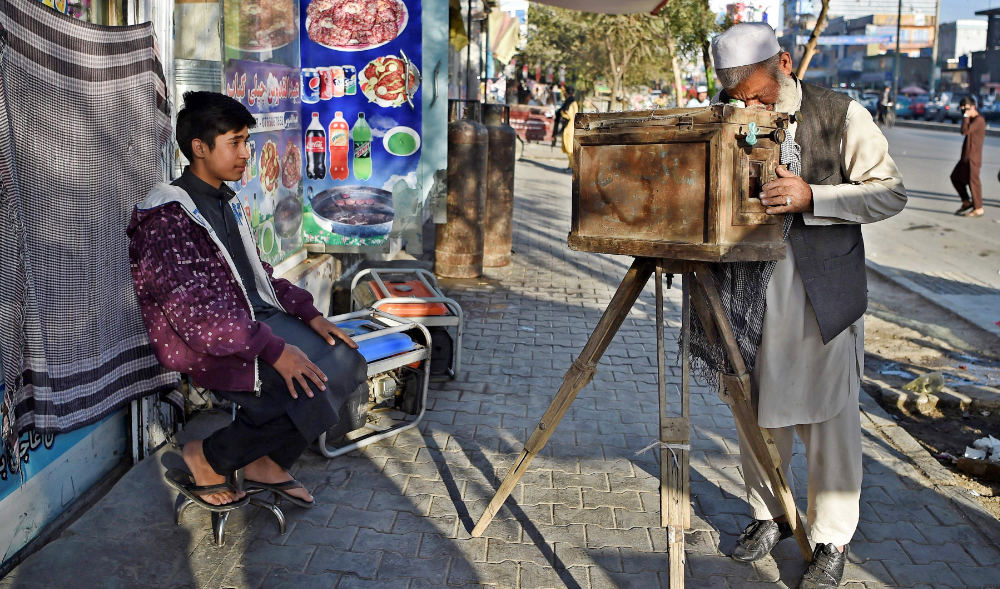


Afghan photographer Haji Mirzaman (R) takes a portrait of a boy with his homemade wooden box camera known as a "kamra-e-faoree" on a sidewalk in Kabul. (AFP)

In a few minutes, the photo was ready.
"Nowadays, photographers all use digital cameras... fewer and fewer people know how this camera works," he said.

The boxes were made by local carpenters, he said, but the lenses were imported.
The golden age of box cameras in Afghanistan came when compulsory national service was introduced in the 1950s, meaning thousands of recruits needed photos for military identity cards.
The Taliban, who ruled Afghanistan from 1996 to 2001 and forbade images of people, allowed Mirzaman to take official photos with his box camera.
After the group's ouster, the machines thrived again when millions of students returned to schools and ID cards were made compulsory.
Since their return to power in August, the hardline Islamists have made no public declaration on taking pictures -- and young fighters are frequently seen snapping photos of each other, or selfies, with their mobile phones.
Mirzaman has taught all four of his sons photography, but none now uses box cameras.
The family's last remaining kamra-e-faoree is now on display outside their studio -- a striking reminder of Afghanistan's photographic history.


Thai coffee chains cut default sugar content in coffee and tea drinks in a new health push

Updated 11 February 2026
Follow

Thai coffee chains cut default sugar content in coffee and tea drinks in a new health push

  • The Health Department says Thais consume 21 teaspoons of sugar daily, far exceeding the World Health Organization’s recommended six teaspoons
  • Officials warn this increases obesity and diabetes risks. A survey found iced coffee and bubble tea contain high sugar levels

BANGKOK: For many Thais, a meal doesn’t feel complete without an iced coffee or tea so sugary it could pass for dessert. The government, concerned about the health consequences, wants them to dial it back.
Starting Wednesday, nine major coffee chains across the country have pledged to cut the default sugar content in some of their drinks by half in a government initiative aimed at tackling excessive sugar consumption.
According to the Health Department, Thais consume an average of 21 teaspoons of sugar per day, more than three times the World Health Organization’s recommended limit of six teaspoons. Health officials warn that such high intake increases the risk of obesity, diabetes and other diseases.
The initiative is the first significant step to change consumers’ sugar consumption behavior, said Amporn Benjaponpitak, the director general of the department.
Pakorn Tungkasereerak, the department’s deputy, said 2025 data show that about 45 percent of Thais aged 15 and older are obese, while 10 percent of the population has diabetes.
A survey by the Bureau of Nutrition found that a 22-ounce (650-milliliter) iced coffee contains an average of nine teaspoons of sugar, while a 10-ounce (300-milliliter) serving of bubble milk tea — an iced milk tea with tapioca pearls known as boba — can contain as much as 12 teaspoons.
Sirinya Kuiklang, an office worker, said she approves of the changes. She already orders her drinks at just 25 percent of the standard sugar level, but she is aware that many others consume too much sugar.
“It’s good for Thai people,” she said.
Another office worker, Porwares Tantikanpanit, said he has enjoyed his non-coffee beverages at their current sugar levels but is willing to adjust if shops reduce the sweetness.
However, putting the policy into practice may prove challenging. Officials have said each brand can apply the initiative as they see fit.
Some customers have expressed confusion in response to social media posts promoting the initiative, asking how to order drinks with the level of sweetness that they prefer. Several brands said that the reduction applies only to certain menu items.