

Pakistan central bank lifts key policy rate to 8.75% amid surging inflation

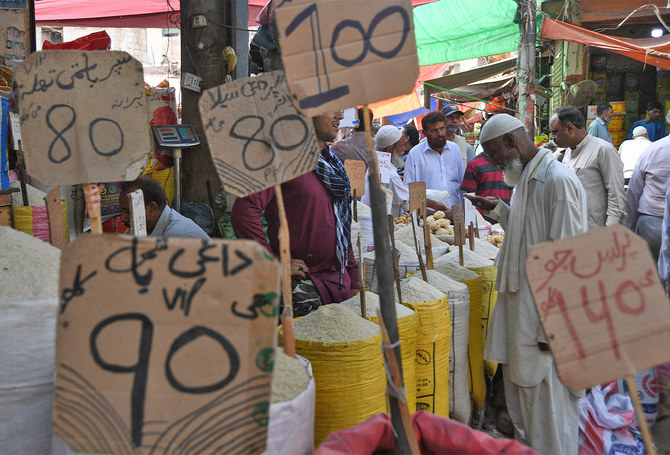
In this picture taken on April 5, 2019, Pakistani customers buy grocery items at a market in Karachi, Pakistan. (AFP/File)
Short Url
Updated 20 November 2021
Follow

Pakistan central bank lifts key policy rate to 8.75% amid surging inflation

  • SBP says inflationary pressures have increased considerably with headline inflation rising to 9.2% in October
  • Rate hike comes as Pakistan is in negotiations with the International Monetary Fund over a $6 billion loan program

KARACHI: Pakistan's central bank on Friday hiked its key policy rate by 150 basis points to 8.75%, citing risks related to surging inflation and the balance of payments.
Pakistan's current account deficit has swollen to $1.66 billion in October from $1.13 billion in September due to a moderate decline in exports, remittance inflows and some uptick in service imports.

Increased energy prices have kept the import bill high despite a downtick in non-energy imports, according to State Bank of Pakistan (SBP) data released ahead of the monetary policy statement. The current deficit for FY22 is expected to exceed previous forecasts of 2-3 percent of gross domestic product.
“The Monetary Policy Committee (MPC) decided to raise the policy rate by 150 basis points to 8.75 percent,” SBP said. “This reflected the MPC’s view that since the last meeting, risks related to inflation and the balance of payments have increased while the outlook for growth has continued to improve."

As the Monetary Policy Committee meeting was previously scheduled for Nov. 26, the central bank said it took place earlier "in light of recent unforeseen developments that have affected the outlook for inflation and the balance of payments, and to help reduce the uncertainty about monetary settings prevailing in the market." 
The SBP said inflationary pressures have increased considerably with headline inflation rising from 8.4% (yoy) in August to 9% in September and further to 9.2% in October, mainly driven by higher energy costs and a rise in core inflation.  

"With respect to the balance of payments, the current account deficits in September and October have been larger than anticipated, reflecting both rising oil and commodity prices and buoyant domestic demand," the central bank said. "The burden of adjusting to these external pressures has largely fallen on the rupee."

The decisions come as the South Asian nation is in negotiations with the International Monetary Fund (IMF) over a $6 billion loan program.
"Falling foreign exchange reserves, higher current account deficit, inflationary pressure and obviously pending IMF deal could be possible reasons of policy rate hike," Muhammad Sohail, chief executive of Topline Securities, told Arab News.
Khurram Schehzad, chief executive of Alpha Beta Core, a financial advisory platform, said "seems so," when asked whether the hike was related to the country's stalled IMF funding facility talks.

The central bank on Friday also decided to increase the number of annual monetary policy committee meetings from six to eight.

"Massive rate hike in a go, and MPS now going to take place eight times a year than six times earlier," Schehzad said. "What happened to 'gradual' and measured response to markets for a direction, as SBP mentioned earlier in its policy statements?"

The rise of the benchmark interest rate to one and half year high exceeded market expectations.
“Higher than expected rise,” Sohail said, adding the central bank's decision to also raise Cash Reserve Requirement (CRR) by 1% for banks was a surprise move

Most of respondents of a Topline Securities survey expected a rise of between 75 bps and 100bps.


Pakistan to promote mineral sector at Saudi forum this month with 13 companies

Updated 02 January 2026
Follow

Pakistan to promote mineral sector at Saudi forum this month with 13 companies

  • Delegation will take part in the Future Minerals Forum in Riyadh from Jan. 13-15
  • Petroleum minister will lead Pakistan, participate in a 90-minute country session

ISLAMABAD: Around 13 Pakistani state-owned and private companies will attend the Future Minerals Forum (FMF) in Saudi Arabia from Jan. 13 to 15, an official statement said on Friday, as the country seeks to ramp up global engagement to develop its mineral resources.

The FMF is an international conference and investment platform for the mining sector, hosted by mineral-rich countries to attract global investors, companies and governments.

Petroleum Minister Ali Pervaiz Malik confirmed Pakistan’s participation in a meeting with the Saudi envoy, Nawaf bin Said Al-Malki.

Pakistan hosts one of the world’s largest copper-gold zones. The Reko Diq mine in southwestern Balochistan, with an estimated 5.9 billion tons of ore, is partly owned by Barrick Gold, which calls it one of the world’s largest underdeveloped copper-gold deposits. Its development is expected to boost Pakistan’s struggling economy.

“Upon an invitation of the Government of the Kingdom of Saudi Arabia, the Federal Minister informed the Ambassador that Pakistan will fully participate in the upcoming Future Minerals Forum (FMF), scheduled to be held in Riyadh later this month,” Pakistan’s Press Information Department (PID) said in an official statement.

The Pakistani minister will lead his country’s delegation at the FMF and take part in a 90-minute country showcase session titled “Unleashing Potential: Accelerating Pakistan’s Mineral Revolution” along with local and foreign investors.

Pakistan will also establish a dedicated pavilion to highlight the vast potential of its rich geological landscape to the global mineral community.

The Saudi envoy welcomed Pakistan’s decision to participate in the forum and discussed enhancing bilateral cooperation in the minerals and energy sectors during the meeting.

According to the statement, he highlighted the potential for cooperation between Saudi Arabia and Pakistan in the minerals and energy sectors, expressing confidence that the FMF would provide a platform to expand collaboration.
Pakistan’s mineral sector, despite its rich reserves of salt, copper, gold and coal, contributes only 3.2 percent to the country’s GDP and just 0.1 percent to global mineral exports.

However, many countries, including the United States, have shown interest in Pakistan’s underdeveloped mineral sector, particularly in copper, gold and other critical resources.

In October, Pakistan dispatched its first-ever shipment of rare earth and critical minerals to the United States, according to a Chicago-based US public relations firm’s report.