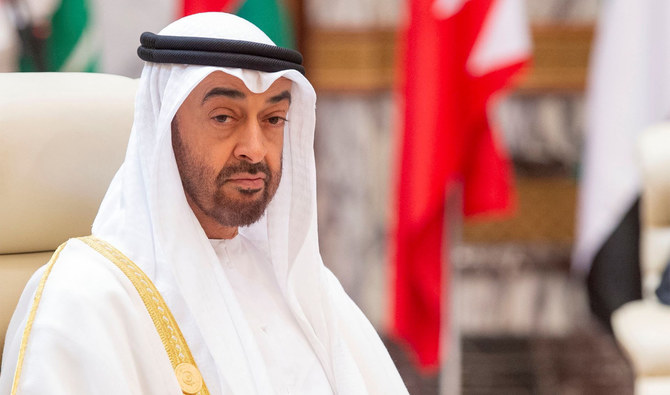

ANKARA: As part of an ongoing reconciliation process, Crown Prince of Abu Dhabi Sheikh Mohammed bin Zayed Al-Nahyan was expected to meet Turkish President Recep Tayyip Erdogan in Turkey over the coming days, marking the highest-level visit to date after years of tensions between the two countries.
A reciprocal trip was also likely to go ahead, while authorities from both nations will meet on Nov. 23 for a business forum in Dubai.
“Such a rapprochement between the UAE and Turkey, this strong cooperation for the resolution of problems, is a good thing,” Turkish ruling Justice and Development Party spokesperson, Omer Celik, recently said, adding that Ankara had a “far-reaching action plan and a frank approach” for resolving regional conflicts.
Experts noted that the visit of the UAE’s de facto ruler would focus on boosting economic and business ties as a first step to building bridges between the two countries.
The UAE’s wealth funds would be offered with possible investment opportunities during the meeting, with energy and defense sectors featuring heavily, a Turkish official, who wished to remain anonymous, said.
A meeting in August between Erdogan and the UAE’s national security adviser, Sheikh Tahnoon bin Zayed Al-Nahyan, was followed by several business deals between the two countries.
The UAE has already made investments in Turkey’s best-known e-commerce firm Trendyol and rapid delivery startup Getir that tripled its valuation to more than $7.5 billion after having expanded since January in Paris, Berlin, London, Amsterdam, and the US.
Soner Cagaptay, director of the Turkish research program at the Washington Institute, told Arab News: “The UAE and its allies, especially Saudi Arabia and Egypt, found Turkey’s recent steps to restrict the Muslim Brotherhood’s activities on Turkish soil as very positive signals because they consider the MB as the greatest domestic and external security threat.”
As part of its regional detente with Egypt, Ankara in March pressed a number of Istanbul-based MB-affiliated opposition channels to tone down their negative coverage of Cairo.
Cagaptay said: “In the meantime, as Turkey and the UAE seek to restore ties, it is not a coincidence that the exiled mafia boss Sedat Peker, believed to be living in the Emirates, took a back step in implicating Turkish rulers for various alleged crimes.
“Although Peker’s allegations should be taken with a pinch of salt, this is a sweetener that the UAE may have offered Turkey to show its sincerity for normalization. Peker’s claims could have been quite damaging for the Turkish government if they continued.
“Turkey wants to jumpstart the economy in order to consolidate Erdogan’s voter base, while the UAE will make a lot of money from the lucrative business opportunities. They will therefore build bridges on a win-win basis,” he added.
The two countries aim to double their bilateral trade volume, which currently stands at around $9 billion.
According to Galip Dalay, an associate fellow at Chatham House and researcher at the University of Oxford, a broader regional strategic picture was evolving with the withdrawal of US President Joe Biden from the region, which had caused unpredictability among regional countries trying to build new alliances.
But he pointed out that Ankara and Abu Dhabi were for now unlikely to discuss challenging issues.
“As there are still some political differences between the UAE and Turkey, having supported opposing sides in the Libyan civil war and the conflicts over the eastern Mediterranean, I expect that the two countries will concentrate their efforts on economic ties rather than taking strategic steps immediately to de-escalate on the political front,” Dalay said.
However, he was skeptical as to how far Turkey would allow Abu Dhabi to go in terms of investment.
“There are some strategic sectors in the defense industry where Turkey may not be willing to permit investment or Ankara may bring some rules and restrictions on critical aspects like know-how transfer,” he added.
He noted that bilateral ties would continue to be tested over geopolitical hotspots such as Libya where compromises on both sides would show whether the recent reconciliation moves were part of a permanent de-escalation of a shorter-term rapprochement.