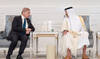
ISLAMABAD: The Saudi-led Digital Cooperation Organization is supporting women's participation in Pakistan's digital economy, DCO Secretary-General Deemah Al-Yahya said on Thursday during her visit to Islamabad.
According to the World Economic Forum, women make up 55 percent of the world’s unbanked population, meaning they have no access to banking or insurance products. The World Bank estimates that in Pakistan, where about 100 million adults have no bank account, only 11 percent women have access to overall financial services.
The DCO was launched by Saudi Arabia in November last year to strengthen cooperation across innovation-driven sectors and accelerate the growth of the digital economy. The organization's founding members are also Bahrain, Jordan, Kuwait, Nigeria, Oman, and Pakistan.
Al-Yahya arrived in Pakistan for meetings with President Dr. Arif Alvi, Foreign Minister Shah Mahmood Qureshi, Information Technology Minister Syed Aminul Haque, and private sector leaders to support the inclusive development of the digital economy and to strengthen the organization's partnerships with Pakistan.
"As female digital inclusion is core to DCO's mandate, I endorse the Pakistan Government’s efforts to enable women to benefit from the digital economy, including through the Digital Pakistan Policy and Universal Access Fund," she told Arab News after her delegation's meeting with the Pakistani president.
"These initiatives are making a real impact through including girls in the technology industry and connecting underserved regional communities to the internet."
In a Twitter post, Al-Yahya shared a photo with students of the COMSATS University Islamabad, saying she was inspired meeting "ambitious young women closing the gender gap in STEM (Science, Technology, Engineering, and Mathematics)."
She has also hosted sessions with Pakistani tech leaders who are developing finance products for the unbanked using mobile technology, and education platforms enabling school students to study online.
"I am delighted to be meeting with young Pakistan entrepreneurs creating digital solutions, and to see innovative IT companies such as including Oraan, Maqsad, and Tez Financial connecting more Pakistanis to the digital economy," Al-Yahya said.
Oraan has recently made headlines for raising $3 million in the largest seed funding closed by a women-led Pakistani startup.
Al-Yahya earlier this week launched with Islamabad officials the Pakistan Innovation Challenge for 1 million students aged six to 18.
"The students will learn maths, computer science, robotics, artificial intelligence, design and innovation online," she said. "If young people don’t have skills, if women are left out, or if entrepreneurs are strangled by bureaucracy, we will all struggle."
As she highlighted the importance of the digital economy in a world where more and more activities are being done online, Al-Yahya said she was privileged to be entrusted by Saudi leadership and DCO member states to lead the organization and "carry forward this major global outreach."
"Seventy percent of the world’s economic growth will be driven by the digital economy over the next decade, so there are enormous opportunities for people, companies and countries in the digital economy," she said.
"The fact that the DCO is headquartered in Riyadh reflects Saudi Arabia’s position as a constructive, collaborative global leader in the new world economy, and I take this same approach when engaging with governments as leader of the DCO."