

UK’s Prince Charles visit to boost Jordan, Egypt ties

1 / 6
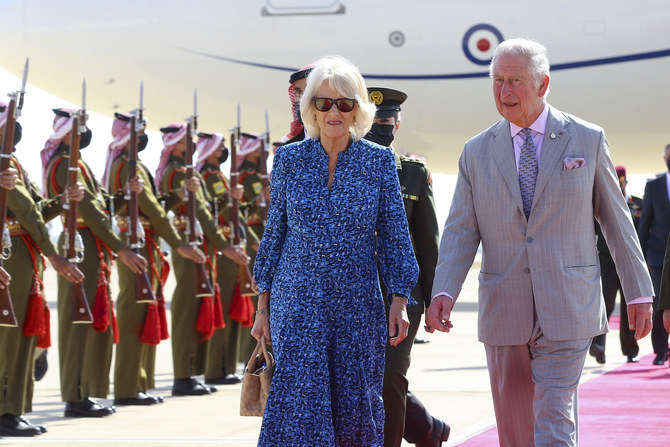
Britain's Prince Charles and his wife Camilla, Duchess of Cornwall, arrive to Amman, Jordan, Tuesday, Nov. 16, 2021, on a four-day tour to Jordan and Egypt. (AP)
2 / 6
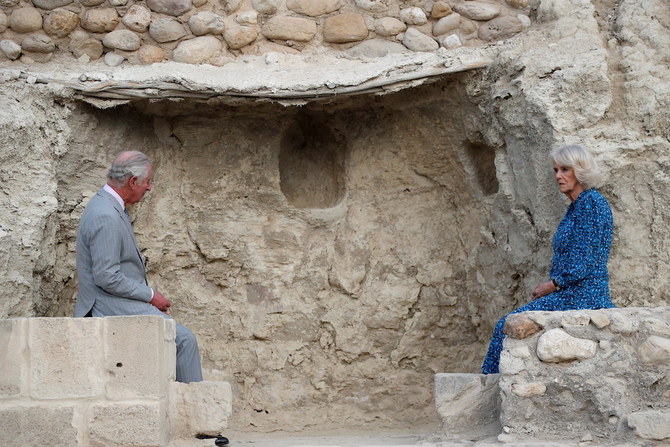
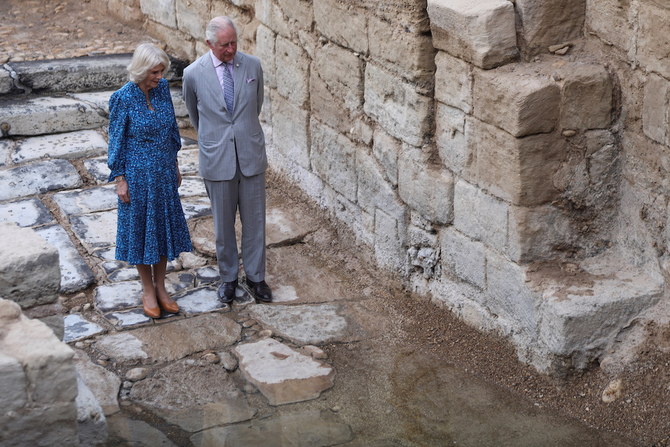
Britain's Prince Charles, Prince of Wales, and Camilla, Duchess of Cornwall, visit Elijah's Hill, near the baptism site along the Jordan River, Jordan Nov. 16, 2021. (Reuters)
3 / 6
Britain's Prince Charles, Prince of Wales, Camilla, Duchess of Cornwall are welcomed by Jordan's King Abdullah II, Queen Rania and Crown Prince Hussein at the Al Husseinnlya Palace, in Amman, Jordan November 16, 2021. (Reuters)
4 / 6
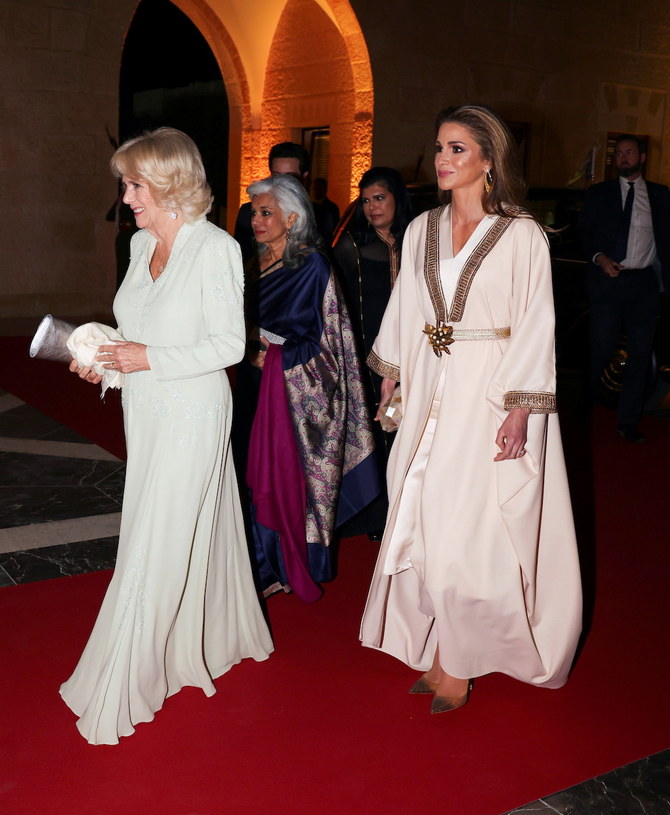
Britain's Camilla, Duchess of Cornwall, walks with Jordan's Queen Rania during a private dinner at the Al Husseiniya Palace, in Amman. (Reuters)
5 / 6
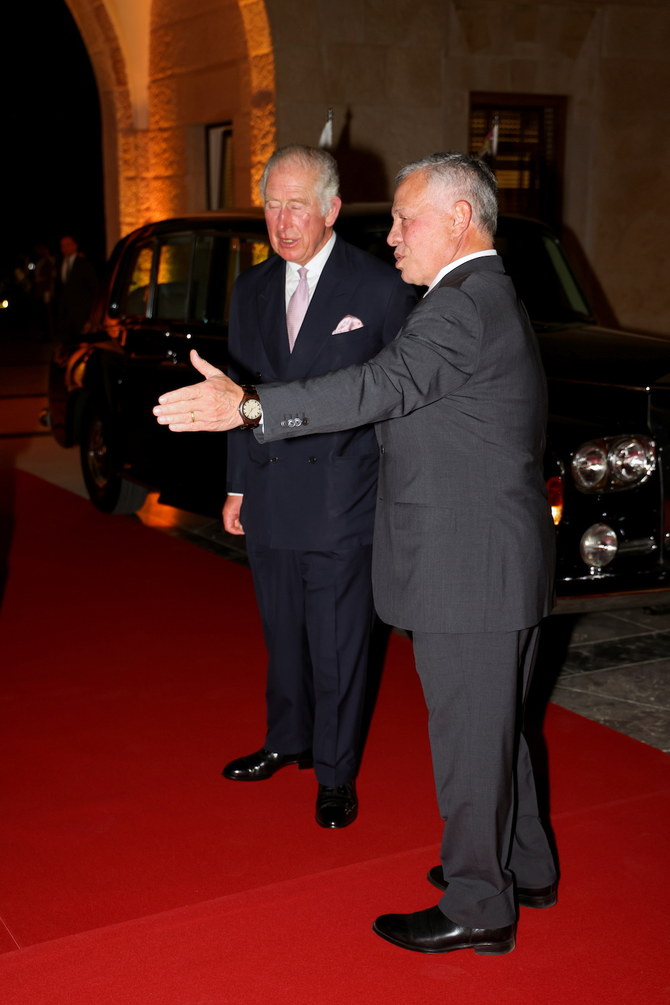
Prince Charles, Prince of Wales, and Jordan's King Abdullah II attend a private dinner at the Al Husseiniya Palace. (Reuters)
6 / 6
Britain's Prince Charles, Prince of Wales, and Camilla, Duchess of Cornwall, visit the baptism site along the Jordan River. (Reuters)
Short Url
Updated 17 November 2021
Follow

UK’s Prince Charles visit to boost Jordan, Egypt ties

  • Prince Charles, 73, and his wife Camilla, 74, were greeted on the tarmac by a Jordanian color guard

LONDON: Britain’s Prince Charles has arrived in the Middle East for a four-day trip to Jordan and Egypt that started on Tuesday, after agreeing with the Queen that the trip must go ahead despite her ill-health.

Charles — the first in line to the throne — is said to have discussed the trip with the queen and agreed with her that the official visit must still go ahead. It is designed to strengthen ties with Egypt and Jordan, both of which have longstanding relationships with Britain.

Queen Elizabeth II, 95, is the UK’s longest-reigning monarch — she has sat on the throne since 1952.

She has reduced her normally packed schedule to “light duties” until the end of the year after spraining her back.

Prince Charles, 73, and his wife Camilla, 74, were greeted on the tarmac by a Jordanian color guard.

They met with Jordan’s King Abdullah II and Queen Rania at the Al-Husseiniya Palace in Amman, where they aimed to build on the longstanding ties between the two royal families.

They were scheduled to visit religious and historical sites during their trip to Jordan before heading to Egypt on Thursday.

The trip will see them carry out over 30 official engagements between them in Jordan and then Egypt.

The British Embassy said last month that the visit was aimed at shoring up “strong bilateral relations” on the centenary of relations between Amman and London.

The royal visit will be putting particular emphasis on combating climate change in the wake of the Glasgow conference, and interfaith tolerance.


UK defense minister suggests Putin’s ‘hidden hand’ behind Iran tactics

Updated 4 sec ago
Follow

UK defense minister suggests Putin’s ‘hidden hand’ behind Iran tactics

LONDON: UK Defense Minister John Healey suggested on Thursday that Russia was influencing Iran’s use of drone attacks in its war with the United States and Israel.
Healey said Russian President Vladimir Putin’s “hidden hand” may be behind some of the tactics deployed by Tehran in the Middle East conflict, which started when the United States and Israel struck Iran on February 28.
He told reporters that officials were analyzing an Iranian-made drone that hit the UK’s Akrotiri air force base in Cyprus on March 1 “for any evidence of Russian or any other foreign components and parts.”
“We will update you and appropriately publish any findings from that when we’ve got them,” he said during a visit to Britain’s military headquarters in Northwood, near London.
“But I think no one will be surprised to believe that Putin’s hidden hand is behind some of the Iranian tactics, potentially some of their capabilities as well, not least because one world leader that is benefiting from the sky high oil prices at the moment is Putin,” he added.
Russia is a close ally of Iran, with the two agreeing last year to help each other counter “common threats.”
US President Donald Trump said Saturday he had no indication Russia was supporting Iran in the war, but that if they were, it was not “helping much.”
Nick Perry, the British military’s chief of joint operations, told Healey there were “definitively” signs of a link between Russia and Iran, including Iran’s use of drones “as learned from the Russians.”
No one was injured when the drone hit a hangar at Akrotiri. British warplanes shot down a further two drones heading for the base the same day.
Guy Foden, a brigadier in the British army, briefed Healey that UK troops based at a military base housing international coalition troops in Irbil, Iraq, had helped shoot down two Iranian drones on Wednesday.