

Residents call for action as Pakistan's Lahore becomes world's most polluted city

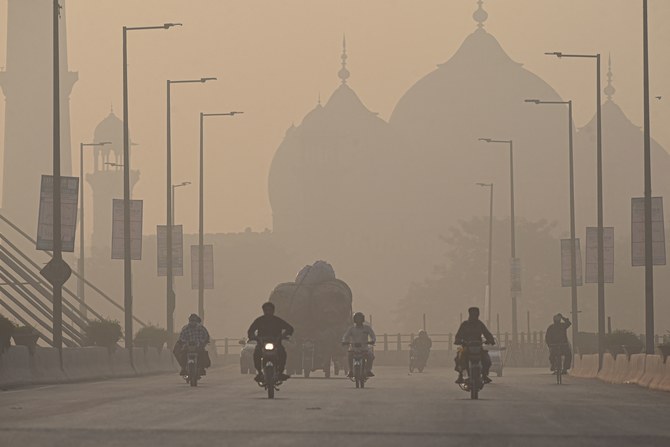
Commuters ride along a road amid smoggy conditions in Lahore on November 16, 2021. (AFP)
Short Url
Updated 17 November 2021
Follow

Residents call for action as Pakistan's Lahore becomes world's most polluted city

  • Lahore had an air quality ranking of 348, well over the hazardous level of 300, according to IQAir
  • Air pollution has worsened in Pakistan in recent years, as a mixture of low-grade diesel fumes and smoke from seasonal crop burn off

LAHORE: The Pakistani city of Lahore was declared the most polluted city in the world by an air quality monitor on Wednesday, as residents choking in acrid smog pleaded with officials to take action.
Lahore had an air quality ranking of 348, well over the hazardous level of 300, according to IQAir, the Swiss technology company that operates the AirVisual monitoring platform.
“Children are experiencing breathing diseases... for God’s sake, find a solution,” laborer Muhammad Saeed told AFP.
Air pollution has worsened in Pakistan in recent years, as a mixture of low-grade diesel fumes, smoke from seasonal crop burn off, and colder winter temperatures coalesce into stagnant clouds of smog.
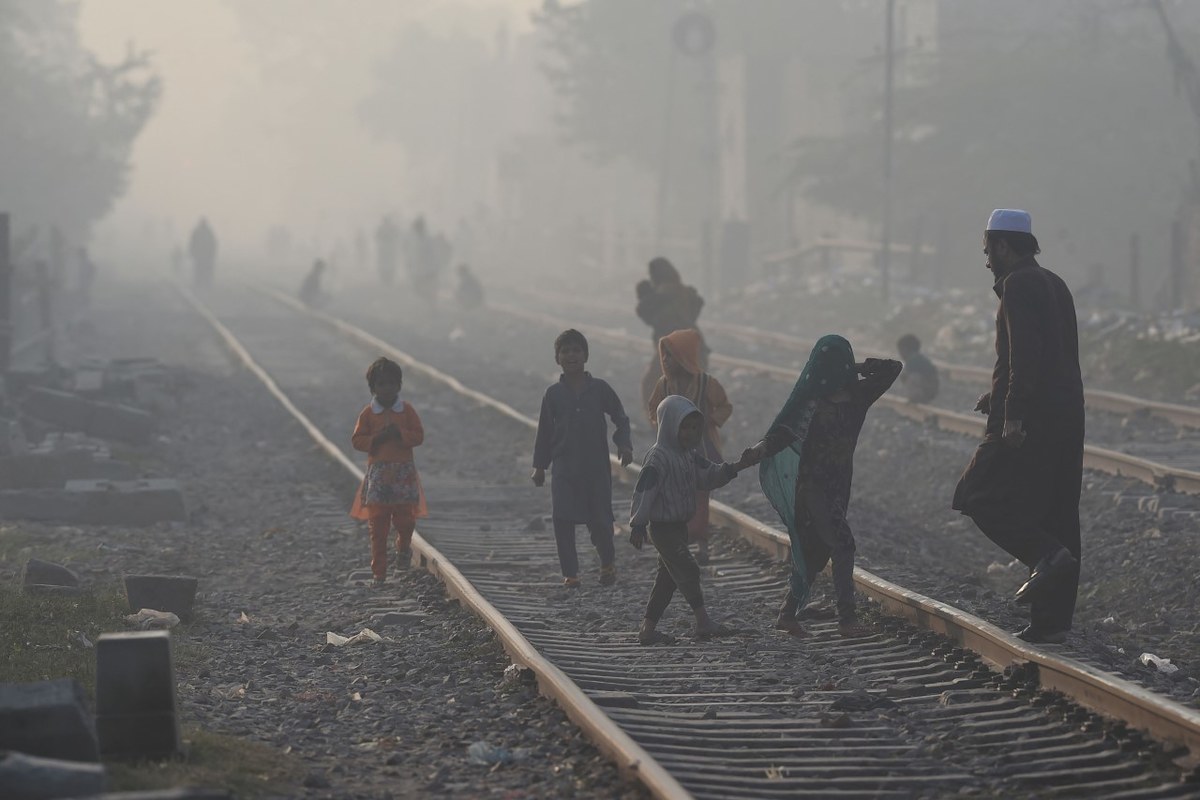


People walk on a railway track amid smoggy conditions in Lahore on November 16, 2021. (AFP)

Lahore, a bustling megacity of more than 11 million people in Punjab province near the border with India, consistently ranks among the worst cities in the world for air pollution.
In recent years residents have built their own air purifiers and taken out lawsuits against government officials in desperate bids to clean the air — but authorities have been slow to act, blaming the smog on India or claiming the figures are exaggerated.
“We are poor people, can’t even afford a doctor’s charges,” shopkeeper Ikram Ahmed told AFP.
“We can only plead with them to control the pollution. I am not a literate person, but I have read that Lahore has the worst air quality and then comes India’s Delhi. If it continues like this, we will die.”
“Before, I used to come (for a walk) with my children but now I don’t bring them out with me,” Saeed the laborer said.
“There are factories and small industries operating here, either shift them somewhere else, give them compensation or provide them with modern technology, so we can get rid of this smog.”


Pakistan announces plan to develop Port Qasim into climate-resilient industrial complex

Updated 4 sec ago
Follow

Pakistan announces plan to develop Port Qasim into climate-resilient industrial complex

  • Port Qasim handles 51% of Pakistan’s sea trade, facilitates Islamabad’s trade with Central Asian states
  • Maritime affairs ministry says 833 industrial units currently operational at Port Qasim, with 40 under construction

KARACHI: Pakistan’s Maritime Affairs Ministry announced on Monday that it aims to develop Port Qasim into a climate-resilient industrial complex, saying the move would create jobs, usher in investment and ensure sustainable development for the country. 

According to its website, Port Qasim is one of the largest contributors to Pakistan’s economy, handling 51 percent of the country’s sea trade. The port also connects directly to Pakistan’s national highway and motorway network, facilitating trade between Afghanistan and the Central Asian Republics.

Pakistan has recently attempted to upgrade its port infrastructure to handle higher trade volumes and improve connectivity between sea lanes and landlocked Central Asian states, leveraging its geographic position at the crossroads of South and Central Asia. 

Maritime Affairs Minister Junaid Anwar Chaudhry chaired a meeting to discuss projects related to Port Qasim, the ministry said in a statement. 

“During the meeting, a long-term plan for a climate-resilient industrial complex at Port Qasim was announced,” the statement said. 

Chaudhry said Port Qasim would be developed into a global industrial and logistics hub, adding that it will become a “key gateway” for Pakistan’s national economy.

Officials briefed the minister that the development project for the port would cover an area of more than 14,000 acres. The port’s industrial complex has been divided into three distinct zones, with the eastern one designated for heavy industry and export-oriented units, and the northwestern zone for the promotion of value-added industries and port services.

The southwestern zone of the complex has been earmarked for special industrial and commercial activities, the ministry said. 

Chaudhry said 833 industrial units are currently operational at the port while 40 are under construction. He also reaffirmed the government’s commitment to modernizing port infrastructure and improving road and rail connectivity.

“Junaid Anwar Chaudhry said the Port Qasim Industrial Complex will emerge as a hub for employment generation, investment, and sustainable development,” the statement said. 

Pakistan seeks to upgrade streamline port operations and enhance trade relations with regional countries as it seeks to escape a prolonged macroeconomic crisis that has put a strain on its resources and triggered a balance of payments crisis in the country over the past few years.