

The return of Syrian refugees key topic in Cavusoglu’s talks in Lebanon

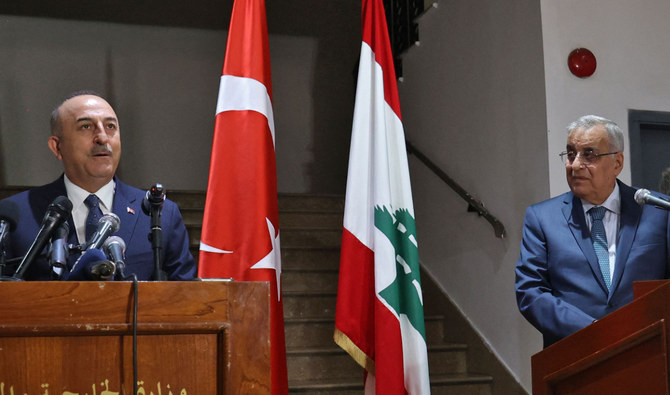
Turkish Foreign Minister Mevlut Cavusoglu (L) and his Lebanese counterpart Abdallah Bou Habib hold a joint-press conference in Lebanon's capital Beirut, on November 16, 2021. (AFP)
Short Url
Updated 16 November 2021
Follow

The return of Syrian refugees key topic in Cavusoglu’s talks in Lebanon

  • President Aoun calls for increasing the quantity of Lebanese products exported to Turkey

BEIRUT: Turkish Foreign Minister Mevlut Cavusoglu called for support for the Lebanese government in overcoming the country’s crises and holding parliamentary elections at a press conference in Beirut on Tuesday.

Cavusoglu stressed that “the Lebanese people should not have to pay the price of regional bargains,” referring to the issue of Syrian refugees in Lebanon. “Lebanon is waiting for urgent solutions to its problems.”

Cavusoglu was speaking alongside his Lebanese counterpart Abdallah Bou Habib, after holding talks with President Michel Aoun, Parliament Speaker Nabih Berri and Prime Minister Najib Mikati.

He also devoted part of his visit to highlighting Turkey’s presence in Lebanon through several development projects funded by Ankara.

Cavusoglu was on his fourth visit to Lebanon since 2016. 

He said he was in Beirut to “stress Turkey’s support for Lebanon, as well as to invite (Prime Minister) Mikati to visit Turkey and make preliminary arrangements for the visit.

“We discussed how to develop tourism and energy fields, especially since the Lebanese people’s top destination is Turkey and the Turkish people are known for how much they love Lebanon.”

The minister added: “We discussed regional issues, since our countries are the most affected by the Syrian crisis; the brotherly Lebanese people should not have to pay the price of regional bargains.”

The Lebanese presidency’s media office noted that Aoun told the Turkish official that he welcomed “any assistance that Turkey can provide to ease the return of Syrian refugees to their homes, most of which have become safe, in terms of pressuring the international community to provide aid to refugees inside Syria, to encourage return.”

Aoun said he supported “coordinating regional efforts to that end with Turkey, Jordan and Iraq” and called for “increasing the share of Turkey’s imports of Lebanese products, especially since the trade balance is currently tilting in Turkey’s favor.”

The president also raised “a request to Turkey to help return the Maronite Cypriots to their villages in the northern part of Cyprus, after the delay that occurred for reasons related to logistics and the COVID-19 pandemic.”

On the parliamentary elections scheduled for next March, Cavusoglu stressed the need to hold them on time.

“We have always given importance to the sovereignty, independence and security of Lebanon and provided the necessary support after the explosions in Beirut and Akkar,” Cavusoglu said. “We also support the army and security forces fighting for Lebanon’s stability and security.”

He added: “We renewed our support by extending (commitment to) the UN Interim Force in Lebanon for a year, and we have a unit working in this regard.”

Bou Habib stated he wished Turkey “to open its markets for the export of Lebanese products.”

The minister added that Lebanon “is keen on maintaining good relations with all countries and highly appreciates the Turkish support and aid, as well as its participation as a country within the UNIFIL.”

He said: “We, and the Turkish foreign minister, signed a cooperation agreement to enhance rapprochement between the two ministries and are working on a memorandum of understanding in other areas.”

Bou Habib noted that “Lebanon and Turkey are suffering from the burden of Syrian refugee issue.”

He called for “the necessity of unifying efforts to tackle the refugees’ issue and asking the international community to share the burden fairly among them or work on their return to their country.”


First responders enter devastated Aleppo neighborhood after days of deadly fighting

Updated 12 January 2026
Follow

First responders enter devastated Aleppo neighborhood after days of deadly fighting

  • The US-backed SDF, which have played a key role in combating the Daesh group in large swaths of eastern Syria, are the largest force yet to be absorbed into Syria’s national army

ALEPPO, Syria: First responders on Sunday entered a contested neighborhood in Syria’ s northern city of Aleppo after days of deadly clashes between government forces and Kurdish-led forces. Syrian state media said the military was deployed in large numbers.
The clashes broke out Tuesday in the predominantly Kurdish neighborhoods of Sheikh Maqsoud, Achrafieh and Bani Zaid after the government and the Syrian Democratic Forces, the main Kurdish-led force in the country, failed to make progress on how to merge the SDF into the national army. Security forces captured Achrafieh and Bani Zaid.
The fighting between the two sides was the most intense since the fall of then-President Bashar Assad to insurgents in December 2024. At least 23 people were killed in five days of clashes and more than 140,000 were displaced amid shelling and drone strikes.
The US-backed SDF, which have played a key role in combating the Daesh group in large swaths of eastern Syria, are the largest force yet to be absorbed into Syria’s national army. Some of the factions that make up the army, however, were previously Turkish-backed insurgent groups that have a long history of clashing with Kurdish forces.
The Kurdish fighters have now evacuated from the Sheikh Maqsoud neighborhood to northeastern Syria, which is under the control of the SDF. However, they said in a statement they will continue to fight now that the wounded and civilians have been evacuated, in what they called a “partial ceasefire.”
The neighborhood appeared calm Sunday. The United Nations said it was trying to dispatch more convoys to the neighborhoods with food, fuel, blankets and other urgent supplies.
Government security forces brought journalists to tour the devastated area, showing them the damaged Khalid Al-Fajer Hospital and a military position belonging to the SDF’s security forces that government forces had targeted.
The SDF statement accused the government of targeting the hospital “dozens of times” before patients were evacuated. Damascus accused the Kurdish-led group of using the hospital and other civilian facilities as military positions.
On one street, Syrian Red Crescent first responders spoke to a resident surrounded by charred cars and badly damaged residential buildings.
Some residents told The Associated Press that SDF forces did not allow their cars through checkpoints to leave.
“We lived a night of horror. I still cannot believe that I am right here standing on my own two feet,” said Ahmad Shaikho. “So far the situation has been calm. There hasn’t been any gunfire.”
Syrian Civil Defense first responders have been disarming improvised mines that they say were left by the Kurdish forces as booby traps.
Residents who fled are not being allowed back into the neighborhood until all the mines are cleared. Some were reminded of the displacement during Syria’s long civil war.
“I want to go back to my home, I beg you,” said Hoda Alnasiri.