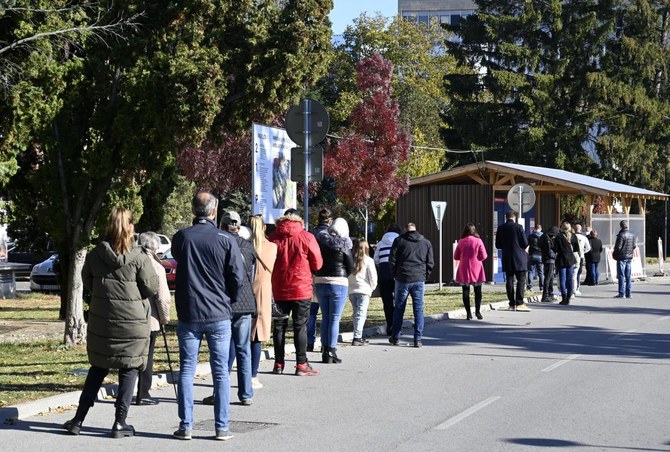
BRATISLAVA, Slovakia: Slovakia is planning new restrictions on unvaccinated people in an effort to tame the latest surge of coronavirus infections that has caused a “critical” situation in the country’s hospitals, the prime minister said Tuesday.
Prime Minister Eduard Heger said his government will vote Thursday on the latest proposals by an advisory group of medical experts that will be effective for three weeks. Among the proposed measures, people who have not been vaccinated will be banned from all non-essential stores, shopping malls, gyms, pools and hotels. They also won’t be allowed to attend any mass public gatherings like sports events.
“The situation in hospitals is critical,” Heger said, adding that some hospitals are already at their limit for COVID-19 patients in their intensive care units and have been transferring new patients to other facilities.
Unvaccinated people will be able to get into their workplaces with negative virus tests.
If the situation doesn’t get any better in the next three weeks, the government is ready to impose even more restrictions, the prime minister said. He urged unvaccinated Slovaks to get their vaccine shots.
The number of COVID-10 patients needing hospital treatment rose to a total of 2,826, with 225 admitted on Monday alone, the Health Ministry said. Over 81 percent of the hospitalized have not been fully vaccinated.
Slovakia, one of the hardest-hit European Union countries, has one of the lowest vaccination rates in the 27-nation bloc. Only about 45 percent of its nearly 5.5 million have been fully vaccinated.
In the latest surge, new coronavirus infections in Slovakia hit a record daily high of 7,244 cases on Friday.

Slovakia to restrict the unvaccinated to tame COVID surge
Short Url
https://arab.news/7jz44
Slovakia to restrict the unvaccinated to tame COVID surge
- Among the proposed measures, people who have not been vaccinated will be banned from all non-essential stores
- Unvaccinated people will be able to get into their workplaces with negative virus tests
Louvre heist probe still aims to ‘recover jewelry’, top prosecutor says
- Police believe they have arrested all four thieves who carried out the brazen October 19 robbery
PARIS: French investigators remain determined to find the imperial jewels stolen from the Louvre in October, a prosecutor has said.
Police believe they have arrested all four thieves who carried out the brazen October 19 robbery, making off with jewelry worth an estimated $102 million from the world-famous museum.
“The interrogations have not produced any new investigative elements,” top Paris prosecutor Laure Beccuau said this week, three months after the broad-daylight heist.
But the case remains a top priority, she underlined.
“Our main objective is still to recover the jewelry,” she said.
That Sunday morning in October, thieves parked a mover’s truck with an extendable ladder below the Louvre’s Apollo Gallery housing the French crown jewels.
Two of the thieves climbed up the ladder, broke a window and used angle grinders to cut glass display booths containing the treasures, while the other two waited below, investigators say.
The four then fled on high-powered motor scooters, dropping a diamond-and-emerald crown in their hurry.
But eight other items of jewelry — including an emerald-and-diamond necklace that Napoleon I gave his second wife, Empress Marie-Louise — remain at large.
Beccuau said investigators were keeping an open mind as to where the loot might be.
“We don’t have any signals indicating that the jewelry is likely to have crossed the border,” she said, though she added: “Anything is possible.”
Detectives benefitted from contacts with “intermediaries in the art world, including internationally” as they pursued their probe.
“They have ways of receiving warning signals about networks of receivers of stolen goods, including abroad,” Beccuau said.
As for anyone coming forward to hand over the jewels, that would be considered to be “active repentance, which could be taken into consideration” later during a trial, she said.
A fifth suspect, a 38-year-old woman who is the partner of one of the men, has been charged with being an accomplice but was released under judicial supervision pending a trial.
Investigators still had no idea if someone had ordered the theft.
“We refuse to have any preconceived notions about what might have led the individuals concerned to commit this theft,” the prosecutor said.
But she said detectives and investigating magistrates were resolute.
“We haven’t said our last word. It will take as long as it takes,” she said.
Police believe they have arrested all four thieves who carried out the brazen October 19 robbery, making off with jewelry worth an estimated $102 million from the world-famous museum.
“The interrogations have not produced any new investigative elements,” top Paris prosecutor Laure Beccuau said this week, three months after the broad-daylight heist.
But the case remains a top priority, she underlined.
“Our main objective is still to recover the jewelry,” she said.
That Sunday morning in October, thieves parked a mover’s truck with an extendable ladder below the Louvre’s Apollo Gallery housing the French crown jewels.
Two of the thieves climbed up the ladder, broke a window and used angle grinders to cut glass display booths containing the treasures, while the other two waited below, investigators say.
The four then fled on high-powered motor scooters, dropping a diamond-and-emerald crown in their hurry.
But eight other items of jewelry — including an emerald-and-diamond necklace that Napoleon I gave his second wife, Empress Marie-Louise — remain at large.
Beccuau said investigators were keeping an open mind as to where the loot might be.
“We don’t have any signals indicating that the jewelry is likely to have crossed the border,” she said, though she added: “Anything is possible.”
Detectives benefitted from contacts with “intermediaries in the art world, including internationally” as they pursued their probe.
“They have ways of receiving warning signals about networks of receivers of stolen goods, including abroad,” Beccuau said.
As for anyone coming forward to hand over the jewels, that would be considered to be “active repentance, which could be taken into consideration” later during a trial, she said.
A fifth suspect, a 38-year-old woman who is the partner of one of the men, has been charged with being an accomplice but was released under judicial supervision pending a trial.
Investigators still had no idea if someone had ordered the theft.
“We refuse to have any preconceived notions about what might have led the individuals concerned to commit this theft,” the prosecutor said.
But she said detectives and investigating magistrates were resolute.
“We haven’t said our last word. It will take as long as it takes,” she said.
© 2026 SAUDI RESEARCH & PUBLISHING COMPANY, All Rights Reserved And subject to Terms of Use Agreement.


