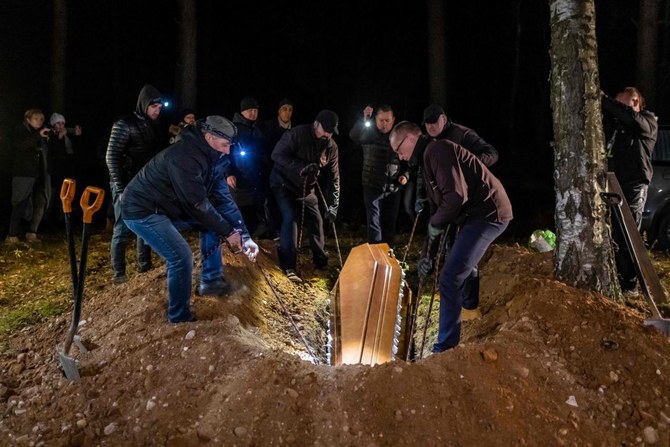
BOHONIKI, Poland: On a dark November evening in a small town in north-east Poland, men lower the wooden coffin of a young migrant into a freshly dug grave to the sound of an imam reciting a funeral prayer.
Ahmed Al-Hassan, a 19-year-old Syrian, drowned in a river last month while trying to cross to the European Union from Belarus, one of at least eight people who have died at the border in recent months.
The EU, NATO and the West say Belarus is orchestrating a migrant crisis in retaliation for sanctions imposed by the bloc. Belarus denies the accusations.
As Hassan is buried by torchlight in a cemetery in Bohoniki, thousands of miles from home, his grieving family in Syria watch via videolink thanks to the Syrian doctor who found Hassan’s body.
“You won’t be able to see much, but I wanted to tell you we are all family,” Kassam Shahadah tells the mourning relatives on the call. “I know you wanted to see him for one last time but there’s not much to do.”
On the glowing screen of his phone, an old woman can be seen weeping, and a child cries out in the background.
Hassan reportedly died on Oct. 19 when he drowned in the river Bug. His body was kept in a morgue in the Polish city of Bielsko Biala until the burial in Bohoniki, a town 600 kilometers (370 miles) away, where a small Muslim Tatar community offered to give him an Islamic funeral.
Migrants from the Middle East and Africa began to appear on the Belarusian side of the border in summer, with thousands trying to reach Poland, Lithuania and Latvia on foot through forests, lakes and swamps.
As winter set in, deaths began to be reported, the first on Sept. 19. Several months on, as at least 4,000 migrants are stranded on the border amid freezing temperatures, the head of the Tatar Muslim community in the village of Bohoniki said he feared more would die.
“We’re worried that there might be more people dead because you know what the weather is like right now. It is cold, people are emaciated. We fear the worst,” said Maciej Szczesnowicz.
He previously advertised on Facebook that the Tatars living in north-eastern Poland on the border with Lithuania and Belarus were ready to organize burials for fellow Muslims.
A small ethnic and religious minority in overwhelmingly homogenous and Catholic modern Poland, the Tatars descend from warriors who were rewarded with land by Polish kings for protecting the country’s eastern border centuries ago.
Fearing the crisis on their footstep is far from over, the community has been delivering clothes and food to both migrants and Polish troops on the border.
At the end of Hassan’s funeral, the very few local attendees knelt down, paying respects by touching the ground.
“We have a large enough cemetery, and want to offer that person a dignified funeral, a person who came from abroad and died on Polish ground,” said Szczesnowicz.


![]()

Body of young Syrian migrant buried in Poland as family watch by videolink
Short Url
https://arab.news/vncgn
Body of young Syrian migrant buried in Poland as family watch by videolink
- Ahmed al-Hassan, a 19-year-old Syrian, drowned in a river last month while trying to cross to the European Union from Belarus
- As Hassan is buried by torchlight in a cemetery in Bohoniki, his grieving family in Syria watched via videolink thanks to the Syrian doctor who found his body


Latest updates


© 2026 SAUDI RESEARCH & PUBLISHING COMPANY, All Rights Reserved And subject to Terms of Use Agreement.