

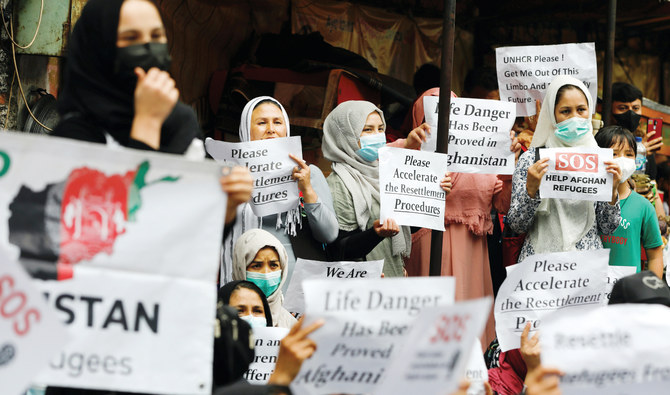

JAKARTA: Roughly 100 Afghan refugees in Indonesia, with women and children at the forefront, rallied on Monday in downtown Jakarta, demanding the acceleration of their resettlement process to a third country.
This is the third rally the refugees have held in front of the UN High Commissioner for Refugees’ office since August, following the Taliban takeover in Afghanistan and the peak of the third wave of the coronavirus disease (COVID-19) outbreak in Indonesia, defying a crowd-forming ban in Jakarta.
There are 13,273 refugees registered with UNHCR in Indonesia; a quarter of them are adults and more than half are from Afghanistan. They are located in several cities in Indonesia and have held rallies voicing the same demands in Medan, Kupang, and Surabaya during the past three months.
About a dozen children formed the frontline of the protesters, with women and teenagers standing behind them as they held up placards that pleaded with the UNHCR to address their plight.
Children took turns holding a speaker and shouting, “We are human, we want process, we want justice, we want future, UNHCR help us.”
Rana Amini, 16, was among the minors who took center stage at the rally, speaking in fluent Indonesian. Amini explained that protesters were holding the rally after the UN agency did not fulfill its promises based on talks with the refugees on Aug. 24, referring to the August rally that turned violent as authorities forcefully dispersed the crowd at the peak of the delta variant outbreak.
“Refugees have had to face uncertainty for more than a decade, which is among the reasons why 14 refugees committed suicide, including seven in the past 14 months. Dozens have died, while almost all the rest of them have been suffering mental and physical illness,” she said.
Amini, who came to the rally with her mother, told Arab News that she arrived in Indonesia eight years ago with her parents and younger siblings, but her father has left their family. She now lives with her mother and siblings in a boarding house in South Jakarta and attends an Islamic middle school where she is a ninth grade student.
The Indonesian government does not allow adult refugees to work since Indonesia is not a party to the 1951 UN Refugee Convention and is only a transit country. It does, however, allow refugees who are minors to go to school, as Indonesia is a signatory to the UN Convention on the Rights of the Child.
According to the UNHCR, as of September this year, some 778 refugee children are enrolled in accredited national schools, but 1,700 school-aged children are not yet attending formal schools. Some 1000 of them, however, are receiving education through refugee learning centers organized by the UNHCR, International Organization for Migration or centers led by refugee communities.
The Indonesian government also allows asylum seekers and refugees to have access to primary healthcare and to stay in the country on humanitarian grounds while waiting for resettlement, even though the process could take years, as third countries such as Canada, the US, and Australia have reduced their refugee intake.
A representative from the UNHCR, who did not want his name published, told refugee coordinator Hassan Ramazan that he would convey the refugees’ letter to the UNHCR.
“We asked you to send your representatives, but you always refused,” the officer told Ramazan, who argued that some of the refugees might want to stay and spend the night at the location.
“If you insist on continuing the rally, you are breaking the law,” the officer added.
“We will continue this peaceful demonstration until we have a response from the UNHCR and a real solution instead of just promises,” said Bibi Rahima Farhangdost, a 31-year-old former teacher who came to Indonesia in 2014.


