PARIS: World powers on Friday told Libya to stick to a plan for holding presidential elections on December 24, adding that foreign mercenaries should also leave and allow the country to turn a page in its history.
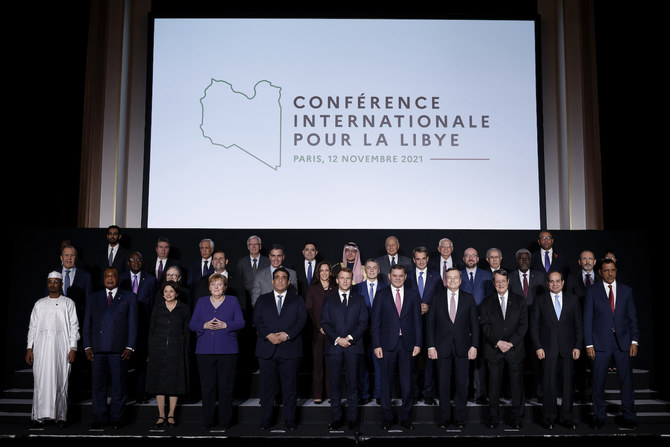
French President Emmanuel Macron hosted leaders and diplomats in Paris for an international conference, declaring that Libya was now as a “crossroads” that would determine its future.
The North African country has been mired in civil war since the overthrow of dictator Muammar Qaddafi in a 2011 uprising, with the bloodshed drawing in competing Libyan factions and extremist groups, as well as regional powers.
The presidential vote on December 24 is the core part of a United Nations plan to help restore stability, but the calendar has been under pressure as tensions flare once more between rival camps.
“We urge all Libyan stakeholders and candidates to respect their commitments toward holding elections on 24 December 2021 (and) to accept the results of free, fair and inclusive elections,” the powers said in a statement after the talks.
The scheduling has remained unclear, after Libya’s parliament in early October pushed back legislative elections until January.
“Libya is once again at a crossroads. There have been 10 years of disorder and upheaval in which the international community is not without responsibility,” said Macron.
“The next six weeks will be decisive,” he added.
The world powers also warned that sanctions could be imposed against anyone deemed to be impeding the process.
“We affirm that individuals or entities, inside or outside of Libya, who might attempt to obstruct, undermine, manipulate or falsify the electoral process and the political transition will be held accountable and may be designated” by UN sanctions, their statement said.
Key players attending the meeting included US Vice President Kamala Harris and Egyptian President Abdel Fattah El-Sisi, one of Paris’s closest allies in the Middle East.
German Chancellor Angela Merkel and Italian Prime Minister Mario Draghi were also present. But President Recep Tayyip Erdogan of Turkey and Russian President Vladimir Putin were conspicuous by their absence.
Libya was represented by transitional presidential council head Mohamed Al-Menfi as well as Prime Minister Abdelhamid Dbeibah who said: “Concrete guarantees must be obtained that the election results will be accepted and that those who reject them will be sanctioned.”
Earlier this week, Libya opened registration for election candidates, with speculation mounting over possible presidential bids by eastern strongman Khalifa Haftar or even Qaddafi’s son Seif Al-Islam, both deeply divisive figures.
The conference to endorse a plan for the departure of all foreign forces and mercenaries from Libya, with the statement giving “full support for the comprehensive Action Plan for the withdrawal of mercenaries, foreign fighters and foreign forces from the Libyan territory.”
Turkey had sent in troops as well as pro-Ankara militia units from Syria to shore up the Tripoli government.
Observers also accuse Moscow of deploying mercenaries belonging to the Wagner group, which is allegedly controlled by a close ally of Putin.
Pro-Haftar forces said in a statement ahead of the conference that 300 foreign mercenaries fighting on their side would leave the country, “at the request of France.”
The nationality of the fighters was not specified and no timeline was given. The UN estimates that 20,000 mercenaries and foreign fighters are deployed in Libya.
“The mercenary withdrawal plan must be implemented. Russia and Turkey must withdraw their mercenaries without delay,” Macron said, welcoming the announcement that 300 mercenaries would leave as a “first step.”
“This is only the beginning, but it is an essential beginning which finally gives credibility to a process that we have been talking about for too long,” said Macron.
France has faced accusations of backing the pro-Moscow and staunchly secular Haftar but has always insisted it has been fully objective in the conflict.
Merkel commented that Turkey had “reservations” about the process of withdrawing mercenaries.
But she added: “It’s a good thing that we can see a first withdrawal, it will serve as an example. Things have started.”


![]()

Powers urge Libya to keep poll plan, want mercenaries out
Short Url
https://arab.news/6xspw
Powers urge Libya to keep poll plan, want mercenaries out
- Friday’s conference is co-chaired by France, Germany, Italy, Libya, and the United Nations
- A leading rights group questioned Thursday whether Libyan authorities can hold free and fair elections


Latest updates


© 2026 SAUDI RESEARCH & PUBLISHING COMPANY, All Rights Reserved And subject to Terms of Use Agreement.