

Tunisian town revolts over trash crisis

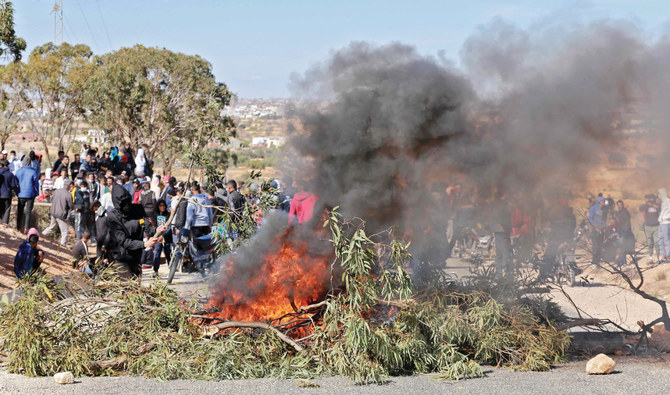
Tunisians gather before blocking a road in the city of Agareb following the death of a protester during demonstrations over the reopening of a rubbish dump. (AFP)
Short Url
Updated 14 November 2021
Follow

Tunisian town revolts over trash crisis

  • Rubbish dumped at the site includes dangerous industrial and medical refuse causing a string of diseases

AGAREB: As tear gas and protest cries filled the air in the Tunisian city of Agareb, Mabrouka Ben Ibrahim vowed to demonstrate for her daughter, whose death she blames on a nearby rubbish dump.

Yousra, 21, died in 2019 after being bitten by a mosquito that came from the toxic trash site, Ben Ibrahim said.

“I lost my daughter and I don’t want other families to lose their children because of the filth in this landfill,” the 59-year-old said.

Residents say rubbish dumped at the site, including dangerous industrial and medical refuse, has caused a string of diseases from cancer to vision problems and infertility.

Authorities decided to close the site in September after declaring it full but reversed course on Monday, prompting angry street demonstrations that degenerated into clashes with security forces.

In the early hours of Tuesday, a protester died of what relatives said was tear gas inhalation, although authorities have blamed his death on an unrelated health condition.

The protests come amid a garbage crisis across Sfax province that has seen refuse piling up on pavements after the closure of the Agareb site, the province’s main dump.

Residents say the site, around three km from the town center and stretching over 35 hectares, has become a public health disaster since it opened in 2008.

“Two years after it was opened, we started seeing an increase in allergies, respiratory diseases and miscarriages as a direct result of burning of trash and the release of toxic gases” from the site, said Bassem Ben Ammar, a doctor who has worked in the town for two decades.

“The number of cancer cases has shot up.”

Even as the smell of tear gas dissipates, the stench of refuse still hangs over the town of 40,000.

“During the summer and throughout the year, the mosquitos and the disgusting smell never leave us. We can’t even open our windows,” demonstrator Adel Ben Faraj said.

The dump, situated in the middle of a nature reserve, receives more than 620 tons of waste every day, according to Ines Labiadh of the FTDES rights group.

Ben Ammar said the site was a destination for “waste of all kinds, including medical waste, amputated body parts and even fetuses.”

The Environment Ministry said medical waste was treated before going into the dump.

The site, one of 13 official landfills in the North African country, serves around 1 million people and receives waste from numerous factories in the city of Sfax, Tunisia’s main industrial hub.

As in the rest of Tunisia, only a small fraction of the region’s waste is recycled, with the rest either buried or incinerated.

Residents say the site was only meant to be active for five years, but its use was extended and it continued operating despite a judge ordering its immediate closure in 2019.

It was deemed full and finally shut down in late September, but authorities reopened it this week, triggering renewed outrage among residents.

Activists have warned that similar protests could easily flare over other landfill sites in Tunisia.

Labiadh told AFP that less than 10 percent of the country’s waste was recycled.

“This is damaging public health and the environment” around landfill sites, she said, calling on the state to set up a functioning recycling system.

Many of the landfill sites are found in marginalized areas.

“Today there are demonstrations in Agareb, but tomorrow they could happen around dumps in the capital. No dump in Tunisia is immune,” she said.

“Some areas have clean air, while others are marginalized and deprived of basic rights.”

In Agareb, some residents have been using art to campaign for a solution.

Maamoun Ajmi, a 29-year-old architect, is part of the “Maneche Msabb” (I’m not a rubbish dump) art collective.

He showed AFP two of his artworks — one a portrait of Yousra as an angel, the other showing a rat eating the section of the Tunisian constitution dealing with environmental rights.

He was among activists who met with President Kais Saied in Tunis on Thursday to highlight the town’s plight.

Ajmi told AFP the protesters had nothing to do with politics.


Israel bars Al-Aqsa imam from entering mosque in Ramadan

Updated 17 February 2026
Follow

Israel bars Al-Aqsa imam from entering mosque in Ramadan

  • ‘This ban is a grave matter for us as our soul is tied to Al-Aqsa, Al-Aqsa is our life’

JERUSALEM: A senior imam of the Al-Aqsa Mosque in East Jerusalem said on Tuesday that Israeli authorities had barred him from entering the compound, just days before the start of the holy month of Ramadan.

“I have been barred from the mosque for a week, and the order can be renewed,” Sheikh Muhammad Al-Abbasi said.
He said he was not informed of the reason for the ban, which came into effect from Monday.

FASTFACT

A Waqf source said 33 of its employees had been barred from entering the compound in the week leading up to Ramadan.

“I had only returned to Al-Aqsa a month ago after spending a year in the hospital following a serious car accident,” Abbasi said. “This ban is a grave matter for us, as our soul is tied to Al-Aqsa. Al-Aqsa is our life.”
On Monday, Israeli police said they had recommended issuing 10,000 permits for Palestinians from the occupied West Bank, who require special permission to enter Jerusalem.
Arad Braverman, a senior Israeli police officer in occupied Jerusalem, said forces would be deployed “day and night” across the compound.
He said thousands of police would also be on duty for Friday prayers, which draw the largest crowds of Muslim worshippers.
The Palestinian Jerusalem Governorate said it had been informed that permits would again be restricted to men over 55 and women over 50, mirroring last year’s criteria.
It added that Israeli authorities had prevented the Islamic Waqf — the Jordanian-run body that administers the site — from carrying out routine preparations, including installing shade structures and setting up temporary medical clinics.
A Waqf source said 33 of its employees had been barred from entering the compound in the week leading up to Ramadan.
Under long-standing arrangements, Jews may visit the Al-Aqsa compound —  but they are not permitted to pray there.
Palestinians fear the status quo it is being eroded.
In a separate development, Israeli NGOs have raised the alarm over a settlement plan signed by the government which they say would mark the first expansion of Jerusalem’s borders into the occupied West Bank since 1967. Palestinians view East Jerusalem as the capital of their future state.
The proposal, published in early February but reported by Israeli media only on Monday, comes as international outrage mounts over creeping measures aimed at strengthening Israeli control over the West Bank.
Critics say these actions by the Israeli authorities are aimed at the de facto annexation of the Palestinian territory.
The planned development, announced by Israel’s Ministry of Construction and Housing, is formally a westward expansion of the Geva Binyamin, or Adam, settlement situated northeast of Jerusalem in the West Bank.
In a statement, the ministry said the development agreement included the construction of around 2,780 housing units for the settlement, with an investment of roughly $38.7 million.
But the area to be developed lies on the Jerusalem side of the separation barrier built by Israel in the early 2000s, while Geva Binyamin sits on the West Bank side of the barrier, and the two are separated by a road.
Israeli settlement watchdog Peace Now said there would be no “territorial or functional connection” between the area to be developed and the settlement.
“The new neighborhood will be integral to the city of Jerusalem,” Lior Amihai, Peace Now’s executive director, said.
“What is unique about that one is that it will be connected directly to Jerusalem, but it will be beyond the annexed municipal border. So it will be in complete West Bank territory, but just adjacent to Jerusalem,” he said.