

Duterte’s daughter to run for Philippines vice president

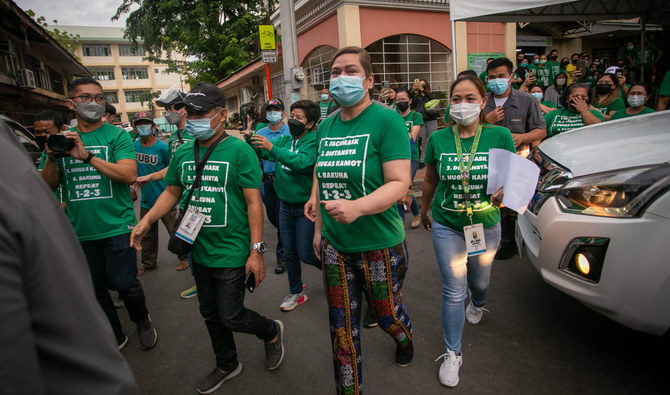
Sara Duterte-Carpio, center, the eldest daughter of the Philippine President Rodrigo Duterte, stood for reelection as the mayor of Davao City. (AFP)
Short Url
Updated 14 November 2021
Follow

Duterte’s daughter to run for Philippines vice president

  • Sara Duterte immediately endorsed by the party of Ferdinand Marcos Jr.

MANILA: The daughter of Philippine President Rodrigo Duterte on Saturday filed her candidacy for vice president, ending speculation about her 2022 election plans.

Sara Duterte-Carpio, 43, who is the president’s eldest daughter, did not file her bid for presidency like other candidates in October and instead stood for reelection as the mayor of Davao City.

Her decision to join the presidential race came ahead of the Nov. 15 deadline for candidates to make a late entry into the May 2022 polls.

Legal representative Attorney Reynold Munsayac submitted Duterte’s certificate of candidacy to the Commission on Elections. She will be running from the platform of the Lakas-Christian Muslim Democrats party of former President Gloria Macapagal-Arroyo, whose Lyle Uy withdrew his candidacy and named the Philippine leader’s daughter as his substitute.

“This is to confirm that Mayor Inday Sara Duterte, through her representative, has filed her Certificate of Candidacy for Vice President under Lakas-CMD,” Duterte’s spokesperson Christina Garcia Frasco said in a Facebook post.

She was immediately endorsed by Partido Federal ng Pilipinas, the party of Ferdinand Marcos Jr., the son and namesake of the former Philippine dictator, to be his running mate in the poll.

“Partido Federal ng Pilipinas announced on Saturday that it had adopted Davao City Mayor Sara Duterte-Carpio as its vice presidential candidate and endorsed her as the running mate of party standard-bearer Ferdinand ‘Bongbong’ Marcos, Jr. in the upcoming 2022 elections,” the party said in a media statement.

In the Philippines, the president and vice president are elected separately, but it is common for candidates to join forces as de facto running mates.

“Knowing her father, I don’t know if he would agree to his daughter running for vice president,” Ramon Casiple, political analyst and executive director of the Institute for Political and Electoral Reform, told Arab News. “He really wanted his daughter to run for president.”

She had been widely expected to run for president and to succeed her father who, under the Philippine constitution, cannot seek a second six-year term.

But Casiple said anything could still happen as Marcos may face disqualification petitions over his conviction in an income tax case in 1995.

“Substitution due to death or disqualification is allowed even on the day of the elections,” he added. “It would be easier if the substitute will be the party’s vice presidential candidate.”

Political analyst Dindo Manhit said in a TV interview that petitions to block Marcos may affect his presidential bid.

“At the end of the day it will depend on Comelec (Commission on Elections),” Mahit said.

Apart from Marcos, other presidential hopefuls in next year’s polls include former boxing champion Manny Pacquiao, Vice President Leni Robredo, Manila Mayor Francisco Domagoso, and Senator Panfilo Lacson.

Duterte’s former police chief Ronald dela Rosa withdrew his presidential bid on Saturday, together with another long-time Duterte aide Senator Christopher Lawrence Go, who sought the vice president role.

As Go subsequently substituted dela Rosa as presidential candidate, Duterte himself might seek a bid as vice president. 

The deadline for substitutions expires on Monday.


Moscow made an offer to France regarding a French citizen imprisoned in Russia, says Kremlin

Updated 26 December 2025
Follow

Moscow made an offer to France regarding a French citizen imprisoned in Russia, says Kremlin

  • Laurent Vinatier, an adviser for Swiss-based adviser Center for Humanitarian Dialogue, Vinatier was arrested in Moscow in June 2024
  • He is accused of failing to register as a “foreign agent” while collecting information about Russia’s “military and military-technical activities” 

The Kremlin on Thursday said it was in contact with the French authorities over the fate of a French political scholar serving a three-year sentence in Russia and reportedly facing new charges of espionage.
Kremlin spokesman Dmitry Peskov told reporters that Russia has made “an offer to the French” regarding Laurent Vinatier, arrested in Moscow last year and convicted of collecting military information, and that “the ball is now in France’s court.” He refused to provide details, citing the sensitivity of the matter.
French President Emmanuel Macron is following Vinatier’s situation closely, his office said in a statement. French Foreign Ministry spokesperson Pascal Confavreux said Thursday that all government services are fully mobilized to pay provide consular support to Vinatier and push for his liberation as soon as possible.
Peskov’s remarks come after journalist Jérôme Garro of the French TF1 TV channel asked President Vladimir Putin during his annual news conference on Dec. 19 whether Vinatier’s family could hope for a presidential pardon or his release in a prisoner exchange. Putin said he knew “nothing” about the case, but promised to look into it.
Vinatier was arrested in Moscow in June 2024. Russian authorities accused him of failing to register as a “foreign agent” while collecting information about Russia’s “military and military-technical activities” that could be used to the detriment of national security. The charges carry a maximum penalty of five years in prison.
The arrest came as tensions flared between Moscow and Paris following French President Emmanuel Macron’s comments about the possibility of deploying French troops in Ukraine.
Vinatier’s lawyers asked the court to sentence him to a fine, but the judge in October 2024 handed him a three-year prison term — a sentence described as “extremely severe” by France’s Foreign Ministry, which called for the scholar’s immediate release.
Detentions on charges of spying and collecting sensitive data have become increasingly frequent in Russia and its heavily politicized legal system since Moscow invaded Ukraine in February 2022.
In addition to criticizing his sentence, the French Foreign Ministry urged the abolition of Russia’s laws on foreign agents, which subject those carrying the label to additional government scrutiny and numerous restrictions. Violations can result in criminal prosecution. The ministry said the legislation “contributes to a systematic violation of fundamental freedoms in Russia, like the freedom of association, the freedom of opinion and the freedom of expression.”
Vinatier is an adviser for the Center for Humanitarian Dialogue, a Switzerland-based nongovernmental organization, which said in June 2024 that it was doing “everything possible to assist” him.
While asking the judge for clemency ahead of the verdict, Vinatier pointed to his two children and his elderly parents he has to take care of.
The charges against Vinatier relate to a law that requires anyone collecting information on military issues to register with authorities as a foreign agent.
Human rights activists have criticized the law and other recent legislation as part of a Kremlin crackdown on independent media and political activists intended to stifle criticism of the war in Ukraine.
In August 2025, Russian state news agency Tass reported that Vinatier was also charged with espionage, citing court records but giving no details. Those convicted of espionage in Russia face between 10 and 20 years in prison.
Russia in recent years has arrested a number of foreigners — mainly US citizens — on various criminal charges and then released them in prisoner swaps with the United States and other Western nations. The largest exchange since the Cold War took place in August 2024, when Moscow freed journalists Evan Gershkovich and Alsu Kurmasheva, fellow American Paul Whelan, and Russian dissidents in a multinational deal that set two dozen people free.