

INTERVIEW: Saudi pavilion at Expo 2020 is a glimpse into KSA’s future, says French politician

Short Url
Updated 14 November 2021
Follow

INTERVIEW: Saudi pavilion at Expo 2020 is a glimpse into KSA’s future, says French politician

  • Senator Olivier Cadic, who represents French expatriates, said Saudi Vision 2030 transformed the country in the past 5 years

RIYADH: French politician Olivier Cadic no longer recognizes Saudi Arabia. During a trip to the Kingdom to prepare for a visit by the France-Gulf countries friendship group he chairs in the Senate, he said he is enthusiastic about the “profound evolution”  of the country since the launch of Saudi Vision 2030.

The senator, who represents French expatriates and has visited 99 countries during 410 official trips, said he was touched by the welcome he received in the Kingdom.
“This is the first time that a parliamentarian from the host country has been there to welcome me as soon as I get off the plane,” he said. “This fact has a unique meaning and indicates that the level of friendship between Saudi Arabia and France is at its optimum.
“I am grateful to the Shoura (Council) for its welcome, and the manner in which a French parliamentarian is treated. I will never forget them and I will never forget Saudi Arabia.”

We have two countries looking to reform. President (Emmanuel) Macron is also seeking to fundamentally reform France. Reforming a country is not easy.

Olivier Cadic, French politician

During an interview with Arab News en Francais at the Alliance Francaise school in Riyadh, the French parliamentarian discussed the cooperation between the countries in the cultural, economic and military fields.

Q Since your election in 2014, and as president of the France-Gulf countries group in the Senate, you have seen the launch in 2016 of Saudi Arabia’s Vision 2030 and its implementation.
Five years later, what are your conclusions?
A Five years after launching this vision, I do not think we can reach any conclusions. We can only have observations. We can tell that this is a growing process and a dynamic has kicked in.
I noticed the difference because the first time I came to Saudi Arabia was in 2015, and when I returned in 2019, I did not recognize the country. This is my first observation.
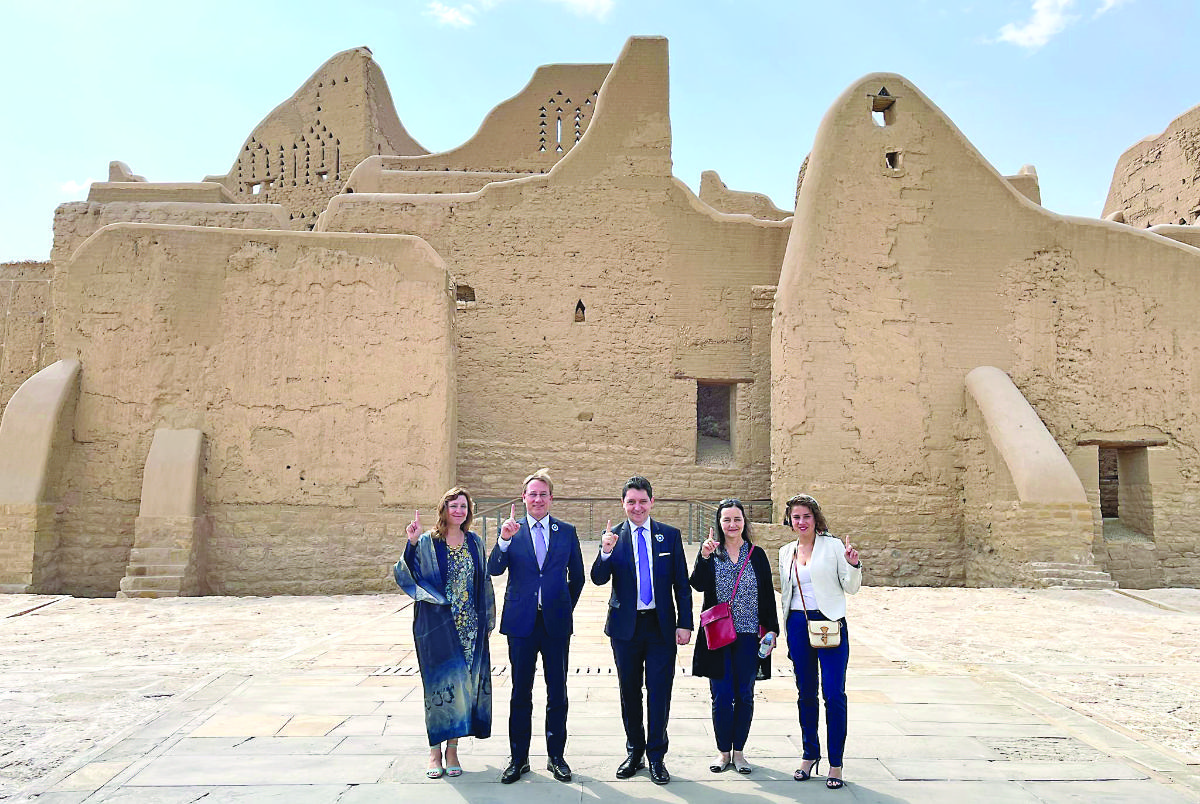


Senator Olivier Cadic with French Ambassador Ludovic Pouille at the gated district of At-Turaif, northwest of Riyadh. It is one of the Kingdom’s most-significant historical treasures. (Supplied)

I am returning in 2021 to prepare for the friendship group visit. I would have liked to come back sooner, but the COVID-19 pandemic made it impossible to travel. What I perceive is an ongoing dynamic, a real internal revolution that takes into account the population of the Kingdom, which is a young population, and therefore I see a political will to be in agreement with its population, and that this energy will positively drive the country to new heights.

Q You have visited Saudi Arabia several times. What changes do you see?
A The first thing that stood out between 2015 and 2019 was that people’s demeanor has changed; I felt they were smiling more. It really surprised me.
Besides, I wanted my partner to come with me because the country has changed a lot since 2015 and I wanted to see this country through her eyes also, not just through mine. The change is really profound and when we had a first look we were surprised, as it was not very positive for her in 2015 and it was really important that she was by my side so that we can watch, together, this country change.

Q You are visiting the Alliance Francaise school in Riyadh. What developments you perceive in Franco-Saudi cultural relations?
A I come, for that matter, to observe certain programs in which France is invested. Obviously, the Alliance Francaise supports the Francophonie, the learning of French, which is the language of the Enlightenment, of Voltaire, of Rousseau, that carries the values of our country. It is of utmost importance that we can share our language and our culture.
With the friendship group, we also plan to go to AlUla because there is really a collective, common work on the site, where France is deeply engaged. We want to see in which way the work was done, and how the alliance of France and Saudi Arabia can help enhance this exceptional archaeological heritage. This is one of the many angles and it would be difficult to summarize them, since there are many projects that go in this direction. It shows the attachment of our two countries, these cultures that blend together so well.
There is, once again, a real evolution in Saudi Arabia to bring out this local culture, which I believe will shine. And if France can help in spreading your culture, then it would be a very beautiful gift of confidence that you are giving us, in allowing us to work with you on this marriage of our cultures.

Q What are the new forms of cooperation between France and Saudi Arabia taking place now?
A There is a lot of mixed cooperation. Some is of economic nature, at the corporate level, with significant investments by French companies in Saudi Arabia. An example that comes to mind is the investments in the energy sector that EDF (Electricite de France), which is investing an € 800 million in Saudi Arabia, can make. These are companies that are investing massively to help develop Saudi Arabia’s economy, to support the Vision 2030 project that truly carries the country.

Q What about military cooperation between the two countries?
A The first thing I would like to say is how affected France is to see these recurring attacks that Saudi Arabia is subjected to on a regular basis. I would like to say that our country stands alongside yours to fight against the aggressions it is suffering. That is really fundamental to me.
After that, obviously, we have a common work and collective issues in front of us.
We will certainly talk about the situation in Lebanon, which despairs us, as well as the Saudi government, I believe. However, we will have to find solutions. We cannot let down the Lebanese people who are suffering from this situation. We are now in extensive discussions.
We admire the announcements made by the crown prince at COP 26, such as Green Riyadh, for example, with this tree-planting project. There is here a vision of the future that emerges.
It has been five years now since (Crown Prince Mohammed bin Salman) announced Vision 2030, whereas it has only been five weeks since the president of the Republic announced France 2030. So somewhere, (the crown prince) might have inspired us, too, in looking ahead to reform your country.
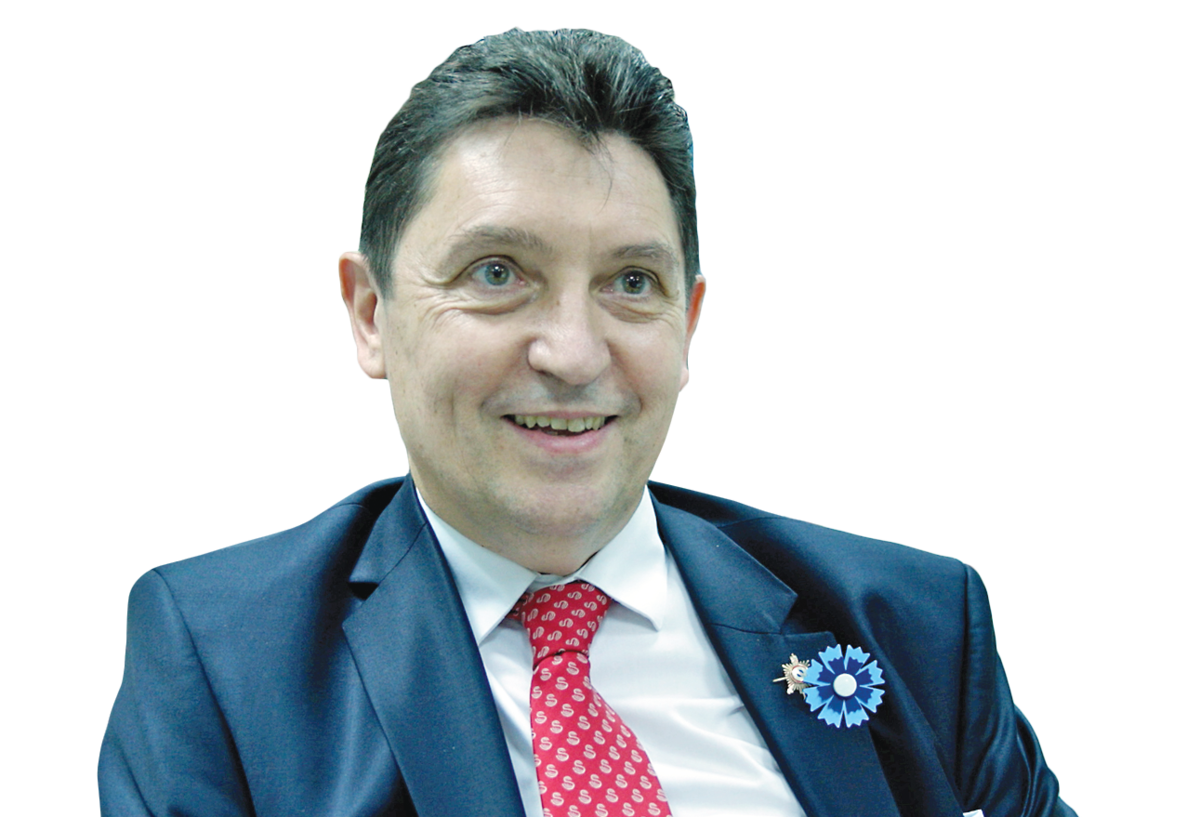


Olivier Cadic, French politician

We have two countries looking to reform. President (Emmanuel) Macron is also seeking to fundamentally reform France. Reforming a country is not easy. This brings us together in all areas and that applies for diplomatic decisions as well as defense decisions. There are proximities. We think together. We work together. We are never very far from each other to make the decisions.

Q How is Saudi Arabia perceived in France today?
A My role is to allow the French to go beyond the cliches. There is an intellectual laziness in thinking that Saudi Arabia looks like this or that. It is a view inherited from the past. In fact, we are talking about a country without knowing it.
My wish is that the French realize that the changes in the country are profound. We cannot judge. You have to come and see this country, meet its people … (I) invite the French to come along with me to meet this country and to help it, to stand by its side, because I believe that Saudi Arabia may need France to help it succeed in its goals.
But France also needs the Saudis so it can move forward and, therefore, we must put all the cliches behind us, look at each other and work together. I think, given what Saudi Arabia is doing, the French will be in awe of the projects here in Riyadh, but also across the country.
What I wish is for the French to come here and discover this country.

Q Where will Saudi Arabia be in 10 years?
A It all depends on how this pandemic will be defeated in order to be able to say where the country will be in 10 years. I think the country will surprise very much for a good and simple reason: I visited Saudi Arabia’s pavilion at Dubai Expo 2020 and I saw that it was the most visited of the 190 pavilions in the expo. This shows that there is an interest in your country.
In this pavilion are precisely displayed the vision, the projects on which the Kingdom is working. So if you want to know what Saudi Arabia will be like 10 years from now, let me give you a tip: Go visit the pavilion at Dubai Expo.

How Saudi Arabia’s five Founding Day symbols tell a 299-year story

Updated 22 February 2026
Follow

How Saudi Arabia’s five Founding Day symbols tell a 299-year story

  • The flag, the palm, the Arabian horse, the souq and the falcon are symbols that connect Saudi Arabia to its roots
  • Researcher Ismail Abdullah Hejles explains how the Kingdom’s symbols anchor identity, heritage and continuity

RIYADH: As Saudi Arabia prepares to mark its 299th anniversary this Founding Day — commemorating the establishment of the First Saudi State by Imam Muhammed bin Saud in 1727 CE — the moment invites reflection not only on history, but on the symbols that distill that history into enduring meaning.

Beyond ceremony and celebration, the Kingdom’s official Founding Day emblems tell a deeper story: of survival in a harsh landscape, of state-building against the odds, and of values carried forward across nearly three centuries. Together, they form a visual language that binds past to present and projects confidence into the future.

The five Founding Day symbols — the green flag, the palm tree, the Arabian horse, the souq, and the falcon — do not serve a purely celebratory function, Ismail Abdullah Hejles, a Saudi researcher in traditional architecture, told Arab News. Rather, they carry an intellectual and cultural role that connects society to its roots.

“Nations that understand their symbols and identity understand themselves and are better equipped to continue their journey with confidence and balance,” he said.

The Saudi flag. (SPA)

The Saudi flag, a representation of unity and sovereignty, embodies the values upon which the state was founded and reflects the continuity of the nation, linking its past to its present. The current design was adopted in 1937, refining historical banners from the first and second Saudi states.

The Shahada, the Islamic declaration of faith, symbolizes the Kingdom’s foundation on Islamic values, while justice and safety are echoed through the sword, which represents the unification of the Kingdom during the reign of the late King Abdulaziz Al-Saud.

The flag’s green color is traditionally associated with Islam, reflecting continuity and faith as central pillars of the Saudi state.

Additionally, the palm tree and the crossed swords — now synonymous with Saudi Arabia — officially appeared in the Kingdom’s emblem around 1950 following unification. Together, they express strength, justice, and the protection of unity.

The Saudi emblem

“The choice was not arbitrary,” Hejles said. “It brought together strength (the sword) and life and sustainability (the palm). It reflects a careful balance of firmness and generosity.”

The palm tree’s symbolic presence, however, predates the modern state, stretching back to the ancient civilizations of the Arabian Peninsula.

“In the simple oases, the palm tree was life, and the swords were dignity. The palm offered shade and sustenance, the swords protected the land and the name. Between the shade of the palm and the edge of the sword, the story of a nation takes place.”

The palm tree served numerous functions essential to the sustainability of civilizations. Its dates were a nutritious food; its fronds were used for roofing; its trunk built walls; its fiber made ropes; and it provided fuel and shade for communities.

In places such as Qatif and Al-Ahsa, the palm tree formed a complete life system with almost no waste. (SPA)

In places such as Qatif and Al-Ahsa, the palm formed a complete life system with almost no waste. It was not merely an agricultural symbol, but a genuine model of sustainability long before the term itself was coined, Hejles said.

Mentioned in the Qur’an more than 20 times, always associated with generosity and abundance, the palm formed the backbone of the agricultural economy in eastern Arabia.

“The souq (traditional market) was not merely a place of trade but a space for social interaction, knowledge exchange, and solidarity,” Hejles said. Through it, economic activity flourished and relationships between communities were strengthened.

A civilizational concept that emerged centuries before Islam, the souq arose from a simple human need: exchange. (Supplied)

“Nomads and desert dwellers possessed surplus goods and sought what they lacked through barter.”

A civilizational concept that emerged centuries before Islam, the souq arose from a simple human need: exchange. That exchange generated social mobility and fostered a culture of openness, which later contributed to the rise of cities.

A civilizational concept that emerged centuries before Islam, the souq arose from a simple human need: exchange. (Supplied)

In the pre-Islamic era, seasonal markets such as Souq ‘Ukaz, Souq Majanna, and Souq Dhu Al-Majaz were not only commercial hubs, but also literary forums, political arenas, and spaces for reconciliation and arbitration.

Once Islam was adopted, Souq Al-Madinah was established on principles prohibiting monopoly, forbidding fraud, and ensuring justice.

In the Saudi state, the souq evolved from traditional mud-and-wood covered bazaars into modern shopping centers and large commercial complexes. “Yet, the concept remained the same: a place of encounter before it is a place of sale,” Hejles said.

A civilizational concept that emerged centuries before Islam, the souq arose from a simple human need: exchange. (Supplied)

The Arabian horse, another Founding Day symbol, is associated with authenticity and courage. It accompanied the early stages of state-building, travel, and defense, becoming a symbol of strength and pride in Arab heritage.

The Arabs’ oldest companion, the Arabian horse is one of the oldest and purest breeds in the world. It was bred on the Arabian Peninsula for extreme endurance, speed, and agility.

Thanks to their lung capacity, endurance, and strong feet and bones, these horses could cover long distances in harsh desert conditions and survive on minimal resources, sometimes fed only dates and camel’s milk.

To protect them against theft and harsh weather, they were sometimes brought inside family tents, which led to the development of intense bonds with their owners. Arabian horses are known to be fearless and loyal, capable of protecting their masters in battle.

The Arabs’ companion, the Arabian horse is one of the oldest and purest breeds in the world. It was bred on the Arabian Peninsula for extreme endurance, speed, and agility. (SPA photo)

They also possessed a “war-sense,” allowing them to act intelligently in combat, known as well to have a high spirit in battle.

In Saudi Arabia, Arabian horses were vital in travel, trade, and warfare. Today, they symbolize nobility, pride, courage, and honor — reflecting and continuing the Kingdom’s equestrian legacy.

And finally, vigilance, insight, and high ambition are represented by the falcon. “It is tied to the practice of falconry, which requires patience and skill, and today symbolizes the continuity of heritage and elevated aspirations,” Hejles said.

The falcon was not merely a hobby but a hunting tool in a harsh desert environment, a companion to the Bedouin, and a symbol of strength, precision, and patience. (AN photo/AN Huda Bashatah)

Falconry was not merely a hobby, but a hunting tool in a harsh desert environment — a companion to the Bedouin and a symbol of strength, precision, and patience. The long training required to master falconry fostered discipline and strong leadership in its practitioners.

Over time, the falcon became associated with prestige and courage, linked to Bedouin identity and nobility, and embedded in poetry and storytelling.

A heritage passed through generations, falconry is now inscribed on UNESCO’s Representative List of the Intangible Cultural Heritage of Humanity, with Saudi Arabia and other participating countries, reinforcing its global cultural significance.

The falcon was not merely a hobby but a hunting tool in a harsh desert environment, a companion to the Bedouin, and a symbol of strength, precision, and patience. (SPA)

“These symbols were not chosen for their visual appeal,” Hejles said. “They were chosen because they were tested across centuries of lived experience.”

Representing more than their individual images, they are collectively an expression of the Saudi citizen’s relationship with land, environment, dignity, and continuity.