GLASGOW, Scotland: Almost 200 nations accepted a compromise deal Saturday aimed at keeping a key global warming target alive, but it contained a last-minute change that watered down crucial language about coal.
Several countries, including small island states, said they were deeply disappointed by the change promoted by India to “phase down,” rather than “phase out” coal power, the single biggest source of greenhouse gas emissions.
“Our fragile planet is hanging by a thread,” United Nations Secretary-General Antonio Guterres said in a statement. “We are still knocking on the door of climate catastrophe.”
Nation after nation had complained earlier on the final day of two weeks of UN climate talks in Glasgow, Scotland about how the deal did not go far or fast enough, but they said it was better than nothing and provided incremental progress, if not success.
In the end, the summit broke ground by singling out coal, however weakly, by setting the rules for international trading of carbon credits, and by telling big polluters to come back next year with improved pledges for cutting emissions.
But domestic priorities both political and economic again kept nations from committing to the fast, big cuts that scientists say are needed to keep warming below dangerous levels that would produce extreme weather and rising seas capable of erasing some island nations.
Ahead of the Glasgow talks, the United Nations had set three criteria for success, and none of them were achieved. The UN’s criteria included pledges to cut carbon dioxide emissions in half by 2030, $100 billion in financial aid from rich nations to poor, and ensuring that half of that money went to helping the developing world adapt to the worst effects of climate change.
“We did not achieve these goals at this conference,” Guterres said. “But we have some building blocks for progress.”
Negotiators from Switzerland and Mexico called the coal language change against the rules because it came so late. However, they said they had no choice but to hold their noses and go along with it.
Swiss environment minister Simonetta Sommaruga said the change will make it harder to limit warming to 1.5 degrees Celsius (2.7 degrees Fahrenheit) since pre-industrial times — the more stringent threshold set in the 2015 Paris Agreement.
Many other nations and climate campaigners criticized India for making demands that weakened the final agreement.
“India’s last-minute change to the language to phase down but not phase out coal is quite shocking,” said Australian climate scientist Bill Hare, who tracks world emission pledges for the science-based Climate Action Tracker. “India has long been a blocker on climate action, but I have never seen it done so publicly.”
Others approached the deal from a more positive perspective. In addition to the revised coal language, the Glasgow Climate Pact included enough financial incentives to almost satisfy poorer nations and solved a long-standing problem to pave the way for carbon trading.
The agreement also says big carbon polluting nations have to come back and submit stronger emission cutting pledges by the end of 2022.
“It’s a good deal for the world,” US climate envoy John Kerry told The Associated Press. “It’s got a few problems, but it’s all in all a very good deal.”
Before the India change, negotiators said the deal preserved, albeit barely, the overarching goal of limiting Earth’s warming by the end of the century to 1.5 degrees. The planet has already warmed 1.1 degrees Celsius (2 degrees Fahrenheit) compared to preindustrial times.
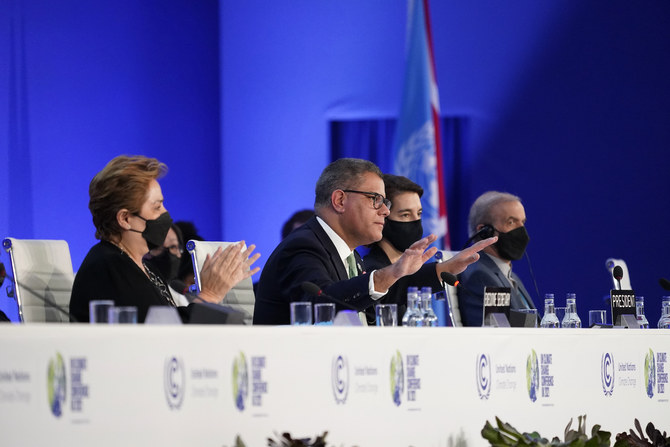
Negotiators Saturday used the word “progress” more than 20 times, but rarely used the word “success” and then mostly in that they’ve reached a conclusion, not about the details in the agreement. Conference President Alok Sharma said the deal drives “progress on coal, cars, cash and trees’’ and is “something meaningful for our people and our planet.’’
Environmental activists were measured in their not-quite-glowing assessments, issued before India’s last minute change.
“It’s meek, it’s weak and the 1.5 C goal is only just alive, but a signal has been sent that the era of coal is ending. And that matters,” said Greenpeace International Executive Director Jennifer Morgan, a veteran of the UN climate talks known as the Conferences of Parties.
Former Irish President Mary Robinson, speaking for a group of retired leaders called The Elders, said the pact represents : the pact represents “some progress, but nowhere near enough to avoid climate disaster....People will see this as a historically shameful dereliction of duty.”
Indian Environment Minister Bhupender Yadav argued against a provision on phasing out coal, saying that developing countries were “entitled to the responsible use of fossil fuels.”
Yadav blamed “unsustainable lifestyles and wasteful consumption patterns” in rich countries for causing global warming.
After Yadav first raised the specter of changing the coal language, a frustrated European Union Vice President Frans Timmermans, the 27-nation EU’s climate envoy, begged negotiators to be united for future generations.
“For heaven’s sake, don’t kill this moment,” Timmermans pleaded. “Please embrace this text so that we bring hope to the hearts of our children and grandchildren.”
Helen Mountford, vice president of the World Resources Institute think tank, said India’s demand may not matter as much as feared because the economics of cheaper, renewable fuel is making coal increasingly obsolete.
“Coal is dead. Coal is being phased out,” Mountford said. “It’s a shame that they watered it down.’’
Kerry and several other negotiators noted that good compromises leave everyone slightly unsatisfied.
“Not everyone in public life...gets to make choices about life and death. Not everyone gets to make choices that actually affect an entire planet. We here are privileged today to do exactly that,” he said.
Before the coal change, small island nations that are vulnerable to catastrophic effects of climate change and had pushed for bolder actions in Glasgow said they were satisfied with the spirit of compromise, if not the outcome of the talks.
“Maldives accepts the incremental progress made in Glasgow,” Aminath Shauna, the island nation’s minister for environment, climate change and technology said. “I’d like to note that this progress is not in line with the urgency and scale with the problem at hand.’’
Shauna pointed out that that to stay within warming limit that nations agreed to six years ago in Paris, the world must cut carbon dioxide emissions essentially in half in 98 months. The developing word needs the rich world to step up she said.
“The difference between 1.5 and 2 degrees is a death sentence for us,” Shauna said. “We didn’t cause the climate crisis. No matter what we do, it won’t reverse this.”
Next year’s talks are scheduled to take place in the Egyptian Red Sea resort of Sharm el-Sheikh. Dubai will host the meeting in 2023.


![]()

Nations compromise on coal to strike UN climate agreement
Short Url
https://arab.news/8beu2
Nations compromise on coal to strike UN climate agreement
- The summit broke ground by singling out coal, and setting the rules for international trading of carbon credits


Latest updates


© 2026 SAUDI RESEARCH & PUBLISHING COMPANY, All Rights Reserved And subject to Terms of Use Agreement.