

Pakistan offers technical assistance to Afghanistan in transit trade, land and air travel 

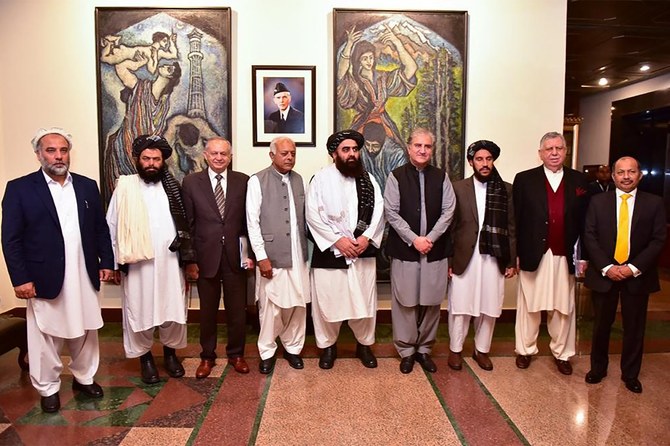
This handout photograph taken and released by Pakistan's Ministry of Foreign Affairs on November 11, 2021, shows Afghanistan's acting Foreign Minister Amir Khan Muttaqi (C), Pakistan's Foreign Minister Shah Mahmood Qureshi (4R), Pakistan Minister for Aviation Ghulam Sarwar Khan (4L), Pakistan's Prime Minister commerce adviser Abdul Razak Dawood (3L) pose for picture along with other delegation members at Pakistan's Foreign Ministry, in Islamabad, Pakistan. (AFP)
Short Url
Updated 12 November 2021
Follow

Pakistan offers technical assistance to Afghanistan in transit trade, land and air travel 

  • Amir Khan Muttaqi holds delegation-level talks on trade, cross-border movement, connectivity 
  • This is first high-level visit of any Taliban official since the takeover of Afghanistan in mid-August 

ISLAMABAD: Pakistan on Thursday offered technical assistance to Afghanistan in transit trade regime, movement of people by land and air, and other fields, the Pakistani foreign office said, after a meeting between acting Afghan Foreign Minister Amir Khan Muttaqi and his Pakistani counterpart Shah Mahmood Qureshi in Islamabad.

Muttaqi is currently on his maiden three-day visit to Islamabad to discuss enhanced trade, cross-border movement, land and aviation links, and regional connectivity. 

On Thursday, Qureshi received the acting Taliban foreign minister and his high-level delegation, including the acting ministers for industry and commerce as well as finance, and the deputy minister of aviation. 

The Pakistani side included Aviation Minister Sarwar Khan, PM’s advisers on finance and commerce, and other senior officials. 

“During the meeting, outcomes of the meetings of working groups on strengthening bilateral and transit trade regime and facilitating movement of people by land and air were shared,” the foreign office said in a statement. 

“Pakistan offered technical assistance in a range of areas and shared a number of proposals. It was agreed to continue discussions with a view to strengthen existing ties and identify new areas of cooperation.” 

Qureshi underscored Pakistan’s continuing efforts for humanitarian assistance and economic support to Afghanistan, given the twin challenges being faced by the Afghan people. 

The acting Afghan foreign minister thanked Pakistan for its continued support to a peaceful and stable Afghanistan, particularly for hosting millions of refugees for the last four decades, according to the statement. 

He assured the Pakistani side of full cooperation in strengthening fraternal ties for the mutual benefit of the peoples of the two countries. 

Earlier in the day, Pakistan-Afghanistan working groups on trade, transit and commerce, finance and aviation met under the chairmanship of the respective ministers from the two countries. 


Challenges for millions pushed back to Afghanistan from Iran, Pakistan

Updated 01 February 2026
Follow

Challenges for millions pushed back to Afghanistan from Iran, Pakistan

  • Over five million Afghans returned home since September 2023 as Iran, Pakistan ramp up deportations
  • Those who returned face challenges in form of unemployment, lack of housing, shortage of electricity and water

KABUL: After decades hosting Afghans fleeing crises at home, Pakistan and Iran have ramped up deportations and forced millions back across the border to a country struggling to provide for them.

Whether arriving at the frontier surrounded by family or alone, Afghan returnees must establish a new life in a nation beset by poverty and environmental woes.

AFP takes a look at the people arriving in Afghanistan and the challenges they face.

FIVE MILLION

More than five million Afghans have returned home from Iran and Pakistan since September 2023, according to the International Organization for Migration (IOM).

The figure equates to 10 percent of the country’s population, according to the agency’s deputy head in Afghanistan, Mutya Izora Maskun.

Three million returnees crossed the borders just last year, some of whom have spent decades living abroad.

Such a huge influx of people would be hard for any country to manage, Maskun said.

INADEQUATE HOUSING 

Months after arriving in Afghanistan, 80 percent of people had no permanent home, according to an IOM survey of 1,339 migrants who returned between September 2023 and December 2024.

Instead, they had to live in temporary housing made from materials such as stone or mud.

More recently, the UN refugee agency (UNHCR) spoke to Afghans who arrived back between January and August last year about their living arrangements.

Three-quarters of tenants said they could not afford their rent, while the majority of families were sharing rooms with up to four people, according to the survey of 1,658 returnees.

DESPERATE SEARCH FOR WORK 

Just 11 percent of adults pushed back from Pakistan and Iran were fully employed, the IOM survey found.

For those who returned in the first few months of last year, the average monthly income was between $22 and $147, according to the UNHCR.

WATER, ELECTRICITY SHORTAGES

More than half the returnee households lack a stable electricity supply, according to the IOM.
The agency said that households headed by women faced “significantly higher vulnerabilities,” with around half of them struggling to access safe drinking water.

SPEEDING UP LAND DISTRIBUTION

More than 3,000 plots of land have been distributed to returnees nationwide, Hamdullah Fitrat, the Afghan government’s deputy spokesman, said in mid-January.

The process “was accelerated,” he said while recounting a special meeting with supreme leader Hibatullah Akhundzada.

On their arrival in Afghanistan, returnees usually receive help with transport, a SIM card and a small amount of money.