

Taliban to be invited to next 'troika plus' meeting on Afghanistan — Pakistan FM

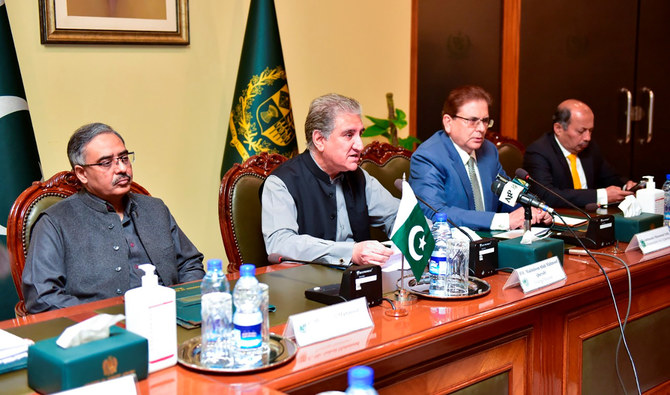
Pakistan's Foreign Minister Shah Mahmood Qureshi addresses the envoys from the United States, China and Russia during "Troika plus" group conference in Islamabad, Pakistan on November 11, 2021. (Photo courtesy: Pakistan foreign office)
Short Url
Updated 12 November 2021
Follow

Taliban to be invited to next 'troika plus' meeting on Afghanistan — Pakistan FM

  • Meeting in Islamabad was the group's first since the Taliban took over Afghanistan on Aug. 15
  • Taliban foreign minister Amir Khan Muttaqi is also currently in Islamabad on his first Pakistan visit

ISLAMABAD: Representatives of the Taliban government will be invited to the next "troika plus" meeting on Afghanistan, the Pakistani Foreign Minister Shah Mahmood Qureshi said on Thursday as US, Chinese and Russian envoys participated in the group's meeting in Islamabad.

The troika grouping of countries consists of the US, China, and Russia. Pakistan is a part of its extended platform, the "troika plus."

The meeting in Islamabad was their first since the Taliban took over Afghanistan on Aug. 15. It was also the latest in a series of diplomatic meetings on Afghanistan, after neighboring India held a conference for regional countries on Wednesday, which Pakistan and China did not attend.

Taliban Foreign Minister Amir Khan Muttaqi is also currently in Islamabad on his first Pakistan visit. While he did not take part in Thursday's meeting, he is expected to meet the participating foreign diplomats on its sidelines.

"It is decided that in next session of troika plus in Beijing, Taliban will be officially invited so that they should involve directly in this process,” Qureshi said during a press conference.

"By their physical presence in troika plus they can share their concerns directly to international community."

He warned that Afghanistan is on the brink of economic collapse and the international community must urgently resume funding, provide humanitarian assistance, and enable Kabul to access its assets frozen in foreign banks.

"Enabling Afghanistan to access its frozen funds will dovetail into our efforts to regenerate economic activities and move the Afghan economy towards stability and sustainability," Qureshi said. "Today, Afghanistan stands at the brink of an economic collapse."

He said Pakistan was already taking steps such as the reopening of its borders for Afghan trade and providing aid to its neighbor, but it was "a collective and shared responsibility of all countries," as instability could lead to another conflict in the war-battered country.

"Nobody wishes to see a relapse into civil war, no one wants an economic collapse that will spur instability," Qureshi said. "Everyone wants terrorist elements operating inside Afghanistan to be tackled effectively, and we all want to prevent a new refugee crisis."

Pakistani experts see the extended troika meeting taking place in Islamabad as a significant development, showing Pakistan's engagement in the Afghanistan situation.

"It also showed the importance Pakistan attached to find solution to Afghanistan situation," Pakistan’s former foreign secretary, Tehmina Janjua, told Arab News. "The presence of Taliban in Islamabad at the same time has also made it more relevant."

Afghan affairs expert Muhammad Ayaz Wazir said the troika plus forum is an established and influential platform and that during his Islamabad visit the Afghan foreign minister will be able to meet its members and discuss with them the possibility of recognizing Afghanistan's new government. 

“Along with discussing ways to help Afghanistan to avoid humanitarian crisis they will also discuss possibilities of recognizing Taliban government," Wazir said.

International relations expert Prof. Zafar Jaspal said the significance of troika's meeting in Islamabad has multiplied after Pakistan and China's absence from Wednesday’s summit on Afghanistan in New Delhi.

"Indian invitation has neither attracted Pakistan nor China, so after that the significance of troika meeting in Islamabad multiplied, and now it is going to establish that the major stakeholders of in Afghanistan are Pakistan, China, United States, Russia, and Afghans themselves,” he told Arab News.


ADB approves $381 million for climate-resilient agriculture, social services in Punjab

Updated 8 sec ago
Follow

ADB approves $381 million for climate-resilient agriculture, social services in Punjab

  • Support will upgrade Punjab’s education and nursing systems, improving learning outcomes and health care capacity
  • Package includes $124 million for agriculture, $107 million for STEM schooling and $150 million for nursing reforms

KARACHI: The Asian Development Bank (ADB) said on Saturday it approved $381 million in financing for Pakistan’s Punjab province to modernize agriculture and strengthen education and health services, with a major focus on building climate resilience after monsoon floods this year caused widespread destruction across the country’s most populous province.

The package includes concessional loans and grants for farm mechanization, STEM education, and nursing sector reforms.

ADB said the investments are intended to help Punjab, home to more than half of Pakistan’s population and a key contributor to its economy, recover from climate shocks and transition toward more sustainable and resilient development.

“Investing in education, health, and agricultural mechanization will play a transformative role in driving the growth of Punjab, a vital pillar of Pakistan’s economy,” said ADB Country Director for Pakistan Emma Fan. “These strategic investments will modernize agriculture, enhance human capital, and significantly improve livelihoods for millions of people across Punjab.”

The bank approved $120 million in concessional loans and a $4 million grant for the Punjab Climate-Resilient and Low-Carbon Agriculture Mechanization Project, which will support 220,000 rural farm households.

The program aims to reduce climate vulnerability by shifting farmers toward modern, low-emission machinery, provide alternative livelihoods for agricultural workers and train 15,000 women in new skills. It will also introduce a financing model to help small farmers access advanced equipment.

Punjab produces most of Pakistan’s wheat, rice, and maize but still relies on outdated machinery, contributing to grain losses and routine burning of crop residues, a major source of air pollution, said ADB.

It noted the new project will promote modern mechanization, including rice harvesters, to address these issues.

ADB also approved $107 million for the Responsive, Ready, and Resilient STEM Secondary Education in Punjab Program, including a $7 million grant from the Asian Development Fund.

The results-based program aims to modernize secondary schooling by expanding inclusive STEM education, improving access and quality across the province.

A further $150 million concessional loan was approved for the Punjab Nursing and Health Workforce Reform Program, which will upgrade nursing curricula, develop disaster-resilient training facilities, strengthen workforce governance, and introduce digital human-resource systems.

The program seeks to expand the pool of qualified nurses to strengthen health service delivery and meet rising national and global demand.

Key components include the establishment of three centers of excellence in Lahore, Multan and Rawalpindi, equipped with simulation labs, digital learning platforms, and gender-responsive hostels.

ADB said it remains committed to supporting climate-resilient and inclusive development across Asia and the Pacific through innovative financing tools and partnerships.