

Pakistan’s national security advisor rejects reports of ‘amnesty’ to Pakistani Taliban fighters

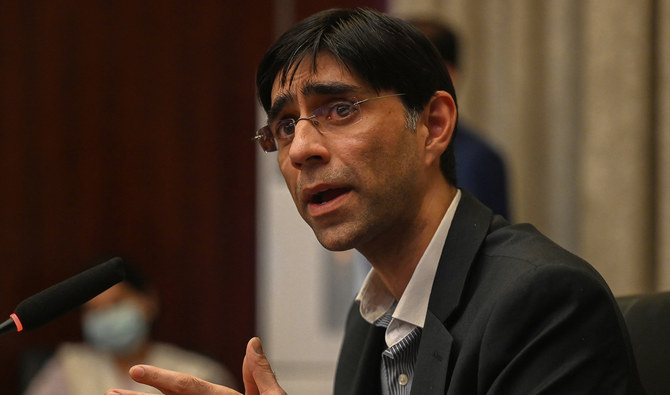
Pakistan's national security advisor Moeed Yusuf gestures as he speaks to members of the media in Islamabad on September 15, 2021 about the ongoing situation in Afghanistan. (AFP/File)
Short Url
Updated 11 November 2021
Follow

Pakistan’s national security advisor rejects reports of ‘amnesty’ to Pakistani Taliban fighters

  • Pakistani government, banned Tehreek-e-Taliban Pakistan earlier this week agreed on a month-long ceasefire
  • On Wednesday, Pakistan's Supreme Court also questioned Prime Minister Imran Khan on talks with outlawed group

ISLAMABAD: Pakistan’s National Security Adviser (NSA) Moeed Yusuf on Wednesday rejected reports that the government was granting “amnesty” to members of the banned Tehreek-e-Taliban Pakistan (TTP), saying no decision had been made in this regard. 

The statement comes a week after the Pakistani government and the outlawed group agreed on a month-long ceasefire.  

Talks with the TTP were "ongoing" and the truce would be extended if the negotiations progressed, Pakistan's Information Minister Chaudhry Fawad Hussain said on Monday, maintaining that the dialogue was in accordance with the Constitution of Pakistan. 

The TTP, or the Pakistani Taliban, is a separate group from the Afghan Taliban. Thousands of Pakistanis have been killed in violence perpetrated by the group over the last two decades.  

The group has accepted responsibility for several high-profile attacks, including an assassination attempt on activist and now Nobel prize winner Malala Yousafzai and an attack on an army-run school in Peshawar in which 134 children and 19 adults were killed in December 2014.  

“I don't know from where this talk started [of granting amnesty], that a decision has been made. There is no such decision [of a general amnesty],” Yusuf said on Dawn News show 'Live with Adil Shahzeb'. 

“State too has experience; we also know that previous agreements didn’t work,” he said, adding that the government would assess whether the TTP was serious after further talks.  

“However, state has decided that if ceasefire and talks [continue] and they [TTP] agree to accept state’s terms, then we can talk [further].” 

On Wednesday, the Supreme Court of Pakistan, which has been hearing a case relating to the 2014 Peshawar school massacre, summoned Prime Minister Imran Khan to question if his government had acted against those involved in the attack and those responsible for providing security. PM Khan appeared before the court and promised to take action against negligent officials. 

"State is absolutely clear [on this] and sensitive. Those who were martyred were our kids, our soldiers and civilians," Yusuf said.  

"Our tribes [people based in Pakistan’s northwestern tribal region] have sentiments for what they lost, so it cannot happen that the state just shuts its eyes.”


Pakistan to promote mineral sector at Saudi forum this month with 13 companies

Updated 02 January 2026
Follow

Pakistan to promote mineral sector at Saudi forum this month with 13 companies

  • Delegation will take part in the Future Minerals Forum in Riyadh from Jan. 13-15
  • Petroleum minister will lead Pakistan, participate in a 90-minute country session

ISLAMABAD: Around 13 Pakistani state-owned and private companies will attend the Future Minerals Forum (FMF) in Saudi Arabia from Jan. 13 to 15, an official statement said on Friday, as the country seeks to ramp up global engagement to develop its mineral resources.

The FMF is an international conference and investment platform for the mining sector, hosted by mineral-rich countries to attract global investors, companies and governments.

Petroleum Minister Ali Pervaiz Malik confirmed Pakistan’s participation in a meeting with the Saudi envoy, Nawaf bin Said Al-Malki.

Pakistan hosts one of the world’s largest copper-gold zones. The Reko Diq mine in southwestern Balochistan, with an estimated 5.9 billion tons of ore, is partly owned by Barrick Gold, which calls it one of the world’s largest underdeveloped copper-gold deposits. Its development is expected to boost Pakistan’s struggling economy.

“Upon an invitation of the Government of the Kingdom of Saudi Arabia, the Federal Minister informed the Ambassador that Pakistan will fully participate in the upcoming Future Minerals Forum (FMF), scheduled to be held in Riyadh later this month,” Pakistan’s Press Information Department (PID) said in an official statement.

The Pakistani minister will lead his country’s delegation at the FMF and take part in a 90-minute country showcase session titled “Unleashing Potential: Accelerating Pakistan’s Mineral Revolution” along with local and foreign investors.

Pakistan will also establish a dedicated pavilion to highlight the vast potential of its rich geological landscape to the global mineral community.

The Saudi envoy welcomed Pakistan’s decision to participate in the forum and discussed enhancing bilateral cooperation in the minerals and energy sectors during the meeting.

According to the statement, he highlighted the potential for cooperation between Saudi Arabia and Pakistan in the minerals and energy sectors, expressing confidence that the FMF would provide a platform to expand collaboration.
Pakistan’s mineral sector, despite its rich reserves of salt, copper, gold and coal, contributes only 3.2 percent to the country’s GDP and just 0.1 percent to global mineral exports.

However, many countries, including the United States, have shown interest in Pakistan’s underdeveloped mineral sector, particularly in copper, gold and other critical resources.

In October, Pakistan dispatched its first-ever shipment of rare earth and critical minerals to the United States, according to a Chicago-based US public relations firm’s report.