

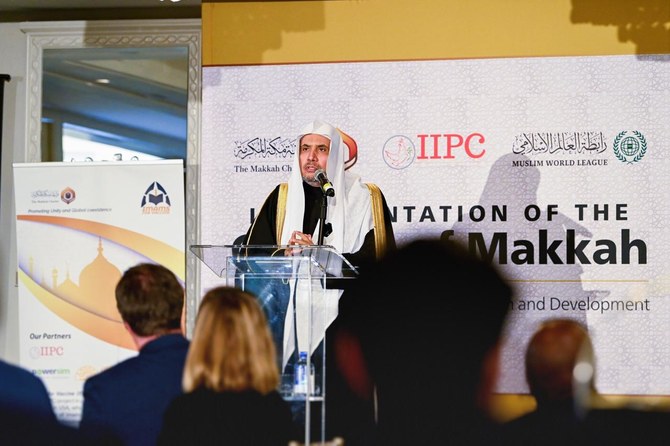

WASHINGTON: The first forum of the Makkah Charter to promote the concept of one social family with common values has been held in Washington.
The forum, entitled “Makkah Charter for Promoting Global Unity and Coexistence: Interfaith Cooperation for Security, Health and Development,” was organized between major Islamic and non-Muslim religious institutions from various American states.
The secretary-general of the Muslim World League and chairman of the Muslim Scholars Association, Dr. Mohammed bin Abdulkarim Al-Issa, participated in the forum, alongside executive director of the White House Office of Faith-Based and Neighborhood Partnerships, Melissa Rogers, and a group of political and intellectual leaders, heads and members of think tanks and research centers and a number of other notable religious and academic figures.
The forum opened with a discussion session, followed by several broad-based workshops on topics related to religious freedoms, cooperation between different religions, social issues for minorities, and the role of religious responses in times of crisis. The forum also included a detailed presentation of the executive planning of the Makkah Charter based on the higher purposes of Islamic law (the five necessities), and also touched on the seventeen internationally agreed-upon sustainable development goals, declared by the UN’s General Assembly as “a blueprint for achieving a better and more sustainable future for all.”
The principles of the Makkah Charter and the Sustainable Development Goals converge around the fundamental issues of justice, poverty, environmental damage, mitigating violence, and promoting peace and coexistence.
During the opening session, Al-Issa discussed the contents of the Makkah Charter, explaining that it was an extension of the Madinah Charter or the Constitution of Madinah, which the Prophet Muhammad drafted with different social groups in the city.
Al-Issa affirmed that the Madinah Charter was the most genuine witness to the value of Islamic religious tolerance, including a call for coexistence with full rights and duties. He also emphasized human dignity and the right to exist in full legitimate freedom “whatever the religion, culture or race.”
He stressed that nothing supports the meaning of freedom more than the constitutional principles that stem from national laws that must be respected to prevent freedom becoming chaos.
Al-Issa pointed out that the Makkah Charter emphasized the importance of respecting diversity, which means respecting the will of God to have pluralism among humans. He added that the charter calls for dialogue and an alliance of civilizations while steering clear of conflict.
He noted that faith and action are central to avoiding conflicts stemming from pessimism and the misperception of human diversity.
Al-Issa further explained that the message behind the Makkah Charter began to take root in Islamic awareness, referring to the session of the Islamic Council of Foreign Ministers in Niamey, Niger, in November 2020. At that time, the ministers discussed and unanimously adopted the Makkah Charter to be used by religious, cultural and educational institutions in their countries.
The charter is perceived as a basis for expressing the religious identity of the Islamic nation. It was signed by over 1,200 muftis and scholars representing 27 different sects, who came from 139 countries to meet and agree on this historic achievement in Makkah next to the Kaaba during Ramadan in 2019. It clarifies for the Islamic nation the thoughts of religious scholars on the most prominent contemporary issues.
“The Makkah Charter is an extension of the Madinah Charter, which established the values of religious tolerance and human brotherhood,” Al-Issa said, stressing that it was the first time in history that Islamic Shariah scholars from different sects had reached a consensus over important contemporary issues.
“The numerous signatures from the various Islamic sects on the Makkah Charter are proof of the great and exceptional impact it has and this is reflected by the unanimous decision of the Islamic countries at the aforementioned Niamey meeting,” he added.
Al-Issa emphasized that today’s world is flooded with international initiatives, speeches and decisions, but lacks tangible action and sustainable work. This is why the Makkah Charter focuses on practical programs and partnerships inside and outside the Islamic world. “Today, for instance, we saw the presentation of four global programs based on the principles of the Makkah Charter: Religious diplomacy and its common values among followers of different religions, youth engagement, women’s legitimate empowerment, and capacity building.”
Following Al-Issa’s speech, the audience and different participants, including politicians and prominent religious leaders of various Christian denominations, as well as independent Jewish religious leaders, shared their views. A multitude of Islamic religious leaders also attended the forum, including prominent figures and academic leaders from Washington.


