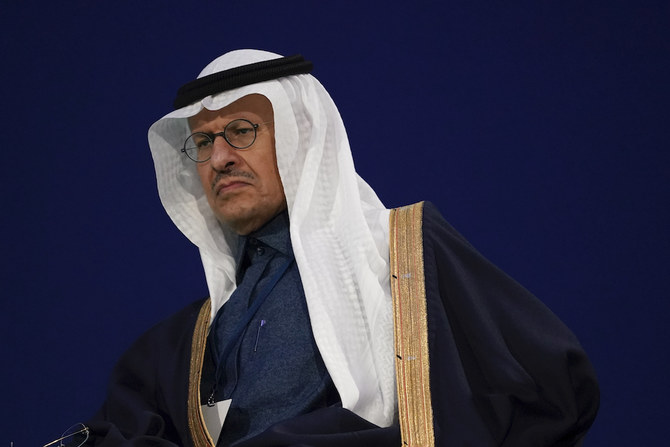

DUBAI: The Saudi energy minister hit out on Wednesday at “lies” and “fabrications” over the Kingdom’s stance at the COP26 climate change summit in Glasgow.
After a speech in which he strongly defended Saudi Arabia’s track record in combating global warming, Prince Abdulaziz bin Salman was asked about “serious allegations” that the Kingdom had been blocking negotiations at the meeting.
He replied: “These are not serious allegations, these are fabricated allegations.” Asked if the allegations amounted to lies, he said: “Absolutely.”
Greenpeace, the environmental activist group with a history of animosity toward the Kingdom, made unsubstantiated claims this week that Saudi negotiators had obstructed progress at key meetings in Glasgow. Saudi negotiators have told Arab News the claims were “baseless and inaccurate.”
In his COP26 speech, a defiant Prince Abdulaziz mounted a plea for an unbiased and objective assessment of possible solutions to the urgent issue of global warming. The world was facing a “universal phenomenon” that required “an international, shared and effective response,” he said. “That response should address three main pillars: Energy security, economic development for the benefit of humanity, and climate change. All of these pillars must be addressed in a holistic manner, without compromising one for the sake of another.
“It is imperative that we recognize the diversity of climate solutions, and the importance of emissions reduction as stipulated in the Paris Agreement, without any bias toward or against any particular source of energy.”
The Kingdom had taken radical steps in the past month to address climate change issues at home and internationally, Prince Abdulaziz said, with key 53 initiatives at a projected cost of $185 billion.
He said the Kingdom shared the view that efforts had to be renewed to reach the goals of the Paris Agreement, but “we all should keep in mind the principle of shared, yet distinct, responsibilities among different countries.
“Equally, we should all be conscious of the special circumstances of the less developed countries, and we should work together to help these countries mitigate the impact of climate change policies, without compromising their sustainable development.”
The Saudi Green Initiative and the broader Middle East Green Initiative aim to reduce regional emissions by more than 10 per cent of the total, a disproportionate amount given relatively small populations and economies in global terms.
The Kingdom has more than doubled the targets for emission reduction in the past decade, and set a target of net zero carbon emissions by 2060 — faster than some much bigger energy economies — via the framework of the Circular Carbon Economy.
Other initiatives include phasing out oil from domestic energy generation, billions of dollars of investment in renewable and alternative fuels such as solar and hydrogen, and a global campaign to provide clean cooking fuel to more than 750 million people around the world.
“This will help ensure that the Kingdom maintains and enhances its leadership role in promoting the security and stability of energy markets,” Prince Abdulaziz said.