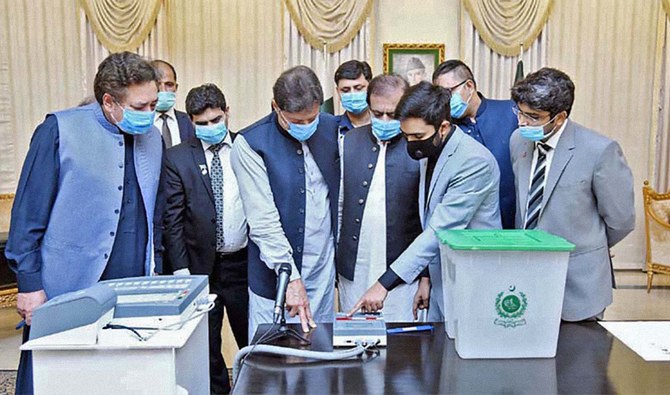

ISLAMABAD: Information Minister Chaudhry Fawad Husain said on Wednesday the government would consult the opposition and work “in good faith” to reach a consensus on the issue of electoral reforms, including using electronic voting machines (EVMs) in the next general election in 2023.
Prime Minister Imran Khan's government has been pushing for the use of EVMs in future elections since it unveiled a prototype at the Parliament House in May.
The idea of introducing electronic voting machines (EVMs) - which directly record votes and are believed to prevent the irregularities that may occur during manual counting - also caught the spotlight in March after a government candidate lost a key senate seat to a joint opposition candidate, unleashing accusations of rigging and horse trading from the ruling party. A subsequent election for the post of senate chairman in April also became controversial after eight ballot papers had to be wasted by the presiding officer for breaking rules.
Opposition parties have been largely mistrustful of the government's plans to introduce EVMs and experts have warned of large transitional costs and other technical and logistical issues.
“Electoral reform is a matter for the future of the country,” Husain said on Twitter. “We are working in good faith to reach a consensus on these issues. In this regard, [National Assembly] Speaker Asad Qaiser has been asked to contact the opposition again so that a consensus on electoral reform bill could be developed.”
Husain said a joint sitting of parliament was being convened to develop consensus: “We hope that the opposition will seriously consider these important reforms and we will be able to come up with a common strategy for the future of Pakistan.”
Former secretary election commission Kanwar Dilshad told Arab News in April it was unlikely EMVs could be introduced by the next general election due to financial, logistical and technical constraints.
“At least an amount of Rs1 trillion is required to replace manual voting with digital voting procedures such as Electronic Voting Machines, Biometric Verification Machines or Internet voting for Overseas Pakistani in general elections,” Dilshad said, saying Rs60 billion would be required for the procurement of 350,000 EVMs alone.
"In my opinion this is a futile exercise," he said. "The Election Commission of Pakistan pilot projects regarding EVMs have failed in the past."