

UN Yemen envoy in rare visit to besieged Taiz

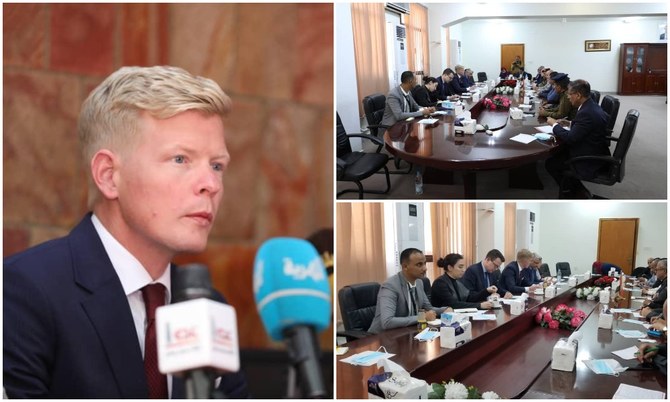
UN Yemen envoy Hans Grundberg on Monday visited the besieged city of Taiz. (Twitter/@OSE_Yemen)
Short Url
Updated 09 November 2021
Follow

UN Yemen envoy in rare visit to besieged Taiz

  • Residents feel ‘UN officials ignoring their suffering,’ army officer says

AL-MUKALLA / NEW YORK: UN Yemen envoy Hans Grundberg on Monday visited the besieged city of Taiz in the country’s south, where he met the governor of Taiz, political party leaders, businessmen, activists and journalists, his office told Arab News.

A long convoy of armored SUVs and military vehicles were seen crossing into government-controlled sections of the city as local security authorities tightened security and sealed off streets around the governor’s office, residents said.

Taiz, Yemen’s third-largest and most populous city, has seen the bloodiest clashes between Yemeni government forces and the Iran-backed Houthis since early 2015.

The Houthis, who control the city’s edges, have laid siege to the city after failing to seize control due to strong resistance from army troops.

The militia has barred people from leaving or entering through checkpoints, obstructed humanitarian assistance to trapped people and repeatedly shelled loyalist neighborhoods to force a surrender.

“Coming … to Taiz for the first time is important,” Grundberg said after his meeting with the governor. “It is a place that encompasses so many things that are central to all of Yemen. There is political plurality, entrepreneurial spirit, cultural and historical richness, and the strength to address the pain and difficulties that this war has inflicted on its people. 

“Taiz shares also the same pains as we see elsewhere in Yemen, (where) it is the civilians that bear the burden of this conflict. 

“Here, as well, we have seen children killed or maimed, and most recently in the deplorable attack on Oct. 30 that claimed the lives of three children. And I would like in this respect to express my deep condolences to the family of these children.”

Local government and military officials urged Grundberg to use his leverage to pressure the Houthis into lifting the siege, ending attacks on residential areas and the use of landmines, and stopping the recruitment of children.

“Our demands are breaking the siege, ending the killing of children and civilians and women, and stopping attacks on hospitals and infrastructure in Taiz,” Abdul Basit Al-Baher, a Yemen army officer in Taiz, told Arab News by telephone, noting that Taiz residents feel that UN officials have “ignored their suffering.”

He said: “We want the UN to be fair and to treat us like the Houthis. The UN officials visit the Houthi militias who plant landmines and even give them cars and humanitarian assistance that fuel their military activities.”

On Sunday, Grundberg met Yemen’s prime minister and foreign minister in Aden to discuss peace efforts.

“He explored possibilities for de-escalation in Yemen, briefed his discussions in the region and shared his concerns on the impact of military operations in Marib,” the envoy’s office said on Twitter.

Grundberg is now trying to convince warring factions to immediately put into place a nationwide truce, which would include an end to Houthi attacks in Marib, and the lifting of restrictions on Sanaa airport and Hodeidah seaport.

In the same sense, US Special Envoy for Yemen Tim Lenderking on Monday touched down in Aden where he discussed with the Yemeni prime minister and foreign minister efforts to end the war, the Houthi offensive on Marib, the Riyadh Agreement and Yemeni government measures to safeguard the economy, state news agency SABA reported.

Foreign Minister Ahmed Awad bin Mubarak tweeted that he discussed in a separate meeting with the US delegation the impacts of Houthi military operations in Marib and peace activities to end the war. “I expressed our appreciation to the US for its continued support,” he said.

Meanwhile, on the ground, a local military official told Arab News on Monday that heavy clashes erupted between Yemeni government forces and the Houthis south and west of the central city of Marib.

In the west, dozens of rebel fighters were killed in heavy battles that continued from Sunday evening to Monday afternoon in Al-Kasara. “The clashes were very fierce. The national army managed to foil Houthi suicide attacks,” the official, who requested anonymity, said.

In the south, government forces engaged in fighting with the Houthis in Al-Amud and surrounding areas under heavy air cover from Arab coalition warplanes.

“Working for peace in Yemen is an uphill battle,” Grundberg said. “However, we should never forget that there is always a way to break the cycle of violence. There are always opportunities for peaceful dialogue. And the people of Taiz know this too well.

“All in all, Taiz is the reminder of the possibility of a pluralistic Yemeni state, and remains a key part of achieving sustainable peace in Yemen.”


Israel’s Barak ‘regrets’ knowing Epstein after documents detail friendship

Updated 8 sec ago
Follow

Israel’s Barak ‘regrets’ knowing Epstein after documents detail friendship

  • Former Israeli prime minister apologizes for his years-long friendship with convicted sex offender Jeffrey Epstein
  • Barak is among several political elites found to have maintained long relationships with Epstein, even after his 2008 conviction
TEL AVIV, Israel: Former Israeli Prime Minister Ehud Barak has apologized for his years-long friendship with convicted sex offender Jeffrey Epstein that included regular correspondence, multiple visits to the disgraced financier’s Manhattan apartment and one to his private island.
The former Israeli leader has not been implicated in Epstein’s sexual abuse of underage girls and faces no accusations of wrongdoing. In an exclusive interview with Israel’s Channel 12 on Thursday, he said he regretted having ever known Epstein and apologized to all those “who feel deeply uncomfortable.”
“I am responsible for all my actions and decisions, and there is definitely room to ask if there wasn’t room for more in-depth judgment on my part and a more thorough examination of what the details really are, what exactly happened there,” he said.
Barak is among several political, business and cultural elites found to have maintained long relationships with Epstein, even after his 2008 guilty plea for soliciting prostitution from an underage girl in Florida. Epstein died by suicide in detention in 2019 while awaiting trial on federal allegations of sexually abusing and trafficking dozens of girls.
Barak, who has previously distanced himself from Epstein, gave the latest interview after millions of pages of documents were released by the US Justice Department in connection with its investigations of Epstein.
Barak and his wife, Nili, have turned up frequently in the documents, showing they stayed in regular contact with Epstein for years, including after he cut a deal with prosecutors in 2008 that resulted in an 18-month prison sentence.
Barak has acknowledged visiting Epstein numerous times, flying on his private plane and staying at his New York apartment when he was out of public office. Barak said he and his wife and some security guards paid a three-hour visit to Epstein’s home in the US Virgin Islands, but saw only Epstein and some maintenance workers there.
Barak said he never observed or took part in any inappropriate behavior. He said he was aware of the earlier Epstein case but assumed he had paid his debt to society.
“Only in 2019, when a reinvestigation of the whole story begins, does the breadth and depth of the man’s heinous crimes become apparent and I cut off relations with him, and everyone cuts off relations with him,” Barak said.

A Netanyahu rival

Barak served as prime minister from 1999 to 2001, when Israel and the Palestinians held high-level peace talks before the process collapsed and a Palestinian uprising broke out. He later served as defense minister.
His ties to Epstein came to light seven years ago after Barak announced a political comeback in an unsuccessful bid to topple Israeli Prime Minister Benjamin Netanyahu.
At the time, US tax records showed Barak received some $2 million in grants for unspecified “research” the previous decade from the Wexner Foundation — a philanthropic organization that supports Jewish causes. At the time, Epstein was a trustee of the foundation.
Barak downplayed those ties when they surfaced, saying Epstein “didn’t support me or pay me.”
The new batch of released documents show regular correspondence among Barak, his wife and Epstein.
Some detail plans for a 2017 stay at Epstein’s New York residence, while others discuss mundane logistics for other visits, meetings and phone calls. In June 2019, Barak’s wife, Nili, emailed Epstein saying they delayed their flight to New York by roughly a week. In 2013, Epstein’s assistant, Lesley Groff, emailed Epstein about dinner with Barak, his wife and several business people and celebrities, including Woody Allen.
In 2019 — about a week before Epstein was arrested — an exchange about Barak between Epstein and an unknown person shows Epstein saying he was ”dealing with Ehud in Israel. Making me crazy.”
The documents show that Epstein connected Barak with US President Donald Trump’s former adviser, Steve Bannon, who was seeking to become more involved in Israeli politics. Emails from Epstein to his staff and others in 2018 discussed setting up dinners or meetings between Barak and Bannon.
Bannon has not been implicated in any wrongdoing related to Epstein.
In Thursday’s interview, Barak said it’s likely more information will emerge from the documents in the weeks ahead, but he maintained that he had done nothing illegal or improper.
“I promise you that nothing will be discovered, because there is nothing,” he said.