

UK county cricket club boss praises Pakistan-born spinner for speaking out on racism

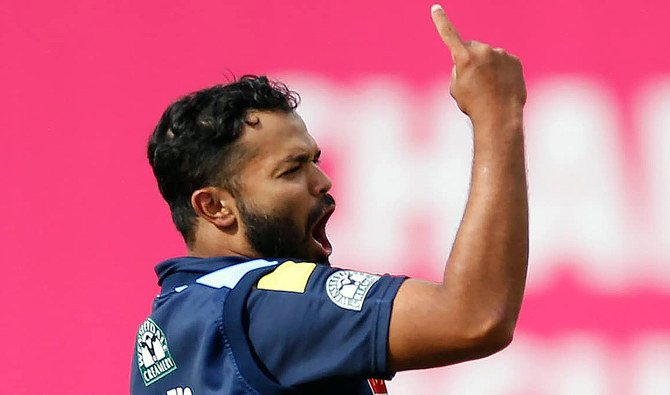
Yorkshire's Azeem Rafiq celebrates the wicket of Durham's Ben Stokes during NatWest T20 Blast Edgbaston in August 20, 2016. (REUTERS/File)
Short Url
Updated 08 November 2021
Follow

UK county cricket club boss praises Pakistan-born spinner for speaking out on racism

  • New Yorkshire apologized to Azeem Rafiq in Sept. but subsequently said they won't take disciplinary action
  • Following this, England and Wales Cricket Board suspended county club's right to host international matches

LEEDS: New Yorkshire chairman Kamlesh Patel praised Azeem Rafiq for speaking out over racist abuse as he apologized to the former player on Monday. 

Pakistan-born Rafiq has accused Yorkshire of failing to deal adequately with racist abuse he suffered while playing for the county, saying he had been driven to thoughts of suicide. 

The club apologized to the 30-year-old in September but subsequently said they would take no disciplinary action against any of their staff. 

Yorkshire were widely criticized, with the England and Wales Cricket Board (ECB) suspending their right to host international matches and sponsors, including Nike, walking away. 

Patel's appointment was announced last week following the resignation of his predecessor, Roger Hutton. 

"Azeem is a whistleblower and should be praised as such, he should never have been put through this," Patel told a press conference at Yorkshire's Headingley headquarters in Leeds. 

"We're sorry for what you and your family have experienced and the way in which we've handled this. 

"I thank Azeem for his bravery in speaking out. Let me be clear from the outset, racism or discrimination in any form is not banter." 

Patel's reference to "banter" came after that word was said to have been used in the county's report to describe a racist term directed at Rafiq. 

The new chairman, who is a lawmaker in Britain's unelected House of Lords, also said Yorkshire had settled a separate employment tribunal with the former spinner. 

"Absolutely no restrictions have been placed on Azeem on what he can or cannot say about his experiences," Patel insisted. 

"The settlement does not involve a non-disclosure agreement." 

Patel added he was also commissioning a specialist independent review of the county's processes and procedures on diversity and inclusion. 

He also said he had spoken to the ECB about restoring international cricket at Headingley but that Yorkshire would have to first "address the root causes" that had led to the suspension. 

While he revealed he had yet not been fully able to digest Yorkshire's report into Rafiq's allegations, Patel said: "What I've seen so far does feel uncomfortable. It makes me feel the process wasn't as well completed as it should have been." 

Patel said he would release the report to those who had a "legal interest" rather than simply make it public. 

This would include, he explained, the Equality and Human Rights Commission and the chairman of a parliamentary committee that is expected to hear testimony from Rafiq and several senior Yorkshire figures on November 16. 

Patel said he had spoken with Rafiq for six-and-a-half hours since his appointment as chairman on Friday. 

"It was difficult and it was actually quite sad," Patel told the press conference. 

"It was tough for me, it was incredibly tough for him. You did feel 'why would we do this to any human being'?" 

Patel revealed he had asked Rafiq to "sit on his shoulder" and "challenge him" on how he handles matters from this point onwards. 

"It would be a shame not to work together to seek his help to find a way forward," he said. 


Pakistan, global crypto exchange discuss modernizing digital payments, creating job prospects 

Updated 05 December 2025
Follow

Pakistan, global crypto exchange discuss modernizing digital payments, creating job prospects 

  • Pakistani officials, Binance team discuss coordination between Islamabad, local banks and global exchanges
  • Pakistan has attempted to tap into growing crypto market to curb illicit transactions, improve oversight

ISLAMABAD: Pakistan’s finance officials and the team of a global cryptocurrency exchange on Friday held discussions aimed at modernizing the country’s digital payments system and building local talent pipelines to meet rising demand for blockchain and Web3 skills, the finance ministry said.

The development took place during a high-level meeting between Finance Minister Muhammad Aurangzeb, Pakistan Virtual Assets Regulatory Authority (PVARA) Chairman Bilal bin Saqib, domestic bank presidents and a Binance team led by Global CEO Richard Teng. The meeting was held to advance work on Pakistan’s National Digital Asset Framework, a regulatory setup to govern Pakistan’s digital assets.

Pakistan has been moving to regulate its fast-growing crypto and digital assets market by bringing virtual asset service providers (VASPs) under a formal licensing regime. Officials say the push is aimed at curbing illicit transactions, improving oversight, and encouraging innovation in blockchain-based financial services.

“Participants reviewed opportunities to modernize Pakistan’s digital payments landscape, noting that blockchain-based systems could significantly reduce costs from the country’s $38 billion annual remittance flows,” the finance ministry said in a statement. 

“Discussions also emphasized building local talent pipelines to meet rising global demand for blockchain and Web3 skills, creating high-value employment prospects for Pakistani youth.”

Blockchain is a type of digital database that is shared, transparent and tamper-resistant. Instead of being stored on one computer, the data is kept on a distributed network of computers, making it very hard to alter or hack.

Web3 refers to the next generation of the Internet built using blockchain, focusing on giving users more control over their data, identity and digital assets rather than big tech companies controlling it.

Participants of the meeting also discussed sovereign debt tokenization, which is the process of converting a country’s debt such as government bonds, into digital tokens on a blockchain, the ministry said. 

Aurangzeb called for close coordination between the government, domestic banks and global exchanges to modernize Pakistan’s payment landscape.

Participants of the meeting also discussed considering a “time-bound amnesty” to encourage users to move assets onto regulated platforms, stressing the need for stronger verifications and a risk-mitigation system.

Pakistan has attempted in recent months to tap into the country’s growing crypto market, crack down on money laundering and terror financing, and promote responsible innovation — a move analysts say could bring an estimated $25 billion in virtual assets into the tax net.

In September, Islamabad invited international crypto exchanges and other VASPs to apply for licenses to operate in the country, a step aimed at formalizing and regulating its fast-growing digital market.