

Arabian oryx returns to Saudi deserts

1 / 4
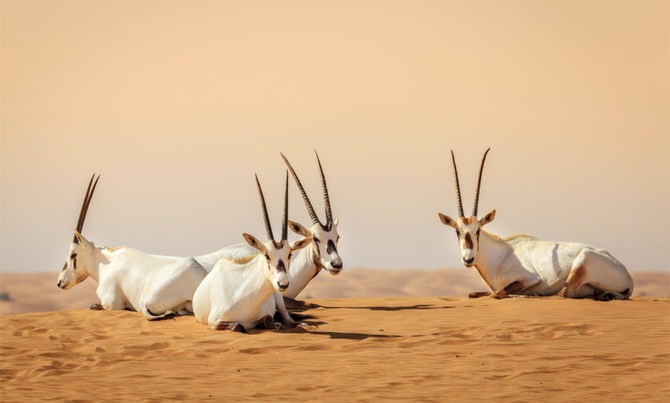
The Arabian oryx returns to the wild after years of uncontrolled hunting. (Supplied)
2 / 4
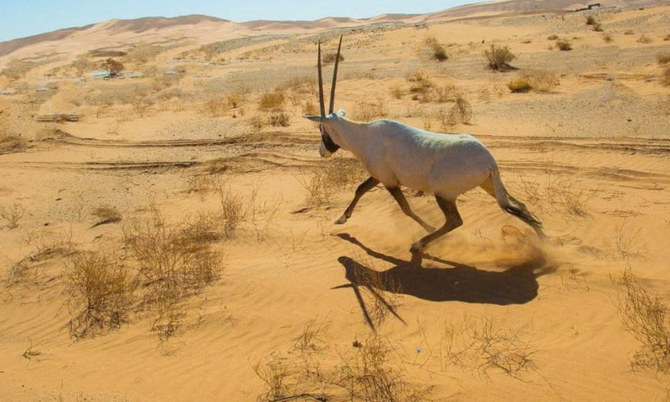
The Arabian oryx returns to the wild after years of uncontrolled hunting. (Supplied)
3 / 4
The Arabian oryx returns to the wild after years of uncontrolled hunting. (Supplied)
4 / 4
The Arabian oryx returns to the wild after years of uncontrolled hunting. (Supplied)
Short Url
Updated 08 November 2021
Follow

Arabian oryx returns to Saudi deserts

  • Due to thousands of years of living in harsh desert environments, he said that the Arabian oryx had developed physiological adaptations that helped it to cope with dry and extreme conditions

MAKKAH: Saudi Arabia has successfully returned the Arabian oryx to the wild after years of uncontrolled hunting and capture brought it to the edge of extinction.
For centuries, the oryx called the Arabian Peninsula home. The animal has faced difficult times in the past few decades in the Kingdom and the GCC region, and attempts to preserve the number of oryx in captivity, ready for them to be released into the wild, have finally succeeded.
Ahmed Al-Bouq, supervisor of the National Center for Wildlife Development’s research and breeding centers and the national launch program, told Arab News that Saudi Arabia’s experience in preserving the Arabian oryx had inspired the world, with 1,200 of the animals to be returned to their natural environment.
About 7,000 are currently in captivity in preparation for other campaigns to return them to three regions in the Kingdom.
Al-Bouq told Arab News that the Arabian oryx was part of Arabia’s identity. There are four species of oryxes in the world but the Arabian oryx, native to the Arabian Peninsula, has a different size and distinguishing features.
“In the past years, the National Center for Wildlife Development succeeded in the relocation programs they launched, thanks to the Saudi experts and their partners in the region. That resulted in reducing the extinction levels, in accordance with the international standard of the International Union for Conservation of Nature whose classification starts with extinct, extinct in the wild (but found in captivity) — which is the previous classification of the Arabian oryx at the beginning of the project — critically endangered and endangered,” Al-Bouq said.

HIGHLIGHT

About 7,000 oryx are currently in captivity in preparation for other campaigns to return them to three regions in the Kingdom.

According to Al-Bouq, in 2013 the classification was changed to vulnerable. “We currently seek to revert it to ‘least concern’ in order to make the species widespread, and such efforts are rare at the international level.”
Due to thousands of years of living in harsh desert environments, he said that the Arabian oryx had developed physiological adaptations that helped it to cope with dry and extreme conditions. This made it an ideal example of how to adapt to harsh environments and climate change.
It has physically adapted with features such as its white color, which reflects heat, playing a significant role in lowering its body temperature. The Arabian oryx also has dark marks on its face and legs, making it appear larger than other desert predators, such as wolves and others, to deter attacks. Its almost straight, sharp horns give it the capability to protect itself from hunting dogs, Al-Bouq said.
The Arabian oryx also has the ability to alter its body temperature. Despite being a warm-blooded mammal, it can change its body temperature from 36 to 44 degrees celsius, helping it adapt to the hot and cold temperatures of the desert.
Al-Bouq said that the Arabian oryx was a symbol of beauty, as seen in Arabic poetry’s descriptive verses and Al-Mu’allaqat, embellishing the work of the greatest poets and representing the restoration of life.


Crown prince sponsors launch of world-class Arabic calligraphy center in Madinah

Updated 23 December 2025
Follow

Crown prince sponsors launch of world-class Arabic calligraphy center in Madinah

  • The Prince Mohammed bin Salman Global Center for Arabic Calligraphy was inaugurated by Prince Salman bin Sultan bin Abdulaziz

RIYADH: A new center for Arabic calligraphy under the patronage of Crown Prince Mohammed bin Salman officially opened in Madinah on Monday.

The Prince Mohammed bin Salman Global Center for Arabic Calligraphy was inaugurated by Prince Salman bin Sultan bin Abdulaziz, governor of Madinah region.

He was joined by Culture Minister Prince Badr bin Abdullah bin Farhan, touring the new facility’s exhibition spaces and receiving briefings on cultural programming and the center’s achievements.

They also viewed collections highlighting Arabic calligraphy’s artistic and historical importance.

Speaking at the opening, Prince Badr said: “From this land of enlightenment and scholarship, we proudly launch a global platform dedicated to Arabic calligraphy as an invaluable cultural asset.”

He went on to credit the crown prince’s “generous and boundless support” for the cultural sector.

The minister said that the center demonstrated to the world the legacy of Arabic calligraphy while underscoring Saudi Arabia’s commitment to safeguarding its cultural identity and heritage.

According to Prince Badr, the facility represents an ambitious vision to elevate Arabic calligraphy as both a universal communication tool and an integral element of Arab heritage, art, architecture and design.

The center further aims to enhance the Kingdom’s cultural identity and strengthen its international presence, targeting calligraphers, emerging talents, visual artists, Islamic arts researchers, educational and cultural institutions, as well as art and heritage enthusiasts worldwide.

It will deliver specialized programs including research and archival services, calligraphy instruction, academic grants, a permanent museum, touring exhibitions, an international calligraphy association and a business incubator supporting calligraphy enterprises.

Additional offerings feature artist residency programs, expert-led workshops, and standardized curriculum development, complemented by international educational partnerships aimed at heritage conservation and expanding global appreciation for this time-honored art form.

The center’s establishment in Madinah carries particular significance, given the city’s historical role as the cradle of Arabic calligraphy and its association with transcribing the Qur’an and preserving Islamic knowledge.